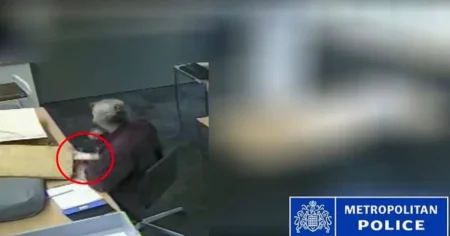




Some plans are doomed from the very beginning, but few are quite as obviously doomed as the one Joshua Smith devised on a summer day outside HMP Hull. The 30-year-old, shirtless and clutching his own shirt, charged across a road toward the prison’s blue metal fence, his bare hands carrying a package stuffed with drugs and a mobile phone. In the grainy CCTV footage released by Humberside Police, the scene plays out less like a criminal operation and more like an awkward, one-sided game of catch between a man and a very stubborn brick wall. The package, estimated to be worth around £12,000, slammed into the prison wall on the first attempt, bouncing back to the pavement as if rejecting Smith’s plan outright. But rather than rethinking the strategy, Smith simply picked the parcel up, walked through a gate into the car park, and tried again. With his shirt still in hand, he slung the package a second time. It bounced back again. A third throw finally sent the parcel sailing over the barbed wire and into the prison grounds. For a single moment, it must have felt like a victory — until a prison guard spotted the package and reported it to the police, ensuring that Smith’s reward would not be cash or profit, but a much longer stay on the wrong side of a prison wall.
The date was July 11 last year, and the location was HMP Hull in East Yorkshire. Smith, who has no fixed address, had apparently decided that the most efficient way to get banned items into the prison was to do it personally, in broad daylight, without a shirt and without any real cover. The footage shows him sprinting from across the road, his torso bare, his movements urgent but clumsy. The first throw was so far off target that the package smacked against the brickwork with an audible finality. Instead of walking away, he gathered the parcel, moved closer, and hurled it again. The second attempt was no better: the package hit something and bounced back toward him, almost as if the prison itself was rejecting his offer. On the third try, he managed to get the package over the barbed wire, and then he left the scene. It was not the smooth, sophisticated operation of a career criminal. It looked more like a man trying to toss a bag of rubbish into a distant bin and refusing to give up until he succeeded. The package was later found by a prison officer almost immediately, and its contents were revealed to be a mixture of Class A and Class B drugs, along with a mobile phone. The estimated street value was put at £12,000. In the end, Smith succeeded in throwing the package inside, but he failed in every way that mattered: he was identified, arrested, charged, and would eventually be sentenced for his trouble.
The investigation that followed was straightforward. Prison officials alerted Humberside Police, and an inquiry was launched into how the package had arrived inside the prison and what it contained. The package was analysed, and the drugs and phone were catalogued. CCTV from outside the prison provided the key evidence, showing a man making several unsuccessful attempts to throw a package over the prison wall shortly before the package was located inside. That man was Joshua Smith. Detective Constable Heather Butler, who led the investigation, said in a statement that the package was found almost instantly and never reached its intended destination, but the potential consequences were serious. “Smith made the decision to facilitate dangerous drugs entering the prison,” she said. “This behaviour will not be tolerated, and we continue to work closely with HM Prison Service to ensure those who engage in this type of crime are held accountable.” Smith pleaded guilty to two counts of throwing a prohibited item into a prison. At Hull Crown Court on Monday, he was sentenced to three years and eight months in jail. It is a heavy price for a plan that never made much sense in the first place. For a few minutes of awkward throwing outside a prison wall, Smith traded his freedom for a prison sentence — one that he will now serve behind bars, perhaps in the very system he tried to contaminate with drugs and contraband.
The case is a reminder of the constant pressure on prisons to keep drugs out, and of the lengths people will go to try to smuggle them inside. For years, prisons have battled against elaborate methods of contraband delivery. Visitors have been caught hiding drugs in body cavities, shoes, children’s nappies, and even in hollowed-out books. People have launched packages over walls with makeshift catapults and crossbows. And in recent years, drones have become a favourite tool for criminal gangs, allowing them to fly drugs, weapons, and even takeaway meals over prison walls without anyone having to get physically close. But Smith’s method was strikingly old-fashioned: he simply stood outside the prison and threw a package as hard as he could, shirtless, hoping that brute force and determination would be enough. It was not. The ease with which the package was spotted and recovered shows how vigilant prison staff have become. But the incident also underscores why this crackdown matters. Drugs inside prison can fuel violence, debt, intimidation, and addiction. They can destabilise an entire institution, putting prisoners and staff at risk. A mobile phone in the wrong hands can be used to organise crime from the inside, intimidate witnesses, or coordinate further smuggling efforts. The £12,000 worth of drugs in Smith’s package would have had a significant impact inside HMP Hull, which is why the quick work of the prison guard and the police investigation were so important. As Detective Butler put it, these drugs “could have had catastrophic consequences.” The fact that the package was intercepted before reaching its intended destination meant that, for once, a bungled crime had a truly positive outcome.
There is something almost absurd about the footage, and it is easy to laugh at the image of a half-naked man failing to throw a parcel over a prison wall multiple times in broad daylight. But beneath the comedy is a more sobering reality. Joshua Smith is a young man, only 30, with no fixed address, who decided to risk his liberty to put dangerous drugs into a prison. That decision did not happen in a vacuum. Many people who become involved in smuggling drugs into prisons are themselves struggling with addiction, coercion, or financial desperation. They are often exploited by organised criminal gangs who prefer to use expendable couriers rather than risk their own members. Smith’s failed attempt may look like sheer stupidity, and in many ways it was, but it also speaks to a larger problem: the demand for drugs is high, the money can be tempting, and the consequences are often devastating. The court clearly took the matter seriously. A sentence of three years and eight months is not a slap on the wrist. It is a significant punishment that reflects the gravity of trying to introduce contraband into a secure environment. Smith will now have years to reflect on the choices that brought him to that roadside, shirtless and throwing packages at a wall. It is impossible to know what was going through his mind that day — whether he was desperate, pressured, or simply reckless. But the image of him charging at the fence, refusing to give up even as the package bounced back again and again, is not just a joke. It is a portrait of someone who had lost sight of the reality of his actions, someone who was so focused on getting the package over the wall that he forgot to think about what would happen once it landed.
In the end, the story of Joshua Smith is one of accountability. He made a choice, he was caught, and he was punished. The prison system and the police worked together to ensure that the drugs never made it into the hands of prisoners, and that the man responsible faced justice. There is a certain irony in the fact that Smith will now serve time in prison himself, becoming part of the very population he tried to supply. One hopes that his sentence gives him a chance to step back from the chaos of his life and reconsider the path he was on. It is also a reminder to all of us that crime, even the clumsiest kind, has real victims. The drugs he tried to throw over that wall could have caused addiction, overdoses, violence, and misery inside HMP Hull. They could have put prisoners and prison staff in danger. They could have fuelled a cycle of crime that would eventually spill back out into the community. Instead, thanks to a sharp-eyed prison guard and a thorough police investigation, those drugs were intercepted, and a would-be smuggler was taken off the streets. The footage of Smith’s failed attempts may be shared and laughed at online, but the lesson is not funny. It is a serious reminder that prisons are not just buildings with walls and barbed wire — they are places where people live, work, and must be safe. Every time someone tries to throw a package over those walls, they are showing a complete disregard for everyone inside. And as Smith now knows, the wall always wins in the end.