

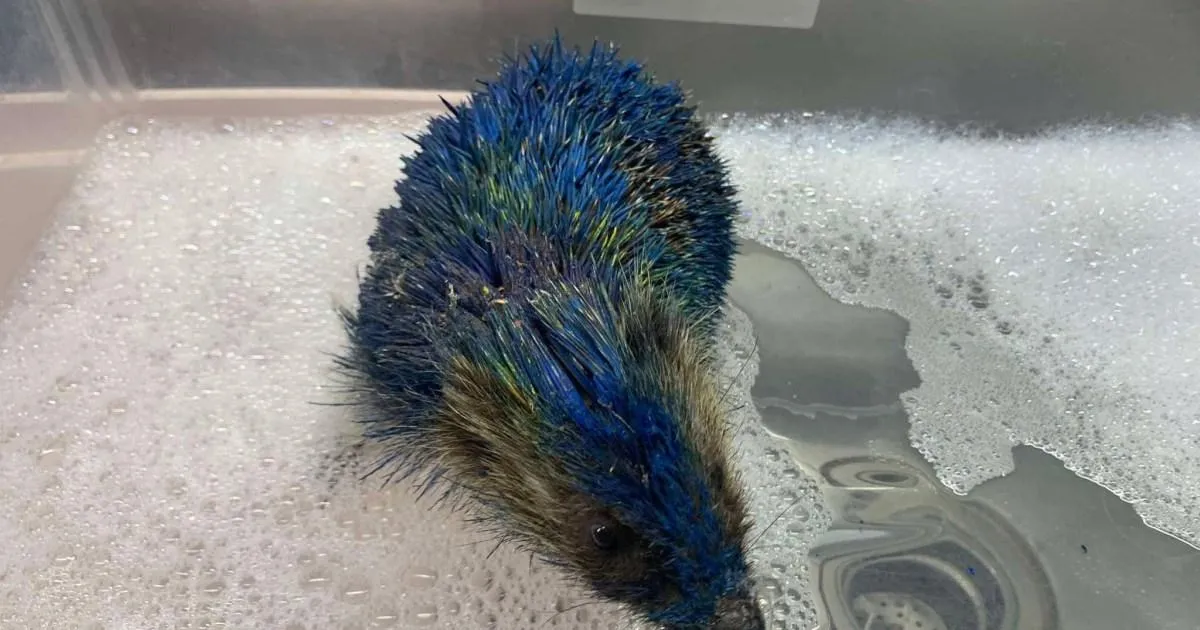
The small creature found in the Yeadon area of Leeds was, by all accounts, a victim of senseless cruelty. What began as a misguided attempt to display team spirit—painting a hedgehog in the blue and yellow colors of Leeds United—quickly turned into a nightmare for the defenseless animal. When the hedgehog was discovered, it was barely recognizable, struggling to navigate its environment while covered in thick, toxic, oil-based paint. It is difficult to fathom the mindset of individuals who would look at a fragile, wild animal and see nothing more than a canvas for a football-related prank, completely disregarding the physical agony and life-threatening danger they were inflicting upon it.
The aftermath of this incident paints a grim picture of the physical toll such an act takes on a wild animal. According to Diane Cook, the founder of Prickly Pigs Hedgehog Rescue, the layer of paint applied to the hedgehog was so dense that it effectively glued its spines together. This, in turn, stripped the animal of its primary evolutionary defense mechanism: the ability to curl into a protective ball. Beyond the loss of its defense, the heavy fumes from the paint caused the hedgehog to suffer from significant breathing difficulties. Had it not been found and brought to the sanctuary, the experts believe the animal would have likely starved to death or succumbed to severe health complications, as it was already struggling to move or survive in its painted state.
The rescue process itself required tireless effort and immense compassion from the volunteers at Prickly Pigs. Staff had to perform the delicate, painstaking work of cleaning each individual spine, scrubbing away the harsh chemical residue while simultaneously providing essential pain relief to the traumatized patient. Witnessing the creature in such a state of distress, it is understandable why those involved in its recovery have labeled the act “absolutely appalling.” This was not just a minor mischief; it was a profound violation of an animal’s welfare, performed by individuals who chose to ignore the suffering of a living being for the sake of a fleeting, shallow joke.
The legal response to this incident underscores the severity with which society views the mistreatment of wildlife. West Yorkshire Police responded quickly, launching an investigation that resulted in the arrests of four individuals—two men aged 44 and 21, and two teenagers aged 17 and 15. The group was detained on suspicion of causing unnecessary suffering to a protected animal, a clear violation of the Animal Welfare Act 2006. As the investigation progresses, these individuals have been released on bail, but the stain of their actions remains, serving as a stark reminder of the responsibility we hold toward the wildlife that shares our urban and suburban spaces.
This disturbing case occurs against the backdrop of a broader, more tragic decline in the British hedgehog population. Listed as “vulnerable” on the national red list of mammals, hedgehogs have seen their numbers plummet by as much as 30% in urban areas and 50% in the countryside since the turn of the millennium. These animals are already fighting a tough battle against habitat loss, road traffic, and environmental changes; they certainly do not need to contend with human cruelty. The incident in Leeds serves as a call to action, highlighting how fragile these creatures are and how much we depend on the vigilance of the public to protect those who cannot protect themselves.
Ultimately, the plight of this blue and yellow hedgehog is a mirror held up to our own capacity for empathy. While the legal system will handle the repercussions for those responsible, the real work lies in fostering a culture where such acts of wanton cruelty are recognized not as “fun” or “pranks,” but as the indefensible harms they are. We should strive to be a society that protects its local wildlife rather than one that exploits it. If anyone has further information regarding this incident, the authorities are still urging the public to reach out, ensuring that justice is served for a victim that had no voice to protest its own torment.