

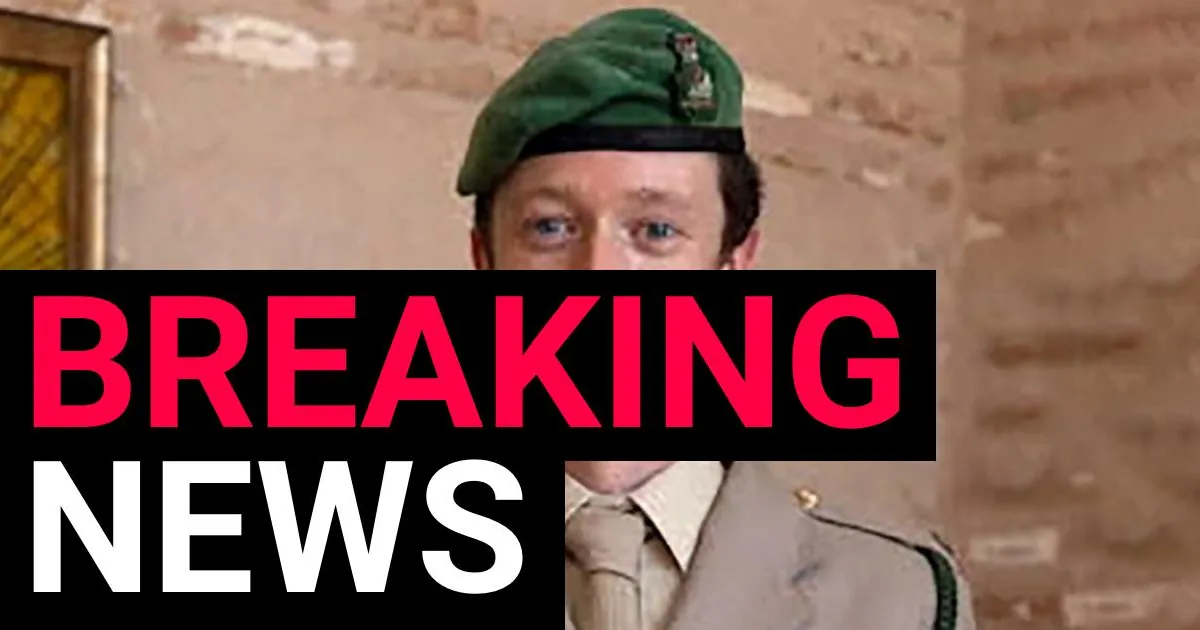
The news emerged through the carefully measured words of officialdom, but behind them was a heartbreak no statement could soothe. The Ministry of Defence announced that Major Paul Wilks, a 40-year-old British officer, had died in a road traffic incident in Ukraine. He died on September 12, away from the front lines, and the MoD was quick to clarify that his death was not the result of hostile action. That detail mattered, if only as a small, fragile comfort: he was not taken by a bullet or a missile, but by the kind of tragedy that can strike anywhere, at any time, especially in a country at war where roads are dangerous, vehicles are heavy, and conditions are unpredictable. For his wife and two sons, however, the distinction offers little relief. They have lost a husband and father, and no official clarification can change the emptiness that now shapes their everyday lives. For his colleagues, there is the dull shock of losing someone who was still among them, leading, advising, supporting, and sharing the burdens of a difficult mission. For the wider public, there is the solemn reminder that Britain’s armed forces are present in Ukraine, even if many of their activities are not widely known. Major Wilks had served his country since joining the Intelligence Corps in 2012, and he had risen through the ranks through a combination of intellect, dedication, and natural leadership. He had been on operational tours before, including Afghanistan, and had been recognized with medals that tell the story of a soldier who repeatedly answered the call. But no medal, no rank, and no official description can fully convey who he was as a man. In the days following his death, tributes began to flow from those who knew him best—tributes that spoke not only of his competence and professionalism, but of his warmth, his kindness, and his devotion to his family. The Ministry of Defence, in its formal language, found a way to acknowledge the truth that everyone who knew him already understood: Major Wilks was the best of what the British military represents, and his loss will be felt for a long time.
Among the first to speak was Defence Secretary Wes Streeting, whose words carried both the weight of official mourning and the intimacy of personal respect. “Major Wilks served this country with pride and dedication,” he said. “His loss will be deeply felt by those around him.” Streeting continued, describing the tributes paid by those who worked with Paul as illustrating “his exceptional talent and ability, underscored by genuine warmth, compassion and a desire to support others.” These are not throwaway phrases. In the language of ministerial statements, every word is chosen carefully, and the decision to highlight warmth, compassion, and a desire to support others speaks volumes about the kind of man Major Wilks was. It would have been easy to praise his professional skills alone, yet the Defence Secretary chose to emphasize the human qualities that made him beloved by colleagues and friends. Streeting also noted that his loss is “a poignant reminder of the enormous sacrifice that our Armed Forces and their families make in the service of our country.” That reminder arrives at a time when the war in Ukraine has become a familiar backdrop, a distant conflict that occasionally re-enters the headlines before fading again. But for the families of service personnel, there is no such distance. Every deployment carries risk, and every goodbye could be the last. The sacrifice of Major Wilks is not an abstraction; it is the very real cost paid by a man who chose to spend his career serving a cause larger than himself. His family, too, have been drawn into that sacrifice without being given a choice. They supported him, loved him, and waited for him to come home. Now they are left with memories, photographs, and the knowledge that his death has been acknowledged by leaders and colleagues, but that no acknowledgment can restore what was taken. The Defence Secretary’s words, for all their formality, reached beyond protocol and touched the shared grief that binds a military community. When a service member dies, an entire network of people grieves—that is the nature of the Armed Forces. Major Wilks’s loss will be felt in briefing rooms, on operations, and in quiet moments among fellow officers who remember his voice, his laugh, and his steady presence.
To understand the significance of Major Wilks’s death, it helps to understand the trajectory of his career. He joined the Intelligence Corps in 2012, a branch of the British Army that works at the sharp end of information, analysis, and strategic understanding. Intelligence officers do not always appear in the public eye; their work is often hidden, their contributions measured in the decisions that shape operations and protect lives. Major Wilks spent his entire career in this world, rising from his initial entry point to the rank of Major—a rank that signifies not only years of service but the ability to lead, analyze, and operate under pressure. His service took him on multiple operational tours, including a deployment to Afghanistan, one of the most demanding and dangerous environments of the modern era. For his service there and elsewhere, he was awarded two Operational Service Medals. These medals are not handed out lightly; they represent time spent in harm’s way, professionalism under fire, and a commitment to the mission. In May of this year, he was further recognized with the Long Service and Good Conduct Medal, an award that reflects years of faithful service and an unblemished record. That timing makes his death even more poignant: he had recently been honored for the very qualities that defined him—loyalty, integrity, and endurance. In the months since, he continued to serve, eventually deploying to Ukraine, where the conflict with Russia has created an extraordinarily demanding environment for military personnel. There are many ways to serve in Ukraine: training, advising, intelligence-sharing, logistics, and a host of other unglamorous but vital tasks. Major Wilks was part of that effort, and his death—even in a road traffic incident rather than combat—underscores the reality that service in a war zone carries risks beyond the obvious ones. For the Intelligence Corps, his passing is a significant loss. He was clearly someone who had more to give, more leadership to offer, and more contributions to make. The career trajectory cut short on a Ukrainian road was one of promise and purpose. It had already yielded medals, recognition, and the respect of peers, but it also held the potential for future achievements that will now never come. Such is the nature of sudden death: it cancels all plans, dismisses all ambitions, and leaves behind only the legacy of what was already done.
The Ministry of Defence shared its own tribute on Facebook, and the words there are perhaps the most revealing of all. “Major Wilks was an exceptionally bright and professional officer who embodied the best of the UK military,” the statement read. “He was a gifted leader who earned the admiration and respect of all those fortunate enough to have served alongside him. He was a formidable officer, colleague and friend to all those who knew him. Above all, Major Wilks was a proud family man and was devoted to his wife and two sons.” It is that last line that lingers. Above all, he was a proud family man. In the hierarchy of a person’s identity, his service, his rank, and his medals were not the most important things to him. His wife and two sons were. The official tribute acknowledges this without dwelling on it, perhaps because the pain is too fresh, too raw. But those words open a door into the private life of a man who was more than his uniform. He was someone who helped with homework, celebrated birthdays, and made plans for the future with the people he loved most. He was someone whose absence will be felt at family dinners, at school events, and in all the small domestic moments that make up a life. For his sons, the loss is particularly cruel. They have lost their father at an age when they need him most—for guidance, for encouragement, and for the simple, steadying presence of a parent. The military community often speaks of the “family behind the uniform,” and in Major Wilks’s case, that phrase becomes heartbreakingly literal. His colleagues remember him as a formidable officer, a term that suggests strength, competence, and respect. But they also remember him as a friend, someone who inspired warmth rather than fear. The combination is rare. Many people are good at their jobs; fewer are both good and good for those around them. The tributes make clear that Major Wilks was one of those rare individuals. His leadership earned admiration, not because he demanded it, but because he deserved it. He was the kind of person people wanted to serve with, the kind of officer who elevated everyone around him. In the coming weeks and months, his family will grieve in public, at a memorial service, surrounded by people who share their loss. But the greater part of their grief will be private, lived out in moments no camera captures and no statement describes. For them, the world will be divided sharply into before and after—before the news arrived, and after.
Major Wilks’s death came to light in the same news cycle as another arresting story from Ukraine, one that highlighted the unpredictable dangers of the conflict. Boris Johnson, the former British prime minister, narrowly escaped a Russian drone strike that missed a train he was riding across the Ukrainian border. The rocket attack struck the train just minutes behind Johnson, who was traveling back to Poland from a security conference in Kyiv. Reports described an air raid alarm while Johnson’s train was at the station, and “swarms of Shaheds” in the sky at 5am on Sunday. Johnson was unharmed, but the close call served as a stark reminder that no one in Ukraine is truly safe. The incident had an almost absurd quality: a former world leader hopping a ride on a civilian train, only for that train to be targeted by a Russian drone moments later. Yet for Ukrainians, such experiences are part of daily life. Johnson took to X to share his reaction, expressing bewilderment at the “warped logic” that drove Putin to blow up a stationary Ukrainian locomotive on the Polish border. He called it “the kind of random and senseless attack Ukrainians are enduring every day—even on civilian railways.” He went on to state that Putin had been responsible for the deaths of 1,700 staff members of Ukrzaliznytsia, the Ukrainian state railway, and described those workers and their daily passengers as “absolutely heroic.” The juxtaposition of these two stories—one about a British serviceman killed quietly, the other about a British political figure narrowly escaping death—creates an uneasy sense of how war interacts with chance. Johnson’s escape was dramatic, headline-worthy, and ultimately resolved with relief. Wilks’s death was less dramatic, but no less real, and far more permanent. The drone strike on the train reinforces the chaos and brutality of the conflict, while the road accident that killed Major Wilks reminds us that even away from front lines, danger finds ways to intrude. Ukraine remains a place where ordinary life—catching a train, driving down a road—can suddenly become a matter of life and death. The 1,700 railway workers killed symbolize the civilian toll of a war that shows no mercy to infrastructure, workers, or travelers. And Major Wilks, a soldier far from the trenches, fell victim to the same environment of risk, where even the most mundane activity carries an edge of contingency.
As the headlines move on, as they always do, the human cost of this war continues to accumulate. Major Paul Wilks is one of countless individuals whose lives have been claimed by the chaos unfolding in Ukraine, but he is not just a count. He was a person of flesh and blood, a British officer who chose to serve his country, a husband and father who mattered deeply to a small circle of people who now face the task of learning to live without him. The tributes from the Ministry of Defence, the Defence Secretary, and his colleagues offer a portrait of a man worth remembering. They speak of talent, warmth, compassion, leadership, and devotion—words that, together, form the outline of a life lived with purpose. They also remind us of the broader sacrifice made by all service members and their families, a sacrifice that is too easy to overlook in the noise of political debates and daily routines. The Russian drone attack that nearly killed Boris Johnson may fade into the background, a near-miss story from a distant war. But for Major Wilks’s family, there is no near-miss. He will not walk through the door again. There will be no phone call, no text message, no moment of relief. There is only the finality of grief, held in the hearts of a wife, two sons, parents, siblings, and friends. In remembering him, we honor not only his service but also the qualities he embodied: duty, humility, and love. We remember that every medal has a story, every rank carries responsibility, and every uniform covers a human being with hopes, fears, plans, and people who love them. Major Paul Wilks gave his life in the service of his country, far from home, in a war that sends drones into the skies at dawn and turns ordinary roads into sites of tragedy. His name may not become famous, but it deserves to be honored. In the end, the most human response to his death is simple: to grieve with his family, to thank him for his sacrifice, and to hold in our hearts the image of a man who loved his country, served with distinction, and treasured the family he left behind. Rest in peace, Major Wilks. You will not be forgotten.