

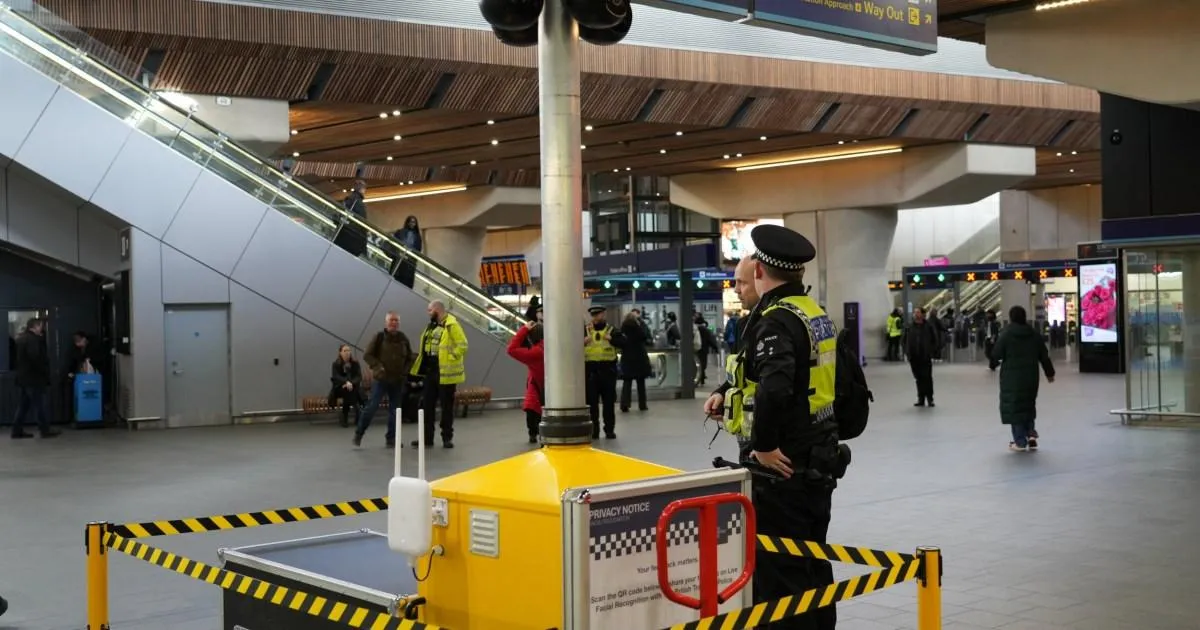
The deployment of live facial recognition (LFR) technology across London’s busiest train stations has sparked a significant debate regarding the balance between public safety and personal privacy. Since February, the British Transport Police have installed these cameras in major hubs like Waterloo, Euston, and Victoria, monitoring hundreds of thousands of commuters. Despite scanning over 330,000 faces, the program has yet to produce a single successful identification of a wanted criminal. In fact, the only time the system generated an alert, it was dismissed as a false alarm, casting a shadow of doubt over the efficacy of such invasive surveillance tools in real-world, high-traffic environments.
Critics, most notably from the civil liberties group Big Brother Watch, have decried the initiative as both ineffective and deeply intrusive. They argue that subjecting millions of innocent commuters to a continuous “digital police line-up” without their explicit consent is an alarming overreach of state power. For the average person just trying to catch a train, the prospect of being involuntarily scanned simply because they are moving through a public space feels like a violation of basic freedom. The group describes the results of the pilot as almost laughable, suggesting that the “cost” to public trust far outweighs any potential security benefit these cameras might offer.
In response to the criticism, the British Transport Police maintain that their intent is not to cast a wide net for surveillance, but to provide an additional layer of security to deter crime. They emphasize that the system is set to a strictly high threshold for accuracy, which naturally reduces the number of potential matches. Furthermore, they note that even if the technology hasn’t directly “caught” a criminal in the technical sense, the increased officer presence associated with these operations has led to several arrests for various offenses. They contend that the visible, proactive policing that accompanies these cameras contributes to a safer, more stable environment for both staff and passengers.
Beyond the railway stations, the implementation of facial recognition by private entities has led to even more troubling human-interest stories. Shoppers in London have reported instances of being wrongly accosted, publicly humiliated, and accused of theft because systems operated by private firms—such as Facewatch—produced incorrect matches. When a technology that claims nearly perfect accuracy fails, the consequences for the individual are immediate and stressful, often forcing innocent people to defend their reputations in front of strangers. These incidents highlight the danger of relying on automated systems that lack the nuance and empathy of human interaction.
Conversely, some areas have embraced similar technology with open arms, largely due to rising frustrations with local crime. In the borough of Croydon, where the Metropolitan Police recently expanded their use of LFR, many residents have expressed support for the measure. For locals, the weariness of enduring unchecked criminal activity and gang violence has led to the belief that if you have nothing to hide, you have nothing to fear. For these citizens, the presence of police technology is a welcome change from a reality where they feel unsafe, even if they remain skeptical about whether cameras can effectively identify masked perpetrators.
Ultimately, the debate over facial recognition in London reveals a deepening divide between the desire for safety and the right to privacy. While the police continue to refine their technology and push for broader coverage in areas like Soho and the West End, the data suggests that these systems are far from a silver bullet. The tension remains: how do we protect our communities from crime without turning our public spaces into a perpetual surveillance state? As this technology continues to evolve and proliferate, the conversation will likely shift from whether we can use it, to whether we should be comfortable living in a society where our faces are, quite literally, our identity tags.