

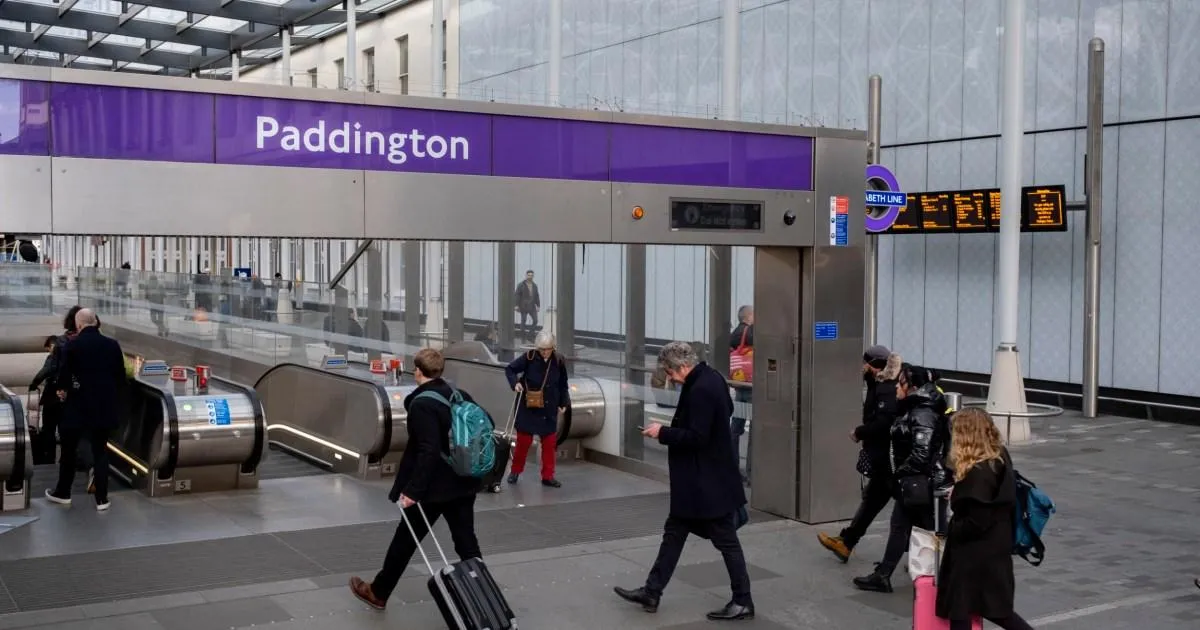
The relentless grey of a London morning was pierced by the unwelcome buzz of a smartphone, heralding a 5:45 a.m. alert that instantly transformed the day into a logistical soldier’s march. For the thousands of weary workers, students, and airport-bound travellers relying on the bustling arteries of the Elizabeth line—affectionately and hopefully dubbed the Lizzie line—this was the dreaded signal of collapse. A faulty track, discovered near the crucial junction at Hayes & Harlington in the borough of Hillingdon, had thrown a spanner into the finely tuned machinery of the capital’s newest railway. The defect necessitated an immediate, safety-mandated speed restriction, meaning trains would have to tiptoe over the affected rails, losing precious minutes that would cascade into hours of cumulative delays. National Rail’s terse announcement confirmed the worst: services between the terminus of London Paddington and Heathrow Terminals 4 and 5, as well as the commuter belt stretching to Reading, would suffer severe delays. Crucially, the disruption was not merely an early-morning inconvenience to be resolved by rush hour; it was officially forecast to persist “until the end of the day,” guaranteeing that mornings, midday, and the torrid evening commute would all face the same agonising crawl. The promise of smooth, high-frequency, state-of-the-art travel that had been the hallmarks of the line since its grand 2022 opening was once again proving brittle under the weight of daily reality. The collective groan of an entire city was almost audible.
The technical root of this suffering lay in the unglamorous but critical infrastructure of the railway track bed. A “defective track” at Hayes & Harlington—a stretch where suburban services converge with express lines and airport shuttles—is not a mere aesthetic issue. It represents a structural anomaly that could compromise wheel alignment, leading to excessive wear, potential derailment, or, at the very least, a hazardous ride for passengers. To mitigate this risk, the principal safety response is a stringent speed restriction. Trains are ordered to reduce velocity to a crawl over the affected zone, allowing engineers to inspect the damage and minimising the kinetic stress on the defective components. While this protects immediate safety, its operational consequence is devastating: a bottleneck is created. Because the Elizabeth line operates at some of the highest frequencies in the UK, with trains arriving every few minutes during peak hours, the slowdown at this single point creates a ripple effect of congestion across the entire cross-London route. TfL’s travel status page grimly noted the severe delays, and National Rail issued an advisory stating that services running between Paddington and the Heathrow hubs or Reading “may be revised.” For the business traveller sprinting to catch a flight, the revised schedule meant potential chaos at check-in; for the office worker in Reading, it spelled a missed morning meeting. The official advice was blunt: expect disruption for the long haul. Railway engineers would be deployed, but the complexity of the defect, combined with the need to maintain some service, meant a full fix was hours away.
By the time the clock struck 7 a.m., the virtual town square of social media had erupted, turning the personal frustration of the morning commute into a symphonic, digital chorus of rage. X, formerly Twitter, became the primary battleground for commuters to air their grievances, vividly illustrating the human cost of the mechanical failure. One particularly evocative post encapsulated the sentiment of many long-time users: “TfL Elizabeth line AGAIN!! No trains same as Saturday this is getting a daily issue. Honeymoon period well and truly over!! Sort it out please!” This specific reference to the “honeymoon period” is poignant, carefully marking the transition of this railway from a shiny, futuristic marvel to a source of routine anxiety. When the Elizabeth line opened, it was greeted with fanfare, royal visits, and gushing press reviews. Its wide trains, air-conditioned carriages, and rapid speeds seemed a panacea for London’s clogged transport system. Now, just a few years later, the gloss has worn off. Another passenger echoed the frustration with a logical grievance: “Why does the Elizabeth line seem to have constant issues that cause trains to constantly be cancelled? And if trains are cancelled, surely the ones that run should stop at all stops? The absolute worst line.” These aren’t just angry tweets; they are testaments to the psychological fatigue of precarious commuting. The constant uncertainty—will the train come? Will it stop? How late will I be?—erodes well-being far more than a predictable delay. Standing on a cold platform, watching board after board flick to “Delayed” or “Cancelled” engenders a visceral sense of powerlessness.
Recognizing the scale of the disruption, TfL and National Rail activated their mutual aid agreements, offering passengers a patchwork of alternative travel arrangements in a bid to ease the pain. Under these emergency protocols, passengers holding valid Elizabeth line tickets could use them at no extra cost on the entire London Underground network, allowing them to navigate central London via the Tube. Additionally, crucial bus services were designated as relief arteries, specifically linking Paddington with the Heathrow terminals and West Drayton, providing a ground-based, albeit slower, route to the airport. For those bound for the Thames Valley, South Western Railway agreed to accept the tickets for journeys between Waterloo and Reading, while the legacy operator Great Western Railway (GWR) stepped in to cover the vital high-speed connector between Paddington and Reading. While these alternatives were welcome in spirit, executing them in practice became a gruelling test of endurance. The seamless one-train journey from, say, Canary Wharf to Terminal 5 was brutally fractured into a multi-stage odyssey: a congested Tube ride to Paddington, a frantic dash to find the right bus stop for a replacement coach to West Drayton, then an uncertain transfer to a stopping train. Each transfer point was a scrum of confused commuters, tapping phones to recalculate routes, missing buses due to overcrowding, and adding an extra 60 to 90 minutes to their trips. The cost in lost productivity and sheer frustration was inestimable, turning what should have been a straightforward commute into an exhausting urban obstacle course.
This recurring chaos forces a more profound examination of the infrastructure that underpins modern Britain. Why does a railway conceived as the future of transport seem so persistently vulnerable to “defective tracks” and daily cancellations? The answer lies in the complex reality of integration. The Elizabeth line, for all its state-of-the-art signalling and new rolling stock, is not an isolated monorail; it is a cross-London route spliced into a broader, ageing National Rail network that includes freight operations, intercity services, and the historical Great Western Main Line. The section around Hayes & Harlington is a dense, interweaving junction carrying high-speed airport express trains alongside local stopping services. The frequency of Elizabeth line trains means margin for error is razor-thin; any minor hiccup is exponentially amplified. Furthermore, the perennial funding crises plaguing Transport for London have led to deferred maintenance and a reactive, rather than proactive, approach to asset management. The “defective track” might have been identified earlier had regular inspections been more thorough, but budget cuts often mean engineers are stretched thin. Critics argue that the honeymoon period ended when the maintenance cycle began. The novelty of the engineering triumph has faded, leaving behind the gritty, unglamorous work of keeping aging steel and ballast functional under immense daily pressure. Without sustained government investment, this could become a recurring theme rather than a one-off incident, further eroding public confidence in the rail network.
As the morning drags into a grey afternoon, the initial frantic rage subsides, replaced by the grim, stoic acceptance that is the hallmark of the hardened commuter. For those spending hours staring at departure boards, the day becomes a patchwork of waiting, rerouting, and compensating. The lunch break is spent frantically rearranging evening plans. The awareness of the continued disruption hangs over every meeting, providing a convenient, if exasperating, excuse for tardiness. The evening rush hour, as promised, brings a fresh wave of constraints, with the bottleneck slowing everyone’s journey home. Yet, within this shared ordeal, there exists a peculiar form of solidarity. Strangers exchange knowing glances of commiseration on overcrowded replacement buses. The grim joke of the “premier league of transport” falls flat against the reality of standing on one’s feet for an extra hour. The human spirit, however, adapts. People learn to build in “buffer time” to their schedules, carrying portable chargers for phones that are constantly used to check live updates. The emotional low point is contrasted by a resilient hope for the next day—a reminder from the rail operators that “disruption is expected until the end of the day,” but implicitly promising that tomorrow might be better. Until then, the city endures. The clattering of wheels on the defective track serves as a stark, rhythmic reminder that infrastructure—physical and social—is always a battle between engineering ambition and the relentless wear of daily heavy use. The day will end, the trains will eventually speed up, and the city will breathe a collective sigh of relief, until the next alert buzzes at 5:45 a.m. forecasting another chapter in the ongoing saga of the modern commute.