

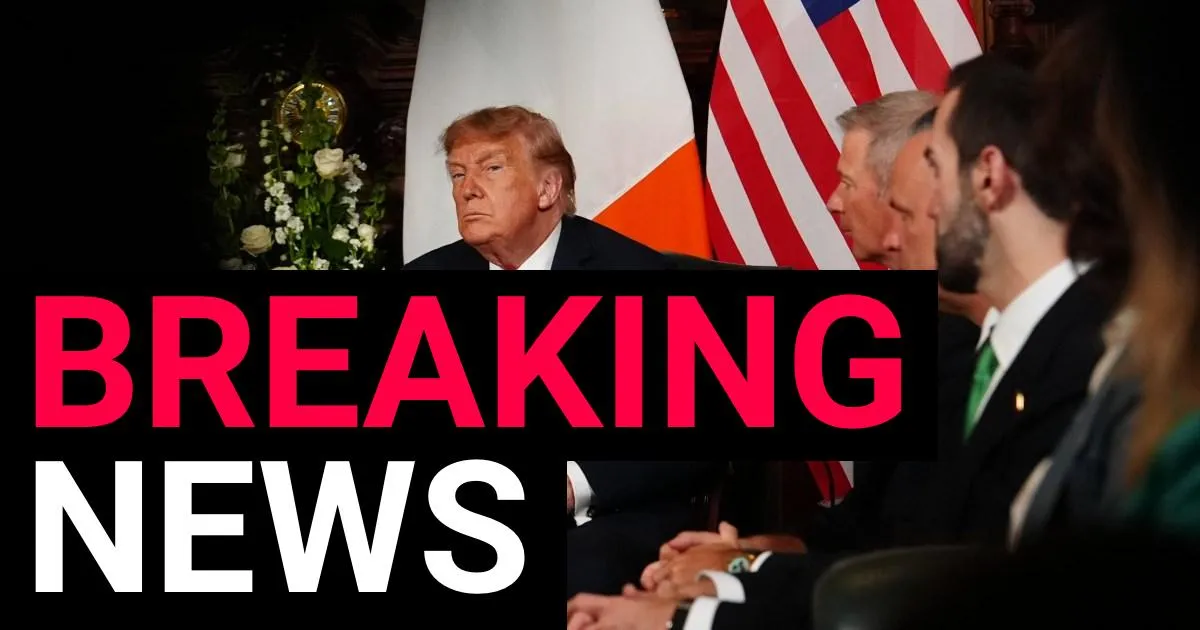
The air in the press conference room thickened with a palpable sense of disbelief. A collective, audible gasp rippled through the assembled journalists as the words left the US President’s mouth. Donald Trump, seated beside the Taoiseach of Ireland, Micheál Martin, had just declared his heartfelt desire to see the island of Ireland unified. The comment, so casually delivered yet so profoundly significant, hung in the room, its implications immediately understood by everyone present. For decades, the political landscape of the UK and Ireland has been a delicate, carefully balanced construct, and the casual intervention of the most powerful man in the world threatened to upend that equilibrium. The Taoiseach himself appeared visibly taken aback, a mixture of surprise and careful calculation playing across his features as he processed the President’s unscripted remarks.
Trump’s words were characteristically direct and laden with his signature brand of personal diplomacy. Asked about the long-term prospect of a united Ireland during his two-day visit, he didn’t hedge or offer diplomatic platitudes. Instead, he leaned into the idea with enthusiasm, framing it as a natural, even inevitable, conclusion to the island’s history. “Well, I don’t want to cause any problems,” he began, a disclaimer that did little to soften the bombshell he was about to drop, “but I will tell you I’d love to see it unified.” He pivoted immediately to a personal connection, a common rhetorical tactic of his, drawing on his own relationships to validate his stance. “I have friends on both sides, great people. They’re Irish people. How can they be bad, right?” This framing, reducing a complex constitutional and historical issue to a matter of personal affinity, was classic Trump, but its implications were anything but simple.
He did not stop there, pressing forward with a prediction that was both bold and provocative. “I’d love to see it unified. I think it would be a great feather in everybody’s cap if that happened. It’s going to happen eventually.” He repeated the sentiment for emphasis, suggesting a sense of urgency that is rarely heard from foreign leaders on this issue. “You know what? The way I look at it, it’s going to happen eventually. It may as well happen now.” He even went so far as to endorse the Taoiseach as the man to orchestrate this historic shift, saying, “We’re talking about it and you got the right man over here to get it moving. But, yeah, I think it would be a fantastic thing.” While he acknowledged the UK’s inevitable involvement, his tone suggested he saw it as a mere formality. “Now the UK will have something to say about it, obviously. But I think it would be a great thing. I mean, how can it be bad?” The rhetorical question, posed with a smile, did little to mask the seismic political tremor he had just sent through the corridors of power in Dublin, London, and Belfast.
The context of his visit only added another layer of peculiarity to the pronouncement. Trump was on the island primarily for personal and business reasons, to visit his golf club in Doonbeg, County Clare, which was set to stage the Irish Open. This was not a high-stakes diplomatic summit, but a trip centered on his commercial interests, making his foray into the most sensitive area of Anglo-Irish relations all the more jarring. The setting underscored the casual nature of his approach; for him, this was an off-the-cuff answer, but for the people of Northern Ireland and the governments of the UK and Ireland, it was a direct intervention into a peace process that has been carefully managed for a generation. The Troubles, a dark period of sectarian violence that claimed thousands of lives, are a living memory, and every word spoken by political leaders on the subject is weighed with the immense gravity of that history.
The core of the issue lies in the fundamental divide that Trump so blithely dismissed. On one side are Irish nationalists, predominantly Catholics, who have long aspired to a united Ireland, breaking the link with the British crown. On the other are unionists, largely Protestants, who identify as British and wish to maintain Northern Ireland’s place within the United Kingdom. For decades, this conflict was fought on the streets, in pubs, and in homes, culminating in the violence of the Troubles. The Good Friday Agreement of 1998, which largely ended the conflict, established a power-sharing government and a crucial principle: the constitutional question of a united Ireland can only be decided by a majority vote in both Northern Ireland and the Republic of Ireland. It is a carefully balanced compromise, and the last thing the architects of that peace wanted was for a foreign leader to casually tip the scales with a declaration of intent.
Trump’s comments, therefore, were seen by many as a reckless disregard for that delicate balance. For unionists, his words were nothing short of a betrayal, a signal from their most important ally in the Western world that the American administration would not only accept a united Ireland but would actively welcome it. The Democratic Unionist Party (DUP), which has historically been the main voice of unionism, relies on the support of conservative allies in the US. To hear the leader of that alliance express a desire to see the very thing they are committed to preventing was a significant blow, undermining their confidence and potentially strengthening the hand of Irish nationalists. It threatened to destabilize the careful equilibrium that has kept the peace, and it raised immediate questions about the UK’s sovereignty over its own territory and the strength of the so-called “special relationship” between the US and the UK.
While the political and diplomatic fallout was immediate, Trump’s personal motivations were a subject of intense speculation. His affection for Ireland was well-documented, a sentiment rooted in his Scottish mother’s heritage and, more tangibly, in his successful business ventures on the Emerald Isle. He is a businessman first and foremost, and his view of the world is often filtered through a lens of personal gain and transaction. A united Ireland is not a core issue for his voter base in the United States, so his comment was not a calculated move to appeal to a domestic constituency. Instead, it felt more like a personal whim, a desire to please his host in Dublin and to express a simplistic, optimistic view of a complex problem. It is also plausible that he genuinely believes his instinctive, deal-making approach can solve any problem, including one that has eluded politicians for a century. For him, it was likely a simple matter of two sides that should just get along, and his saying so might just make it happen.
The Taoiseach’s reaction was a study in diplomatic restraint. Micheál Martin, a seasoned politician well aware of the minefield he was in, had to navigate the enthusiasm of a powerful ally without appearing to endorse a timeline or a process that could inflame tensions. While publicly he acknowledged the President’s warm sentiments, his primary focus was on the Stability of the Good Friday Agreement, the principle of consent, and the need for a long-term, peaceful path towards any future change. He carefully welcomed the interest of the US President but recalibrated the conversation, emphasizing that any change must be decided by the people of Northern Ireland and the Republic, not by foreign pronouncements. He had to manage the extraordinary circumstance of having a US President publicly stating a preference that could embolden one side of the political divide and alienate the other, a tightrope walk between appeasing his guest and protecting the integrity of the peace process.
The implications of Trump’s remarks reverberated far beyond the immediate news cycle, landing with particular force in Westminster. The British government, typically cautious in its public statements, found itself in a difficult position. They had to respond to a direct intervention from their closest ally without either endorsing a policy that contradicts their constitutional position or creating a diplomatic rift with a vital partner. The Prime Minister’s office was forced to reaffirm the UK’s commitment to the Union and to reiterate that the question of a united Ireland was not for a foreign leader to decide, but for the people of Northern Ireland. The incident laid bare the uncomfortable reality that the UK’s constitutional future could be subject to unsolicited commentary from the White House, highlighting the vulnerability of a political union that is so deeply intertwined with its neighbor and its most powerful ally.
Ultimately, Trump’s comments served as a stark reminder of the fragile nature of the peace that was hard-won in Northern Ireland. While the walls of separation are gone and the guns have fallen silent, the underlying divisions remain. The peace is not sustained by grand statements from abroad but by the patient, daily work of politicians in Belfast, Dublin, and London, and by the will of the people themselves. A casual remark from a visiting dignitary, however powerful, cannot and does not change the fundamental principle of consent that underpins the Good Friday Agreement. In the end, Trump’s “love” for a united Ireland is a sentiment, not a policy, and its power to shape history is limited by the very constitutionally sound and democratic processes he so casually overlooked. The future of the island remains, as it always has been, in the hands of its own people, and not in the aspirations of foreign presidents who see it through the simplistic lens of a business deal or a personal friendship. The echo of his words will linger, but the path forward is still governed by the ballot box, not by the rhetoric of a press conference.