


More than two decades after the night Diana, Princess of Wales, was killed in a car crash in Paris, the wounds of that loss remain startlingly fresh. The latest tremor comes not from Buckingham Palace, but from Diana’s brother, Charles Spencer, the ninth Earl Spencer, whose memoir Swan Song: Diana, My Sister has been serialized in the Daily Mail. At the heart of the controversy is a telephone call he claims took place between himself and the then Prince Charles in the days after Diana’s death, when the world was still trying to understand how the brightest light of the royal family had been extinguished at just thirty-six years old. According to Spencer, he had argued that Diana’s sons, William and Harry, then aged fifteen and twelve, should not be forced to walk behind their mother’s coffin through the streets of London, exposed to the gaze of millions. When Prince Charles reminded him that he himself had walked in the funeral procession of Lord Mountbatten, his beloved “Uncle Dickie,” Spencer replied that Charles had been thirty years old at the time, not a grieving child. According to the Earl, there was a pause on the line—and then the future King allegedly unleashed a torrent of anger, culminating in the words that have now made headlines across the world: “Rest assured, we’ll forget her soon enough.” Buckingham Palace has responded with a carefully worded statement, saying that the King is “mindful that the pain of fraternal grief can cloud reason, affect judgment and colour memory in ways others do not recognise, even many years after such a loss.” It is an extraordinary exchange, not just because of the allegations, but because it reveals two men still wrestling, decades later, with the ghost of a woman they both loved in profoundly different ways.
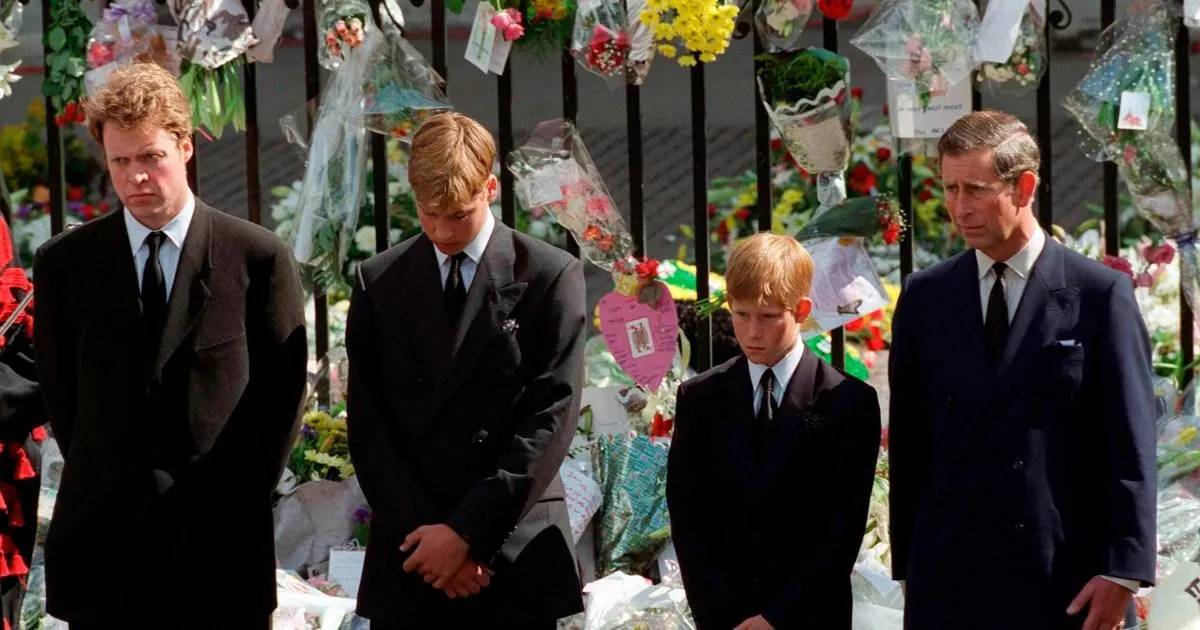
To understand the depth of the accusation, it is necessary to revisit the fraught weeks after Diana’s death, a time when the royal family seemed to be caught between private sorrow and public expectation. The image of two young boys standing behind their mother’s coffin is one of the most painful photographs ever taken of the monarchy, and it has haunted both princes in ways they have only begun to speak about in recent years. Earl Spencer writes that he was determined to protect his nephews from that ordeal. He told an aide to Queen Elizabeth II that William and Harry walking in the procession was “not going to happen,” and he believed with every fibre of his being that his sister would have wanted the same. Diana had always been ferociously protective of her boys, sheltering them from the press, taking them to theme parks and burger joints, trying to give them a childhood that the palace’s rigid protocols could never allow. To Spencer, forcing them to march behind her coffin was a violation of that motherhood—a public spectacle dressed up as duty. But Prince Charles, raised in a tradition where royal grief was something to be borne in silence and ceremony, saw it differently. He had walked behind Lord Mountbatten’s coffin at his funeral in 1979, and for him, the act was a final gesture of love and respect, not a burden. The disagreement was not merely about logistics; it was about two completely different philosophies of mourning. For Charles, duty meant showing the world that the monarchy could endure even the most shattering loss. For Spencer, duty meant protecting two boys who had just lost their mother and were about to have their grief turned into a global event.
The phone call that followed has become the emotional core of Spencer’s account. He describes the pause after his remark about Mountbatten as a moment of stillness, a silence he assumed meant the Prince was trying to control his temper. But then, in Spencer’s words, Charles “unleashed down the phone what I have always taken to be his pent-up contempt for Diana, and his horror that the world was so bowled over by her death.” The words “Rest assured, we’ll forget her soon enough” were, if true, chilling in their coldness. They suggest a man who viewed Diana less as the mother of his children and more as a threat to the institution he was sworn to serve, a woman whose enormous popular appeal had made her untouchable in life and even more powerful in death. Spencer has always believed that the royal family never truly understood Diana, and that some members resented the love she received from the public. In his telling, the phone call was a raw, unfiltered moment when the mask slipped and the resentment finally came pouring out. Yet it is also worth pausing to consider what might have been happening inside the Prince of Wales on that day. He had just lost, in his own complicated way, the woman he had once loved. He was watching his sons suffer unimaginable pain. He was being criticised from all sides for the breakdown of his marriage and the tragedy that had followed. Under that kind of pressure, even a careful man might say something he later regretted. The royal family had taught Charles to suppress his feelings, to appear unmoved in the face of crisis, to carry on with the rituals of monarchy no matter how hollow they felt. Diana, by contrast, had taught the world that emotions were not weakness but strength. The clash between those two worlds is perhaps the real tragedy behind the angry words.
Buckingham Palace’s response to Spencer’s allegations has been scrutinised as carefully as the allegations themselves. The statement, issued through a spokesman, avoided outright denial. Instead, it offered a form of psychological defence: “While we do not comment on books as a matter of principle, His Majesty is mindful that the pain of fraternal grief can cloud reason, affect judgment and colour memory in ways others do not recognise, even many years after such a loss.” The choice of the word “fraternal” is significant. It gently reminds the public that Earl Spencer is not an impartial witness; he is a brother who lost a sister, and whose grief has shaped the way he remembers the past. The palace is not accusing him of lying, but of seeing through the lens of mourning. That is a subtle and powerful argument, because it is impossible to refute. Grief does change people. It sharpens certain memories and softens others; it can make a careless phrase feel like a deliberate attack; it can preserve anger for years after the original wound has healed. The statement also carries a hint of sadness, almost an admission that both men were damaged by that terrible week. If the King truly believed the conversation never happened, one might have expected a flat denial. Instead, the palace seems to be saying that even if something was said, it was said by a man overwhelmed by the impossible demands of leadership, grief, and public scrutiny. That is not the same as an apology, but it is a recognition that the past is never simple. And in a way, the statement invites the public to extend the same grace to Spencer—his grief, too, has coloured his memory, perhaps making him hear cruelty where none was intended. Between those two flawed, grieving men, the truth may lie in a painful grey area that no amount of memoir writing or royal statement can ever fully resolve.
Earl Spencer has spent much of his life defending his sister’s memory, and Swan Song: Diana, My Sister is clearly part of that long campaign. At Diana’s funeral on 6 September 1997, he stood before a billion people and made a vow that has echoed through the years: that she would never be forgotten. That promise has shaped his public life. He has spoken out against the press culture that chased Diana into the tunnels of Paris, he has curated her legacy through exhibitions and memorials, and he has remained a vocal critic of the institution he once belonged to by marriage. In his own words, the new book has been written to correct “untruths” told about his sister—the many versions of Diana that have appeared in articles, biographies, and television dramas, reducing a complex woman to a set of clichés. The title Swan Song suggests a final farewell, a last gift from a brother who believes he has one more story to tell before he lets her go. But his decision to revisit the phone call with Prince Charles also reopens wounds that the royal family may have hoped were closed forever. It forces the country to remember that Diana’s death was not just a national tragedy but a family tragedy, one that fractured relationships in ways that have never fully healed. The Spencers and the Windsors have existed in a state of mutual suspicion for decades, and this book is unlikely to mend that rift. Yet Spencer would likely argue that the truth matters more than comfort. If Diana’s own husband’s brother, or his own household, truly dismissed her death as something to be forgotten, then the public deserves to know. For Spencer, the book is not an act of revenge but of loyalty—a final attempt to ensure his sister’s story is told with the honesty she never received while she was alive.
In the end, this entire controversy is a reminder of how complicated grief can be. Every family has its own unresolved arguments, its own versions of events that never quite match, its own words said in anger that echo for decades. The difference is that this family grieved on a public stage, with the entire world watching. Prince Charles, now King, had been raised to believe that the monarchy must endure, that personal pain must be set aside for institutional stability. Earl Spencer had been raised to love his sister unconditionally, and after her death, that love became a protective fury that has never entirely cooled. Both men are haunted by the same woman, but they remember her differently—one as a wife whose struggles conflicted with his duty, the other as a sister who was failed by the world. The phone call, if it happened as Spencer describes, was a collision of those two realities. Perhaps the King did say those words. Perhaps he did not. Perhaps he said something similar but in a different tone, or with different intent. Memory is a strange and unreliable thing, especially when sharpened by trauma. What is beyond doubt is that two boys lost their mother in a horrifying way, and that the men charged with caring for them could not agree on how to help them say goodbye. That is a tragedy that no amount of royal comment will ever erase. The palace’s plea for compassion in the face of “fraternal grief” could perhaps be extended not just to Earl Spencer but to the King himself—and to all of us, as we try to make sense of a story that never seems to reach a peaceful conclusion. In the end, the only certainty is that Diana herself, whose embattled brother is still fighting her corner, remains unforgettable, no matter what was promised in that bitter telephone call so many years ago.