

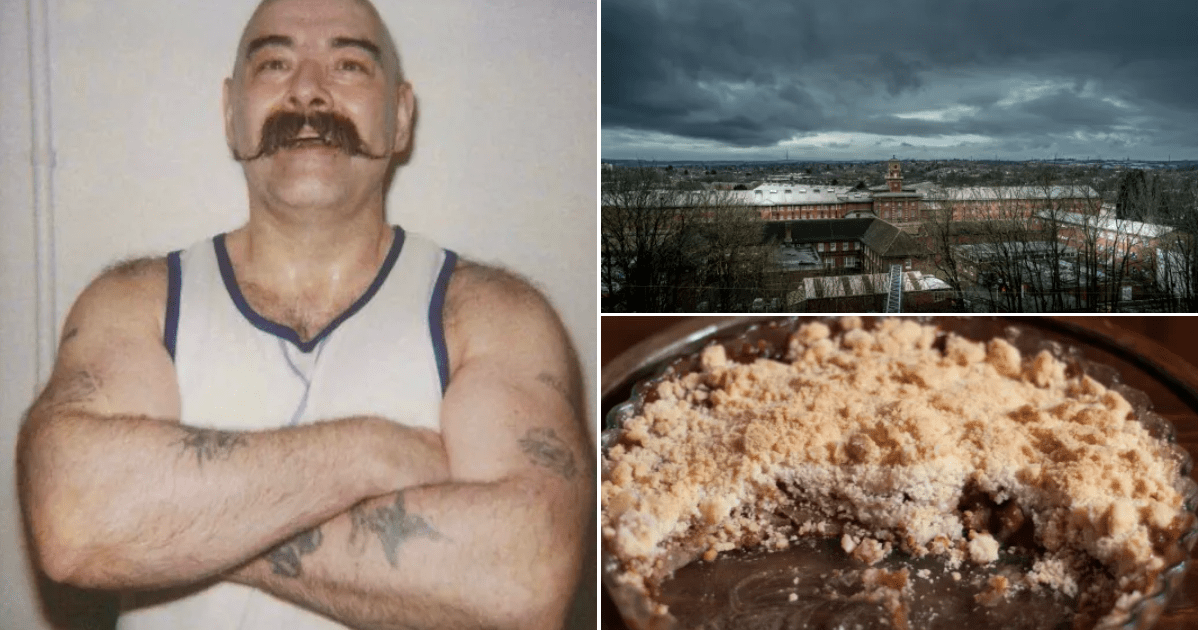
Charles Bronson, the man often dubbed Britain’s most notorious prisoner, recently found himself at the center of an incident that perfectly encapsulates the strange, claustrophobic reality of a life spent almost entirely behind bars. At 73, and after half a century of incarceration, one might expect a man of his infamous reputation to be focused on profound existential matters. Instead, the spark for his latest standoff at HMP Wakefield—a maximum-security facility known as “Monster Mansion”—was something as trivial and domestic as a bowl of apple crumble served without its customary portion of custard. For a man who has lived decades in the shadows of the prison system, the absence of a simple dessert became a symbolic grievance, a perceived slight that he felt compelled to challenge with his signature brand of defiant, high-stakes stubbornness.
When Bronson refused orders to leave the exercise yard following the “custard catastrophe,” he effectively turned a minor dietary disappointment into a security operation. While it might seem absurd to an outsider that a piece of pastry could trigger a confrontation, within the rigid, high-tension world of a Close Supervision Centre, nothing is truly small. Prison officials cannot afford the luxury of dismissing the behavior of a man who has made a career out of volatile, unpredictable protests. When he sat down in the yard and refused to budge, he wasn’t just protesting a dessert; he was reasserting his presence in an environment where he has spent 23 hours a day in solitary confinement, constantly struggling against the crushing monotony of state-controlled life.
The spectacle that followed involved teams of officers in full riot gear, a dramatic response to a man who, in that moment, seemed to be reliving the theatricality of his own legend. Witnesses noted him running toward an officer’s shield, shouting, “This is for Reggie Kray,” a nod to the old-school criminal underworld he grew up admiring. It was a fleeting, bizarre moment of aggression that saw him forcibly returned to his cell, yet it highlighted the paradox of a life lived in a box. In a place where you cannot control your schedule, your company, or your future, the contents of your dinner tray become one of the few things left to exert ownership over. For Bronson, claiming his custard became an act of defiance against a system that has long since deemed him beyond redemption.
Bronson’s history is a long, tangled web of armed robberies, hostage-taking, and rooftop protests, dating back to his first conviction in 1974. He has been a constant headache for the authorities, shifting between prisons and enduring long stretches of isolation. Yet, beneath the violent reputation and the “Hannibal Cage” confinements, there remains a man who has spent these later years trying to reinvent himself as an artist and a philosopher of his own predicament. He has made earnest requests for parole, arguing that after years of “eating more porridge than Goldilocks,” he deserves a final chance at freedom. He claims he has earned his break, even if the world outside sees only the man who once held his own art teacher hostage for two days.
However, the reality of his situation is stark: incidents like the “custard protest” are essentially self-inflicted wounds that sabotage his chances of freedom. As he prepares for yet another parole hearing this November, his behavior acts as a double-edged sword. To his supporters, he is a man pushed to the brink by decades of harsh treatment; to the Parole Board, he is a man who still lacks the emotional regulation required for society. The irony is that the more the prison environment grinds him down, the more he reacts with these outbursts, and the more these outbursts reinforce the argument that he simply cannot be trusted to live among the general public. He is a man desperate to walk free, yet seemingly unable to stop being the “Charles Bronson” that the system insists he is.
Ultimately, this incident serves as a grim reflection on the nature of long-term incarceration. Whether or not one sympathizes with him, the custard standoff highlights the profound psychological degradation of life in a maximum-security cell, where even the smallest deviation in a meal can trigger a collapse of order. As he approaches his upcoming parole hearing, Bronson finds himself at a crossroad where his past actions and his present impulses collide. Whether he is a man who has truly evolved or a man forever trapped in the cycle of his own chaos remains a question that he, through his daily choices, continues to answer in the most difficult way possible. For now, he remains inside, waiting to see if he will ever get to taste freedom, or if his life will simply continue to be defined by the walls around him and the grievances of the daily grind.