


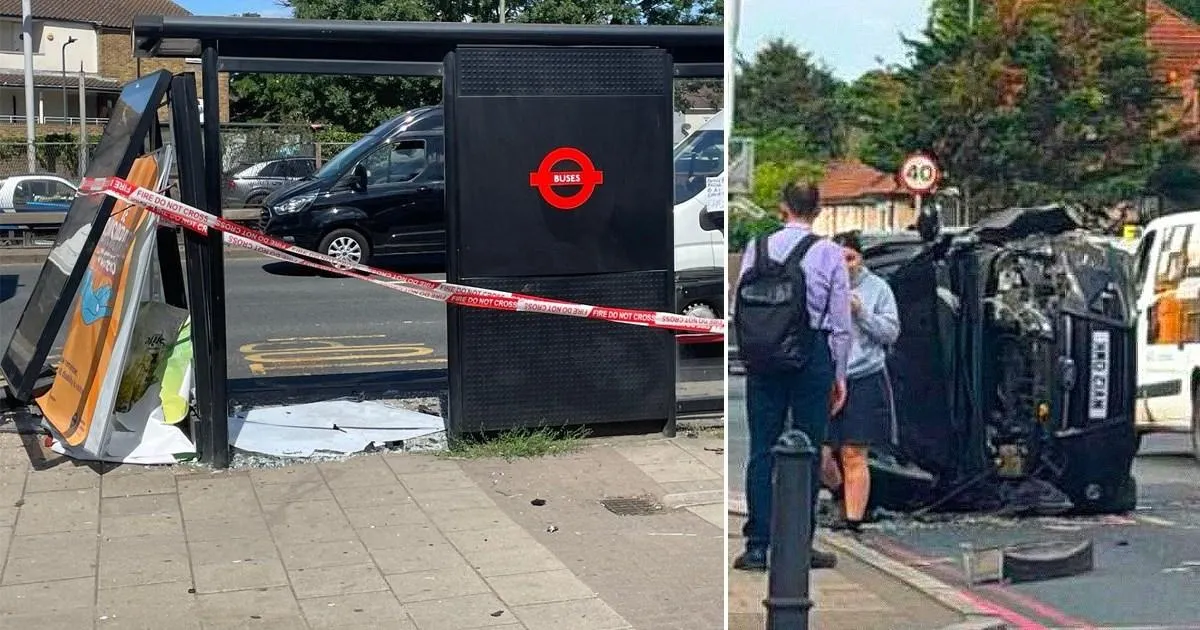
The morning commute in North London turned into a scene of absolute chaos this past Monday when a black Ford Focus careened off the road and smashed into a crowded bus stop. The incident, which occurred just before 8:00 a.m., saw commuters and schoolchildren—who rely on that stop for their daily routines—scrambling for safety as the vehicle hurtled toward them. The impact was violent enough to completely obliterate the bus shelter, sending debris flying and resulting in the car flipping onto its roof. For those waiting in the queue, it was a terrifying few seconds of fight-or-flight, with many later describing the ordeal as a brush with death that left them shaken to their core.
Witnesses at the scene painted an alarming picture of the events, noting that the vehicle appeared to be traveling at high speed as it navigated a slight, notorious bend on the North Circular. Local resident Rico Kwame, who observed the aftermath, remarked on the sheer carnage left behind, noting that people were running for their lives as the car barreled toward the sidewalk. While the driver miraculously managed to climb out of the overturned vehicle, seemingly physically unscathed though clearly in a state of deep shock, two innocent bystanders were not as lucky. They sustained injuries that required immediate medical attention, leaving onlookers to remark that it was a genuine miracle the incident did not result in a fatality.
The emergency response was swift, with police and multiple ambulance crews descending on the North Circular to treat the injured and manage the growing chaos. As paramedics worked to stabilize the victims before transporting them to a local hospital, police officers cordoned off the wreckage, turning the area into an active investigation site. This closure naturally caused massive gridlock for commuters heading into central London, compounding the sense of frustration and anxiety for those already affected by the morning’s traumatic events. Authorities are now busy analyzing the scene and reviewing evidence to determine exactly how fast the vehicle was moving and why it left the road in such a devastating manner.
For the families living in the immediate vicinity, this accident was far from an isolated shock; it felt like an inevitable tragedy waiting to happen. Several residents spoke out about the dangers of this specific stretch of road, labeling it a “death trap” that is fundamentally unsuited for a bus stop. One mother, whose own children frequently use the shelter to get to school, expressed her outrage and fear, pointing out that there had been another collision at that exact location just two days prior. The recurring nature of these accidents—including a lorry crash only a week earlier—has ignited a renewed call from the community for local officials to finally implement serious traffic-calming measures to protect pedestrians.
The emotional toll on those who witnessed the crash was palpable. Neighbors described the deafening sound of the impact, which drew them to their windows, where they saw the mangled wreckage and commuters fleeing in terror, fearing the car might ignite. The scene, now marked by a taped-off, hollowed-out bus shelter, serves as a grim reminder of how quickly a mundane Monday morning commute can turn life-altering. While the two injured individuals are receiving care in the hospital, the community is left to grapple with the realization that they were inches away from a much darker outcome, fueling their demands for safer streets.
Moving forward, the investigation will likely focus on the design of this stretch of road and the safety protocols governing it. With a 40mph speed limit on a busy dual carriageway that serves as a thoroughfare for shops and homes, residents are questioning whether current safety standards are sufficient. The authorities have appealed for witnesses to come forward to help piece together the final moments before the crash. As the city returns to its usual pace, those who live near the North Circular are holding on to a mix of relief that no one was killed and a persistent demand for change, hoping that the next time a car drifts toward that curb, there will be something—or someone—in place to stop it.