


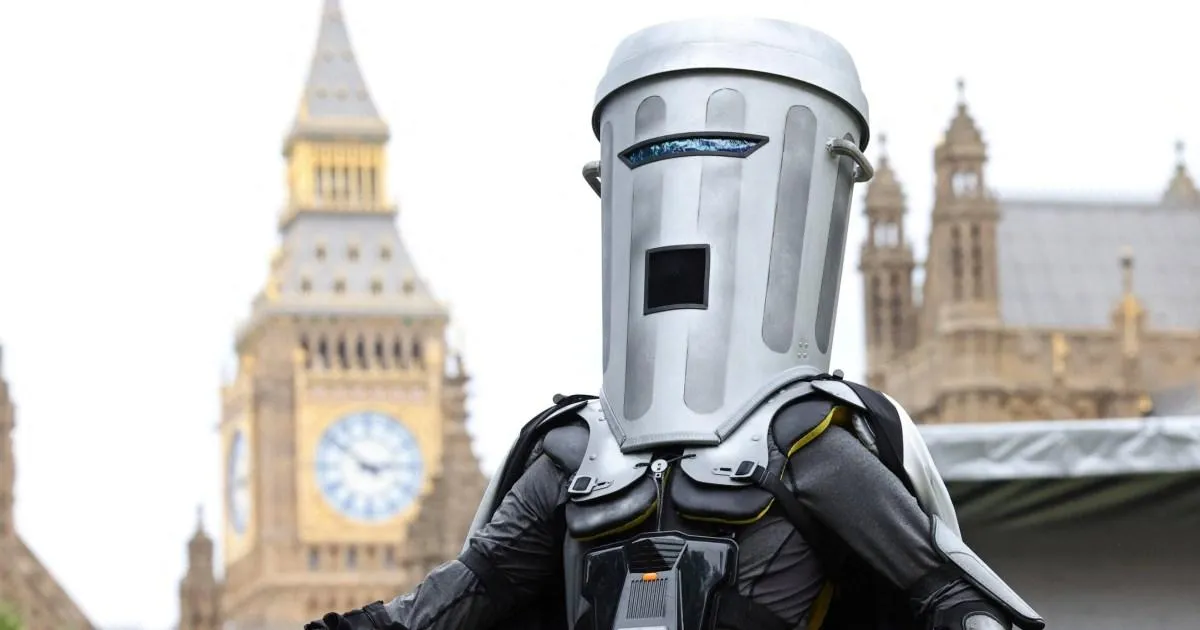
In the often-gray, predictable landscape of British politics, a shiny, metallic-headed protagonist has emerged to inject a much-needed dose of absurdity. Count Binface, who famously describes himself as an intergalactic space warrior and leader of the Recyclons from planet Sigma IX, has officially entered the electoral fray to challenge Nigel Farage in Clacton-on-Sea. While his arrival might seem like a mere sideshow in the serious business of parliamentary democracy, the Count has carved out a unique space for himself as a satirical protest candidate. With a quick wit and a penchant for showing up in the background of solemn victory speeches, he has become a staple of modern UK elections—an alien presence that offers voters a chance to protest the mundane status quo with a laugh.
Behind the literal bucket-shaped facade is Jon Harvey, a seasoned stand-up comedian and writer with a deep background in British political satire. Having cut his teeth on legendary shows such as The Thick of It, Have I Got News for You, and Time Trumpet, Harvey possesses an intimate understanding of the political machinery he now mocks. Born in Croydon and an ardent Crystal Palace supporter, Harvey’s transition from behind-the-scenes satirist to an active participant in the ballot box was born out of a mix of creative brilliance and, at times, legal necessity. His previous iteration as ‘Lord Buckethead’ ended in a copyright dispute with an American filmmaker, prompting the upgrade to the now-iconic Count Binface, proving that even intergalactic space warriors aren’t immune to the rigid laws of earthly intellectual property.
The Count’s platform is a delightful blend of surrealism and biting social commentary, designed to highlight the preposterous nature of the political establishment. His manifesto typically features crowd-pleasing, if eccentric, promises: capping the price of croissants, ice creams, and kebabs at one pound, forcing former prime ministers to perform mandatory national service, and introducing severe penalties for public transport faux pas, such as using speakerphones. Yet, beneath the jokes, he addresses real frustrations. He advocates for improved train Wi-Fi, better traffic flow, and, in a nod to the digital age, the return of ‘Ceefax.’ His campaign is a mirror held up to the public, offering a satirical alternative that resonates exactly because it refuses to take the traditional, self-important political theatre seriously.
Despite the humor, the Count has proven that he can hold his own against more traditional opponents. In the 2021 London mayoral race, he secured an impressive 24,775 first-choice votes, famously outperforming both the Britain First candidate and other fringe parties. This wasn’t merely a fluke; it was a testament to a growing desire among the public for a candidate that breaks the mold. Whether he is appearing on stage at Glastonbury or debating the merits of competitive kebab pricing, supporters often find themselves nodding along to his platform, noting that, in a world of broken promises and political jargon, a bin with a plan is at least refreshingly honest.
Clacton-on-Sea, a coastal town facing significant challenges, from housing struggles to social deprivation, represents the latest, and perhaps most daring, frontier for the Count. Critics might argue that a laughing stock has no place in a town with such genuine, deep-seated difficulties, but the Count’s approach is specifically designed to puncture the gravity of the political elite. He has positioned himself as an anti-establishment force, explicitly targeting Nigel Farage and daring the major parties to step aside for a “unity candidate” who has pledged to build at least one affordable house—a goal he frames with his signature irreverence. It is a bold move that highlights how his candidacy is not about winning power, but about challenging the dominance of mainstream figures who the public is often forced to choose between.
Ultimately, Count Binface embodies the peculiar, cherished absurdity of the British electoral process. He has become a litmus test for voter sentiment; his rise in popularity, marked by thousands of votes in previous elections, suggests that many voters are exhausted by the cycle of disappointment provided by legacy politicians. While he will likely never occupy 10 Downing Street, he serves as a necessary safety valve for a public that feels unheard and ignored. As he prepares to face off against Farage, the Count continues to prove that in a democracy, sometimes the most honest candidate in the room is the one who isn’t even from this planet. Regardless of the final tally, he has succeeded in his primary mission: making sure that, for a few weeks at least, the political giants of the country have to share the stage with an intergalactic crusader.