


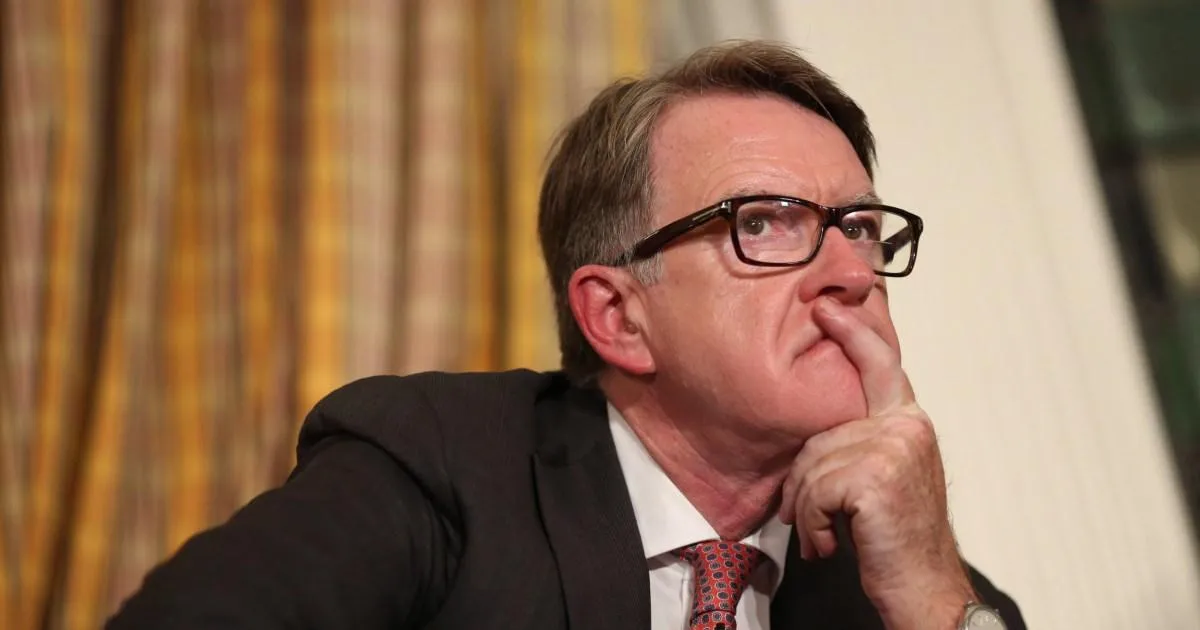
The British political landscape has been rocked by the surfacing of a controversial leaked dossier that casts a long, dark shadow over the career of Lord Peter Mandelson. The report, which has surfaced in the wake of his departure from the role of British Ambassador to the United States, makes the sensational allegation that the Labour peer has been a “privileged contact” for Russian intelligence for over three decades. According to the document, codenamed “Project Fish” and allegedly compiled in 2022 by former MI6 Russia desk chief Christopher Steele, Mandelson was reportedly targeted by the KGB as early as 1990. The dossier suggests that he became one of Moscow’s most significant assets in their long-term effort to subtly manipulate British politics—a claim that is as explosive as it is difficult to substantiate.
To understand the weight of these accusations, one must look at the source of the report. Christopher Steele is a polarizing figure in the intelligence community, having previously gained global notoriety for his 2017 dossier on Donald Trump, which claimed the Kremlin held “kompromat” or compromising material on the then-president. While that previous report became a lightning rod for debate and was largely disputed by the Trump camp, the new claims against Mandelson have introduced a level of chaos to Westminster that even seasoned observers find unsettling. Despite the gravity of the language used in “Project Fish,” it is vital to note that there is currently no hard evidence suggesting Mandelson functioned as a spy or committed acts of espionage for the Kremlin. Indeed, various sources close to the situation have been quick to dismiss the dossier’s contents as absolute nonsense, insisting that the peer has done nothing wrong.
The timing of these allegations is particularly damaging, given that Mandelson’s brief tenure as ambassador ended in disgrace last September following public scrutiny over his past friendship with the late, convicted sex offender Jeffrey Epstein. His appointment to the Washington post was already steeped in controversy before this latest bombshell arrived. It has recently emerged that during his initial security vetting, intelligence officials flagged Mandelson as a “borderline case.” Despite these internal warnings, the Foreign Office ultimately cleared him for the role. This decision reportedly caused a significant rift within the civil service; Sir Olly Robbins, a high-ranking official, was effectively ousted after reports surfaced that he had overruled objections to deny Mandelson security clearance. Robbins later defended himself, suggesting the situation was far more nuanced and that he had felt intense pressure to expedite the appointment.
The fallout from this vetting debacle has rippled far beyond the quiet offices of the Foreign Office, ultimately destabilizing the highest echelons of British government. The turmoil surrounding how a “borderline” candidate was ushered into such a sensitive diplomatic role became a focal point of public frustration, serving as a primary catalyst for Sir Keir Starmer’s unexpected resignation as Prime Minister last week. For many, the situation illustrates a breakdown in accountability, where political desire for a specific appointment seemingly overrode the rigorous safety-first logic of national security protocols. The public is left wondering how a man who was already a lightning rod for controversy due to his personal associations could be entrusted with the most important diplomatic bridge in the Western world.
Reflecting on the nature of these leaks, one cannot help but notice a pattern in how modern political warfare is conducted. The use of dossiers, often created in the shadows and leaked at moments of maximum political vulnerability, seems to have become a staple of contemporary discourse. Just as the Steele dossier on Donald Trump was partially funded by political rivals during the 2016 US election, the appearance of “Project Fish” naturally raises questions regarding its origins and intent. Are these documents legitimate internal security assessments, or are they tools of political assassination designed to ensure that those who hold power can be toppled when the shifting winds of public opinion turn against them? It is a stark reminder that in the halls of Westminster, information is rarely just information; it is almost always a weapon.
Ultimately, the story of Peter Mandelson and the “Project Fish” dossier serves as a bleak commentary on the current state of British governance. We are seeing a public lose faith in the institutions tasked with vetting those who represent the nation on the world stage. Whether or not Mandelson was ever a tool of Russian influence is a question that may never be fully settled to the public’s satisfaction, but the damage to the reputation of the UK’s diplomatic process is already done. As the country moves forward, the conversation will likely shift from the specific claims against a single peer to the broader necessity for transparency and integrity in the vetting systems that safeguard our democracy. In an era where “everything is changing, all the time,” one thing remains consistent: the public’s desperate need for truth in the face of persistent political noise.