


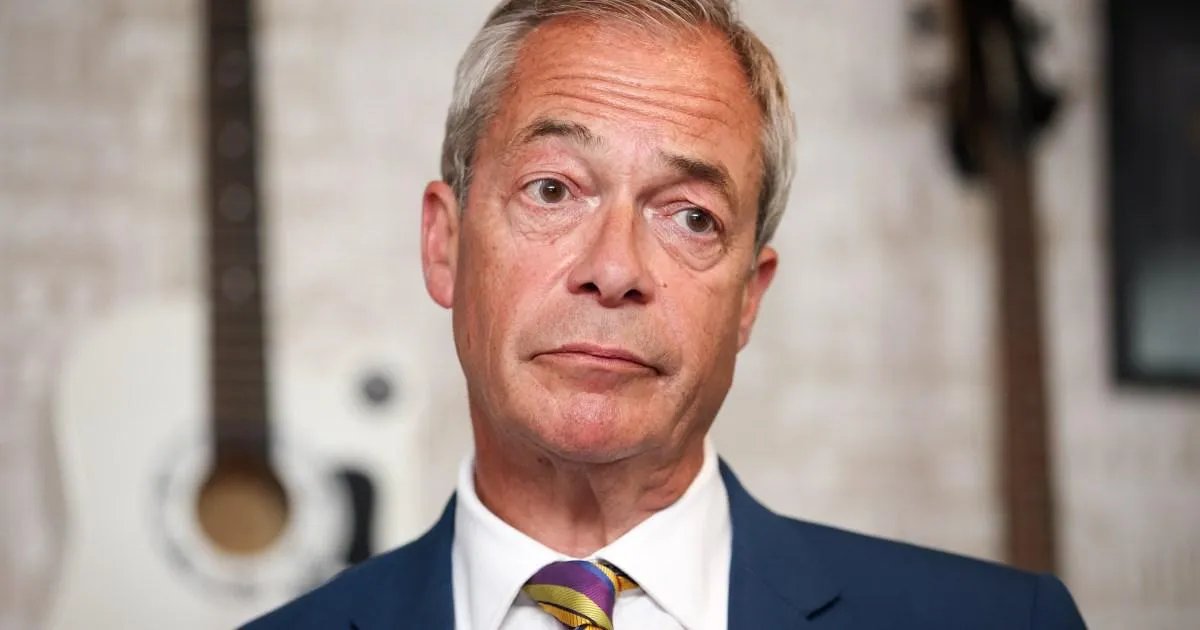
Nigel Farage, the perennial firebrand of British politics, finds himself navigating a treacherous path as his party, Reform UK, faces internal friction and external challenges. While Farage is a master of political theater, the current situation is far from a choreographed stunt. Reform is currently grappling with a dual-pronged crisis: a messy, public disagreement between two of its most prominent spokespeople and the emergent threat of a grassroots rival on the far-right. For an organization built on the cult of personality and a promise of unified disruption, these fissures are more than just growing pains; they are a sign of the volatility inherent in trying to capture the shifting mood of the British electorate.
The internal discord centers on a classic political stumble: conflicting narratives. When Robert Jenrick, Reform’s Treasury spokesman, appeared on Sky News to pitch a policy regarding tax relief, he was forced into the weeds of social housing and visa requirements. His nuanced response—that foreign nationals in social housing might face barriers to renewing visas if they failed to meet specific economic criteria—was swiftly slapped down by his colleague, Zia Yusuf. In the digital arena of X (formerly Twitter), Yusuf declared that Jenrick’s interpretation was wrong, doubling down on a more aggressive stance: if a foreign national is in social housing, they fail the economic test and face automatic deportation. This wasn’t just a difference of opinion; it was a public refutation that highlighted deeper, long-standing tensions between two high-profile figures who have historically struggled to share the same political tent.
This pattern of “spikiness” is becoming a recurring theme for Zia Yusuf, whose history with Reform is peppered with dramatic departures and internal friction. From his temporary resignation over a disagreement regarding a burqa ban to his involvement in the fallout that led to the departure of Rupert Lowe, Yusuf has cemented a reputation as a volatile operator. For a party that prides itself on being the only true alternative to the political establishment, these personality clashes create a chaotic impression. When the people responsible for shaping policy can’t agree on the fundamental mechanics of that policy in front of the cameras, it erodes the voter’s confidence that the party is ready for the serious business of governance.
The second, and perhaps more dangerous, front is the rise of “Restore Britain,” a fledgling political movement founded by the aforementioned Rupert Lowe. While Reform aims to be the standard-bearer for the right, Restore is nipping at its heels, appealing to the most radical fringes of its support base. Though their footprint remains small, their presence is already being felt in local, granular contests. By capturing even a modest slice of the vote share, groups like Restore serve as a spoiler, effectively acting as an anchor that prevents Reform from consolidating its reach. In a political system that relies so heavily on momentum, losing even five or seven percent of the vote to a splinter group can be the difference between a breakthrough victory and an agonizingly close defeat.
Recent polling data from the Makerfield by-election provides a sobering look at this dynamic. As Reform’s candidate struggles to bridge the narrow gap with the Labour opposition, the presence of a Restore candidate is siphoning off support that could have been pivotal. For Farage, this is a nightmare scenario: the “splitting of the right” that he has long warned about is no longer a theoretical risk—it is happening on the ground. As these small, ideologically driven parties peel away voters from Reform, they threaten to dilute Farage’s brand, transforming his quest for electoral dominance into a fight to keep his own flank from collapsing.
Ultimately, Reform UK is learning the difficult lesson that occupying the populist space is a double-edged sword. By catering to a wide spectrum of anti-establishment sentiment, they have created a coalition that is as fragile as it is passionate. As Nigel Farage looks toward the future, his greatest challenge may not be battling the Labour Party or the Conservatives, but managing the chaos within his own ranks. Whether he can muzzle his outspoken colleagues and neutralize the drain caused by fringe rivals will determine if Reform remains a significant political force or if it gradually fractures, leaving the right wing of British politics as splintered and ineffective as ever.