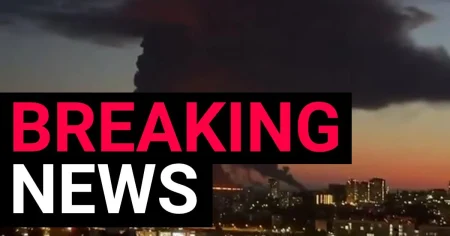

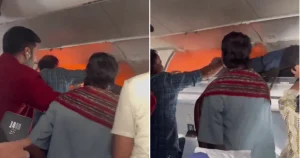

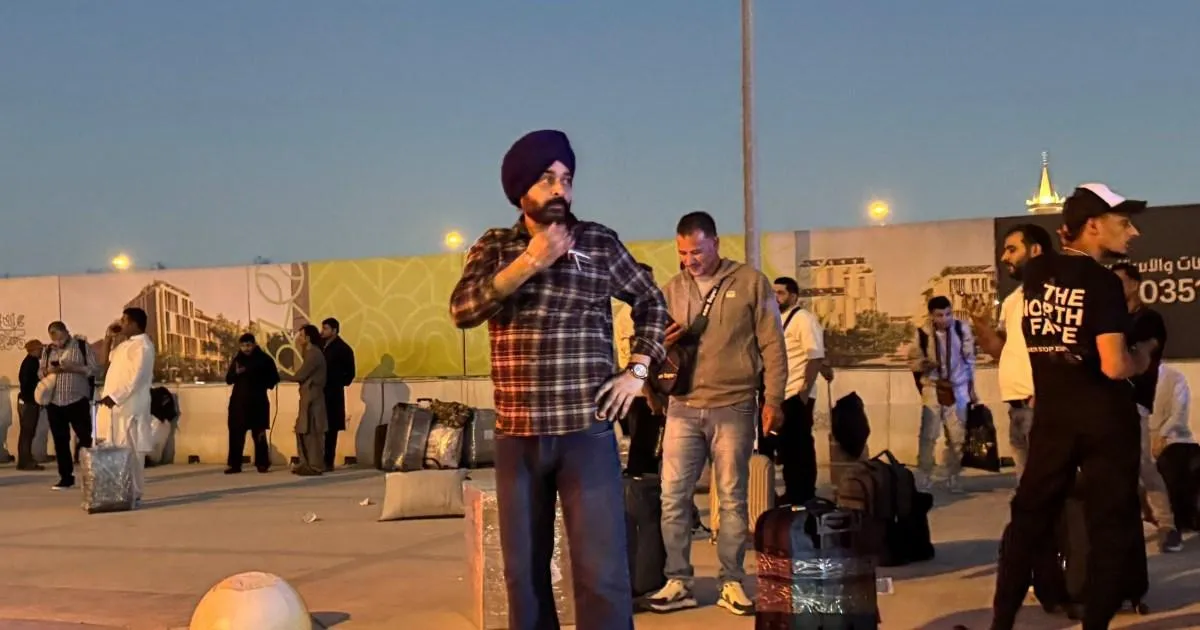
1. On a Saturday that should have been an ordinary day of travel and transit, chaos tore through the heart of Riyadh. King Khalid International Airport, Saudi Arabia’s largest and busiest aviation hub, became the scene of a deadly attack that left twelve people dead and more than three hundred injured. The strike, blamed on Yemen’s Iran-backed Houthi rebels, hit a complex housing Terminals 3 and 4, the sections of the airport that handle domestic flights. Footage from the scene showed a missile slamming into a Saudia Airlines jet parked at the terminal, the aircraft vanishing in a thick plume of black smoke as alarms blared and passengers scrambled for safety. The blast was not just an assault on infrastructure; it was an assault on everyday life. For the families waiting at arrival gates, the airport staff guiding planes to gates, and the passengers clutching boarding passes, the routine of air travel was shattered in an instant. Flight-tracking data by Sunday showed all operations remained suspended at the airport, a facility that normally welcomes some 40 million passengers a year. The silence of grounded planes and the emptiness of the terminals told a story of fear and uncertainty. What had once been a symbol of Saudi Arabia’s modern ambitions and global connections had suddenly become a target, and the psychological toll on those who lived through the attack will not be measured in casualty counts alone.
2. Half a world away, the political response was swift, and perhaps even more unsettling. Donald Trump, the President of the United States, said he was deciding whether to join Saudi airstrikes against the Houthi rebels. Asked directly whether the United States would get involved, Trump replied with a terse, ambiguous “We’ll find out.” He confirmed that he would be speaking to Saudi Crown Prince Mohammed bin Salman, and his words carried a mix of unpredictability and bravado. “We may. We’re going to look at it. We just found out about the recent attack, so we’ll make a decision. We move very quickly,” he said. The possibility of American military intervention added another layer of gravity to an already volatile situation. Meanwhile, just six miles from the devastated airport, the WPC Energy Congress was getting underway, a major international event that had drawn 70 ministers, 300 company executives, and representatives from more than 25 international energy organisations. Despite the attack, authorities confirmed the event would go ahead as planned. There was something almost surreal about the juxtaposition: world leaders and industry titans gathering to discuss energy and economics while black smoke still hung over the airport and the wounded were being rushed to hospitals. The decision to proceed was a defiant signal, but it also underscored the uncomfortable reality that global business and geopolitical violence increasingly occupy the same space. For the delegates arriving in Riyadh, the luxury hotels and conference halls must have felt like fragile bubbles, with the knowledge that a single missile could turn any moment from ordinary to catastrophic.
3. The Houthi rebels, for their part, showed no signs of backing down. In a chilling warning posted on X, the Iran-backed militia addressed airlines directly: “We renew our warning to all airlines, experts, employees, workers and travellers against using Saudi airports and airspace, as they are vulnerable to attack and have become a theatre of operations for our forces, with the exception of the airports in (the holy cities of) Mecca and Medina.” The message was not just a threat; it was a deliberate attempt to instil fear in the daily rhythms of millions. And the warning was not empty. On Sunday, another projectile fell near King Fahd International Airport in Dammam, and a drone was intercepted in the region. Across the kingdom, schools suspended in-person classes, with students shifting to remote learning until at least Thursday. Parents were left scrambling to arrange childcare and manage the anxiety of children who sensed that something was deeply wrong. The Houthis’ targeting of civilian aviation infrastructure transformed the abstract idea of war into a tangible, everyday menace. For airline employees, airport workers, and travellers, the simple act of boarding a plane now carried an added layer of dread. The militia’s exception for Mecca and Medina, the holiest cities in Islam, felt less like mercy and more like a calculated political gesture, drawing a line between the sacred and the secular while reminding the world of the sectarian and ideological dimensions of the conflict. Ordinary Saudis, who had watched their country project wealth and power on the global stage, were now being forced to look over their shoulders at the sky.
4. In London, the British government reacted with a mixture of condemnation and resolve. Wes Streeting, the UK’s Defence Secretary, called the Houthi strike on King Khalid International Airport a “dangerous escalation” and described the broader pattern of attacks on civilian sites as “contemptible.” Speaking to Sky News, Streeting said, “What we’ve seen overnight is a dangerous escalation and I’m afraid an increasing pattern of behaviour from the Houthis that’s targeting civilian sites in Saudi Arabia. This is completely contemptible action and it’s one of the reasons why the UK is providing support to Saudi Arabia in the form of air defences, but also air-to-air refuelling.” His words reflected a deepening worry among Western allies that the conflict was spiralling out of control. The UK’s support for Saudi Arabia is not merely rhetorical; it involves practical military cooperation, including air-to-air refuelling that allows Saudi jets to sustain longer missions and air defences that protect against incoming projectiles. For British military personnel involved in these operations, the stakes are personal. They are not just pushing buttons and monitoring radar screens; they are part of a chain of effort aimed at preventing further bloodshed in a region that has already seen far too much. Streeting’s call for an end to the conflict, his insistence that “It cannot be right that the Houthis are attacking civilian targets in this way,” was an appeal to shared humanity as much as to international law. But the reality on the ground is that wars rarely end because one side asks nicely. They end when the cost of fighting becomes too high, or when diplomatic pressure becomes too intense. For now, the UK remains firmly in Saudi Arabia’s corner, even as the world watches nervously.
5. To understand the fury behind this attack, one has to rewind to a conflict that has been simmering for years. Since 2015, Saudi Arabia has been fighting the Houthi rebels in Yemen, intervening on behalf of the country’s internationally recognised government after the rebels swept across much of the country. The Houthis, a key ally of the regime in Tehran, had for a time stayed on the sidelines of the wider US-Iran war, but their battle with Saudi Arabia has been relentless. The Red Sea, a crucial alternative to the blockaded Strait of Hormuz, has become a key front, and Saudi Arabia, one of the world’s largest oil producers, has been providing air support to halt Houthi gains. The economic stakes are enormous. The flow of oil, the stability of global energy markets, and the security of shipping lanes all depend on a region that is perpetually on the brink. But the human stakes are just as high. The Houthis’ missile and drone attacks have repeatedly targeted Saudi territory, and the kingdom has reportedly been running low on missile interceptors, a dangerously vulnerable position. In response, Saudi Arabia has reportedly asked for support from France, Britain, Pakistan, and Egypt to help protect the region. This is not a distant, abstract war fought by faceless soldiers; it is a conflict that draws in nations, disrupts lives, and threatens to ignite a broader regional conflagration. The attack on Riyadh’s airport was a reminder that no one is truly safe, not in a capital city, not at an airport, not even in the middle of an energy conference meant to shape the future of the global economy.
6. And yet, life, stubbornly, continues. The WPC Energy Congress is still set to go ahead, with ministers, executives, and experts gathering just a few miles from the scene of destruction. Schools have moved online, but teachers still log on to virtual classrooms, trying to maintain some semblance of normalcy for children who are too young to fully understand the danger. Airlines have suspended flights, but ground crews still report to work, maintaining the silent planes that may or may not fly again soon. The attack killed twelve people and injured more than three hundred, but numbers alone cannot capture the trauma of those who saw the missile strike, heard the explosion, or waited in terror for news of loved ones. The psychological scars will linger long after the wreckage is cleared. Donald Trump’s decision on whether to join Saudi airstrikes hangs in the air, as unpredictable as the politics that have shaped this conflict. The Houthis have vowed more attacks; the Saudis have vowed to respond; the British have vowed to help. In the meantime, the people of Riyadh, and indeed people across the region, are left to navigate an increasingly uncertain world. The airport, once a symbol of connection and prosperity, has become a symbol of vulnerability. The question is no longer whether there will be more violence, but how much more, and who will be caught in the middle. As the world watches, one thing is clear: the attack on Riyadh was not just an act of war, but a human tragedy, one that will ripple through families, communities, and nations for years to come.