
Paragraph 1: A Vulnerable Announcement in St. Peter’s Square
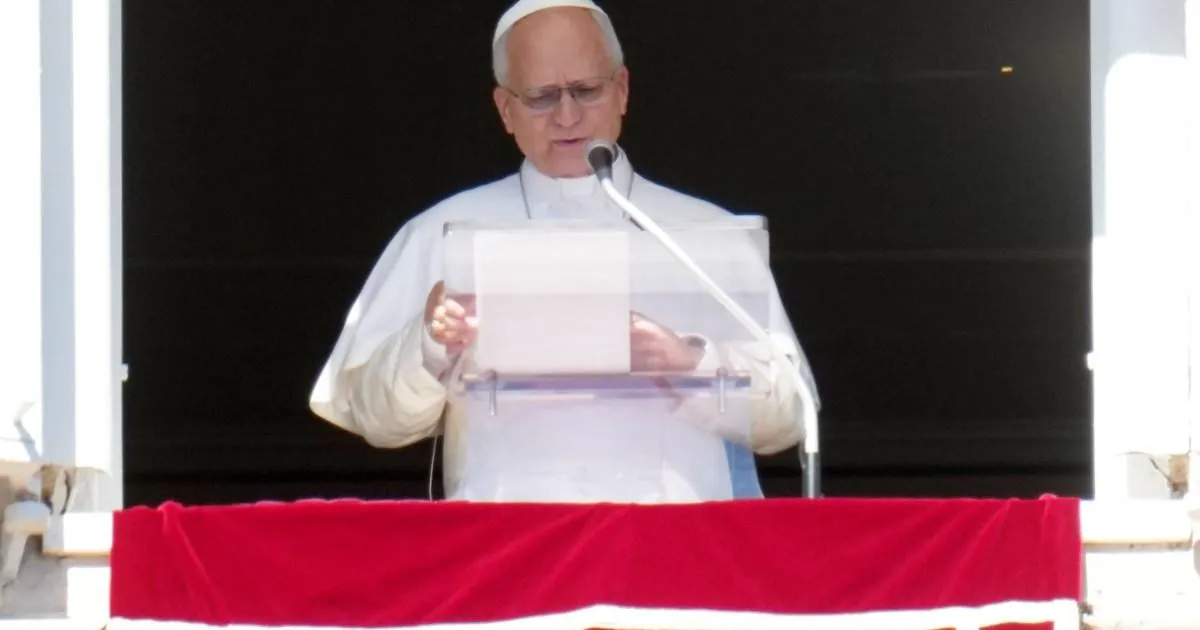
There was a hush that rippled through St. Peter’s Square on Sunday, a collective intake of breath that seemed to soften the usual chatter of pilgrims and tourists. Pope Leo, the 71-year-old pontiff who has already made history as the first American to lead the Catholic Church, stood before the crowd not with a message of geopolitical urgency or theological decree, but with something far more personal and human: the news that he would soon go under the surgeon’s knife. His voice was steady, but there was an unmistakable tenderness in his delivery as he explained that routine medical tests had uncovered a “localised nodule” in his lung. He used the word “localised” carefully, almost reassuringly, as if to tell the world that while this was serious, it was also contained. The nodule had been caught at a very early stage, he said, and the doctors were optimistic. They had advised intervention, and the Pope, in his characteristic blend of humility and practicality, decided to listen. “I have decided to undergo surgery to have it removed,” he told the crowd, before asking them not for applause or grand gestures, but simply for their prayers. It was a moment that stripped away the pageantry of the papacy and left behind a man facing a universal fear with remarkably honest grace. The crowd responded with a wave of applause and visible emotion, many people crossing themselves and murmuring prayers in a variety of languages. For a few minutes, the leader of the world’s 1.4 billion Catholics was just another patient about to place his life in the hands of medical professionals, and the vulnerability was both striking and deeply moving.
Paragraph 2: The First American Pope and His Road to Recovery
This announcement carries particular weight because of the unusual journey that brought this man to the Chair of St. Peter. Born Robert Francis Prevost in Chicago, he was named a cardinal by Pope Francis in 2023, and in 2025 he made history by becoming the first American ever elected to the papacy. For many American Catholics, his election felt like a long-awaited homecoming, proof that the heart of the Church could beat in the New World as strongly as in the Old. Now, just months into his pontificate, the Pope faces a health challenge that will test his physical resilience and, perhaps more importantly, his ability to remain a symbol of strength while lying in a hospital bed. The Vatican confirmed that the surgery would take place this week, and that the recovery period is expected to last roughly a week. That timeframe, while optimistic, is still filled with uncertainty. Lung surgery, even for a small nodule, is no small matter, and at 71, the Pope’s age is a consideration. Yet those who know him say he approaches this with the same practicality that marked his time as a missionary, a bishop, and a cardinal. He has always been a man who trusts in science, in medicine, and in the prayers of the faithful. He told the crowd that he “entrusts himself” to their intercessions, language that suggests both surrender and confidence. In the days since the announcement, there has been an outpouring of well-wishes from around the world, from world leaders to ordinary parishioners who remember him as a pastoral figure deeply concerned with the poor and the marginalized. The coming week will be a quiet one in the Vatican as the Pope steps back from the spotlight, but his presence in the hearts of the faithful will be anything but quiet.
Paragraph 3: A Strong Stance Against Capital Punishment
The surgery announcement, however, was not the only news emanating from the Vatican this past week. In a move that has reignited a fierce debate across the United States and beyond, Pope Leo took to social media to declare capital punishment “inadmissible,” a powerful echo and reinforcement of a stance that Pope Francis had previously made official Church teaching. The post was not written in legalistic language but in the direct, pastoral tone that has become characteristic of this pontiff. “The death penalty attacks the inherent dignity of a human being,” he wrote, adding that “the common good can be safeguarded and the requirements of justice can be met without recourse to capital punishment.” He went on to note that modern society has developed effective detention systems that protect citizens while still leaving the door open for redemption, even for those who have committed the most heinous crimes. The timing of this declaration was anything but coincidental. It came just days after the United States Department of Defense announced its intention to livestream the execution by firing squad of Nidal Malik Hasan, the former Army psychiatrist convicted in 2009 for the deadly shooting rampage at Fort Hood, Texas, which claimed 13 lives and wounded more than 30 others. The thought of a public execution being broadcast for all to see struck many as a return to a darker era, and the Pope’s words landed with the force of a moral thunderbolt. He did not mention Hasan by name, nor did he directly reference the Pentagon’s plan, but the subtext was unmistakable. The Pope was making a universal statement about the sanctity of life, even the life of a mass murderer, and in doing so he was placing himself in direct opposition to a growing movement in some parts of the United States to make executions more visible and performative.
Paragraph 4: The Controversial Case and the Question of Public Executions
The case of Nidal Malik Hasan is one of the most painful and complex in modern American history. In 2009, he walked into a processing center at Fort Hood, shouted “Allahu Akbar,” and opened fire on unarmed soldiers, killing 13 and wounding 32 others. The attack was later described as an act of domestic terrorism, and after a lengthy trial, Hasan was convicted and sentenced to death. For the families of the victims, the long wait for justice has been agonizing, and the prospect of seeing the sentence carried out has brought a mixture of relief and sorrow. But the Pentagon’s decision to livestream the execution represents a new and troubling frontier. Never before has a federal execution been broadcast live to the public, and critics argue that the move transforms a solemn act of justice into a macabre spectator event. The announcement also came in the shadow of a particularly botched execution in Tennessee, that of Christa Pike, a convicted killer who survived two attempted lethal injections, leaving some to question whether the system is capable of carrying out its duties with any semblance of dignity. Pope Leo, characteristically, did not wade into the specific details of these cases. He did not mention the botched lethal injections or the firing squad logistics. Instead, he elevated the conversation to the level of principle, reminding the world that no matter how terrible the crime, the state should not engage in the deliberate destruction of human life. His words were short, but they were potent, and they immediately placed the Vatican at the heart of a roiling American debate about vengeance, justice, and the limits of state power.
Paragraph 5: A Wave of Reactions from Clergy and World Leaders
The Pope’s statement did not go unnoticed by the hierarchy of the Catholic Church in the United States. Cardinal Pietro Parolin, the Pope’s top deputy and one of the most influential figures in the Vatican, had already spoken out forcefully, describing the planned public execution as “unacceptable” just hours before the Pope’s post. Then, Archbishop Paul Coakley, head of the United States Conference of Catholic Bishops, issued his own impassioned response, expressing “shock” and “great sorrow” at the Pentagon’s plans. Reading his words, one can almost feel the weight of his frustration and moral anguish. “In no way can Hasan’s actions be condoned,” Coakley said, carefully acknowledging the horrific nature of the crime before pivoting to his central point. “But this decision is a barbaric promotion of a culture of death and must be reconsidered.” He continued with language that was both powerful and prophetic, warning that “the public execution even of one who has done grave harm will only further undermine the moral fabric of our nation and be a blight on the conscience of its people.” Those words—”blight on the conscience”—seemed to capture the essence of the Church’s argument. The hierarchy is not asking for sympathy for Hasan; they are asking for something far more difficult: that the nation resist the urge to dehumanize even those who have committed terrible acts. The reaction from the broader Catholic community has been similarly divided but increasingly vocal. Some faithful are outraged, accusing the Pope of ignoring the suffering of victims and their families. Others see this as a prophetic moment, a reminder that the Church’s opposition to the death penalty is not a matter of political ideology but a fundamental belief in the dignity of every human soul, even a soul stained by murder.
Paragraph 6: A Defining Moment for a New Pontificate
Taken together, the Pope’s health crisis and his moral declaration create a portrait of a leader who is both fragile and formidable. In one week, he has asked the world to pray for his body, while boldly challenging the world to rethink its darkest impulses. It is a striking juxtaposition, perhaps even a divinely inspired one. Here is a man who may soon face his own mortality in an operating room, yet he is using his voice to remind us all that life, in every form, is precious and inviolable. His message about capital punishment is not merely a political stance; it is a deeply personal theology that speaks to the possibility of change, the reality of human weakness, and the astonishing reach of God’s mercy. As Pope Leo prepares for surgery, the prayers he has requested are not just for a successful operation, but for the strength to continue a papacy that promises to be as challenging as it is historic. He knows that being the first American pope means navigating a landscape where his authority is debated, his statements are scrutinized, and his health is watched with intense interest. Yet he seems undeterred. In the coming days, while he recovers in a hospital room, the world will wait with bated breath, not only for medical updates but for the next word from a man who has already shown that he is willing to speak uncomfortable truths. Whether he is lying in a hospital bed or standing on a balcony overlooking thousands of faithful, the message remains the same: human dignity is non-negotiable, redemption is possible, and in the end, love—not violence—must be the final word. The surgery may slow him down for a week, but if his first months in office are any indication, Pope Leo intends to use every remaining breath to push the Church and the world toward a more compassionate, life-affirming future.