

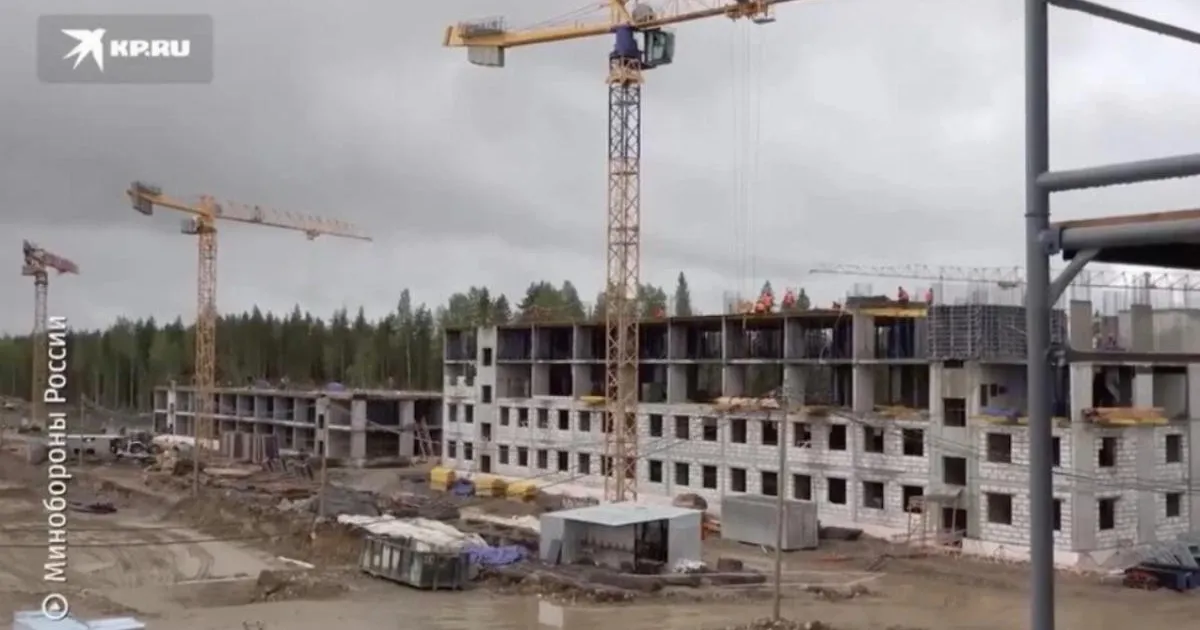
The geopolitical map in Northern Europe is shifting in ways not seen since the height of the Cold War. Recent satellite imagery has unveiled a striking development: Russia is actively constructing a sprawling new military base, situated uncomfortably close to the Finnish border. This marks the first major expansion of its kind since the collapse of the Soviet Union. Forest land, previously untouched, has been cleared to make way for a dozen new barracks, a move that serves as a physical manifestation of the rising tensions between Moscow and the West. When viewed from above, these clearings act as a stark reminder that the relative peace once enjoyed in this corner of the globe is being rewritten by the machinery of national defense.
Experts estimate that this new facility could eventually house between 4,000 and 6,000 military personnel. Marko Eklund, an astute observer and former Finnish intelligence officer, notes the magnitude of the project, though he offers a sobering perspective on its operational reality. He points out that building a modern, combat-ready force is not merely a matter of erecting walls; it requires immense time, capital, and the modernization of equipment that has, in some sectors, fallen into disrepair. While the barracks are a deliberate strategic statement, turning this site into a fully capable front-line threat will be a grueling, long-term logistical challenge for the Kremlin rather than an overnight transformation.
This infrastructure effort is not an isolated incident but part of a broader, more ominous pattern. Over the last two years, satellite reconnaissance has tracked a surge in military activity—including new aircraft hangings and housing installations—at four distinct locations near the frontier. In Kamenka, located just 35 miles from Finnish soil, nearly 130 structures have been identified, capable of supporting thousands of troops. These sites are being strategically prepared as potential staging grounds, suggesting that Russia is breathing new life into the Leningrad military district. While officially framed as defensive posturing, these developments are being closely monitored by NATO, which views them as the foundational layers for future regional power projection.
For Finland, these developments have forced a rapid and necessary hardening of their national security policy. Having officially joined NATO in response to Russia’s invasion of Ukraine, Finland transitioned from a position of historical neutrality to being a frontline member of the alliance. This change effectively doubled the length of NATO’s border with Russia, adding 830 miles of contact zone. In response, Finland has not only engaged in high-level military planning, such as the establishment of a new NATO forward command center in Lapland, but has also implemented physical deterrents, including a massive 10-foot-high steel fence topped with barbed wire to secure the most vulnerable transit points.
The tension, however, is not limited to troop movements and barbed wire; it is also unfolding in the “gray zone” of hybrid warfare. The Finnish government has frequently accused the Kremlin of weaponizing migration, alleging that Moscow orchestrated the arrival of over 1,300 asylum seekers from the Middle East to congest and destabilize the border region. Compounded by consistent reports of cyberattacks, these tactics have led to the total closure of the eastern border. While Vladimir Putin has publicly dismissed the notion of an attack on Finland as “total nonsense,” the optics on the ground tell a different story—one of a country preparing for a long, cold game of cat-and-mouse where the stakes are the security of Northern Europe.
Ultimately, these developments serve as a somber reflection of our current era, where the barriers between neighboring nations are hardening into iron and stone once again. As both sides dig in, the prospect of a return to the status quo seems increasingly distant. Finland, once an example of pragmatic diplomacy, now finds itself bracing against a neighbor whose military ambitions are growing in visibility and scope. Whether this buildup is a genuine preparation for a future conflict or a heavy-handed psychological tactic intended to intimidate the alliance, the reality remains the same: the quiet woods along the Finnish-Russian border have become the latest focal point in an escalating struggle for sovereignty and influence.