


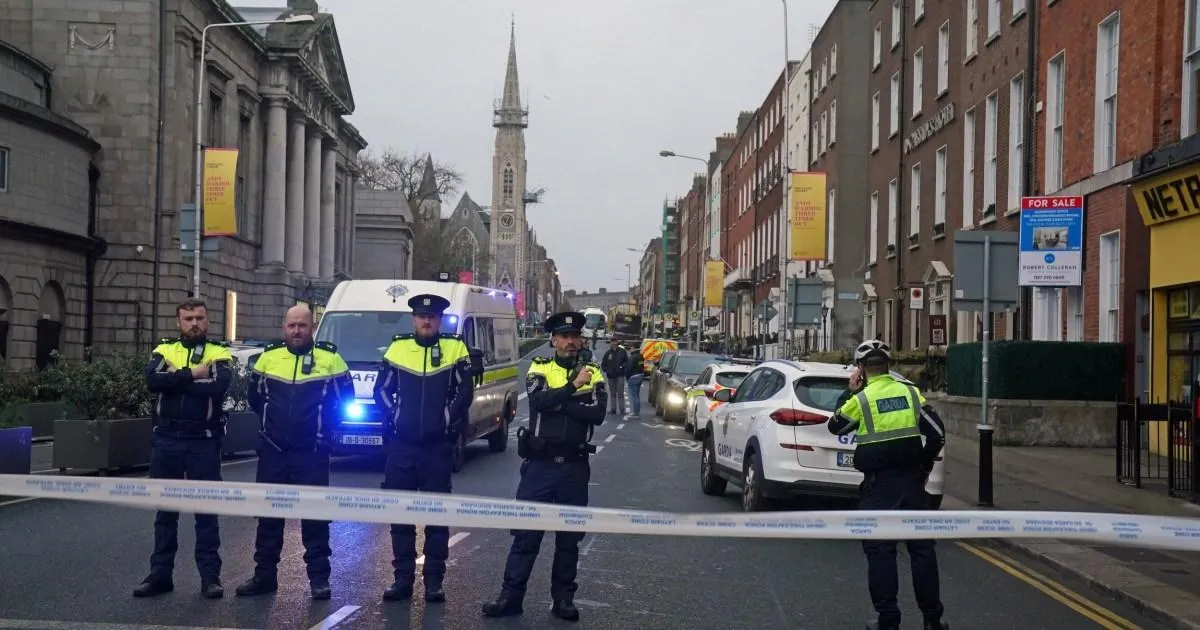
The aftermath of the horrific stabbing incident on Dublin’s Parnell Square last November remains a source of profound national sorrow, cast against a backdrop of deep legal proceedings. On November 23, 2023, what should have been an ordinary day outside the Gaelscoil Cholaiste Mhuire turned into a scene of unimaginable trauma. Three young children and a dedicated creche worker were violently attacked, an event that not only shattered the lives of the victims and their families but also triggered widespread civil unrest across the city. As the case against the accused, 52-year-old Riad Bouchaker, unfolds in the Central Criminal Court, the focus has shifted toward the harrowing testimonies of those who lived through the nightmare, forcing the public to confront the human cost of a day that changed the community forever.
For the mother of one of the five-year-old victims, that day began like any other, but ended in a desperate struggle to save her child’s life. In court, she recounted the frantic, breath-stealing moment she received a call from her daughter’s creche owner, hearing the agonizing plea to get to the school immediately. Upon arriving, she was met with a scene of chaos, spotting her daughter’s familiar pink backpack and tiny shoes cast aside on the pavement among the emergency teams. In an act of unbearable maternal restraint, she describes how she had to stand back, paralyzed by the realization that the professionals were the only ones who could intervene, forced to watch as they fought to keep her child alive in the wake of a brutal assault.
The medical reality of the young girl’s injuries highlights the sheer brutality of the attack. Following the stabbing, which caused a wound to her heart and deprived her brain of oxygen for nearly 40 minutes, the little girl was rushed into life-saving surgery. Her mother’s first words upon being allowed to speak with the surgical team were the heartbreaking question, “Is she dead?” The ensuing weeks were marked by the sterile, frightening hum of the intensive care unit, where the child remained under heavy sedation. It was a period defined by terrifying ambiguity, with doctors laboring to assess the extent of the brain damage sustained during those agonizing minutes when her body was failing, leaving a mother in a state of impossible limbo.
Today, the girl’s recovery is a slow, grueling journey that requires immense courage from both her and her family. Having celebrated her fifth birthday just before the incident, she is now forced to relearn the most fundamental aspects of existence. According to her family, the child is currently non-verbal, confined to a wheelchair, and is working to regain the basic ability to swallow. Her communication is now limited to blinking to signal “yes” or “no,” and her sleep is dictated by the reliance on necessary medication. This stark, daily reality serves as a painful reminder of the permanent shift in her trajectory, turning a vibrant child’s life into a sequence of intensive rehabilitation and quiet endurance.
As for the legal process, Riad Bouchaker, who is of no fixed abode, remains at the heart of the proceedings. He faces a long list of grave charges, including the attempted murder of the two young girls and the boy, as well as several counts of assault causing serious harm to the care worker who was caught in the violence. While the defense has entered pleas of not guilty to all charges—with claims that the accused was “not in his right mind” at the time—the testimony provided by the families serves to keep the human element at the forefront of the trial. The translation of these proceedings through an interpreter acts as a barrier, yet it cannot obscure the gravity of the 36cm kitchen knife used in the attack or the weight of the testimonies being shared.
The trial continues to cast a long shadow over Parnell Square and the wider Irish public. While the legal system works to determine accountability, the survivors are left with the quieter, more complex burden of healing, both physically and emotionally. The stories flowing from the courtroom provide more than just the facts of a crime; they offer a sobering reflection on the fragility of life and the immense strength required to move forward after a tragedy that no parent or child should ever have to endure. As the community continues to offer its support, the focus eventually returns to the girls and the boy who were targeted that day, waiting for the peace and normalcy that were stolen from them in a single, devastating afternoon.