

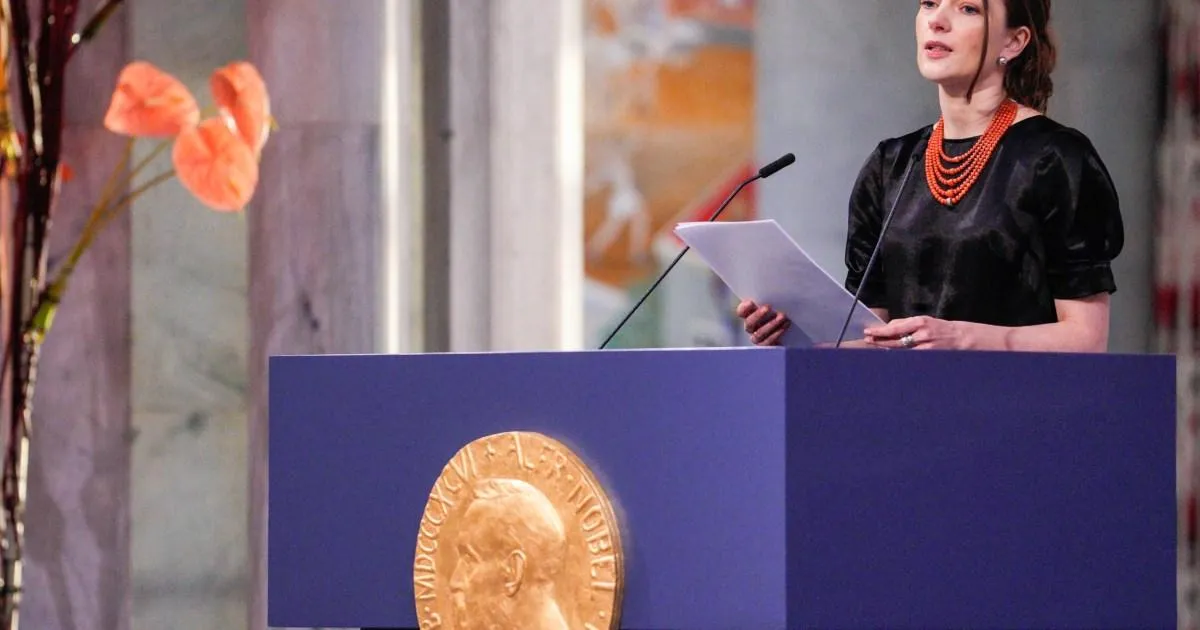
Behind the formal title of a Nobel Peace Prize laureate is a woman who has spent years listening to stories most people cannot bear to hear. Oleksandra Matviichuk, who leads Ukraine’s Center for Civil Liberties, shared the 2022 Nobel Peace Prize with Belarusian activist Ales Bialiatski and Russia’s Memorial society, an honor that recognized years of tireless, dangerous documentation of state violence and resistance. For Matviichuk, however, the prize was never a victory lap. It gave her a stronger platform to keep telling a painful truth. That truth now includes a devastating report titled Anatomy of Torture, compiled by the Center for Civil Liberties with support from the UK government, which alleges that Russian authorities have systematically weaponized doctors and medics against Ukrainian civilians and prisoners of war. This is not a claim about isolated malpractice or rogue individuals. The report describes medical professionals actively participating in a system of abuse: denying badly needed care to wounded and sick prisoners, using tasers inside prison cells, and even carving pro-Russian slogans into the bodies of unconscious soldiers. The idea of a white coat being used as an instrument of cruelty is deeply disturbing, and Matviichuk does not soften it. “We want to share this information to put pressure on Russia in order to save lives, because people are dying. People are dying,” she said. “Their conditions are inhuman and the treatment is beyond human imagination.” The repetition is not accidental. It is the sound of a woman who has spent too long in the company of suffering, and who knows that the world’s attention is one of the few forces that can still make a difference.
Among the testimonies gathered in Anatomy of Torture, one of the most harrowing comes from a man who told Matviichuk that he saw medical personnel only once during his entire imprisonment. He had lost consciousness while being tortured, and the medics were brought in not to treat his wounds but to give him an injection that would bring him back to consciousness. “The Russian medics were invited to give an injection and to return him to consciousness, to provide the opportunity to continue the torture process,” she said. The image is almost unbearable: a human body reduced to a broken object, temporarily patched up so that it can be broken again. Another story involves a Ukrainian soldier who woke from an operation to discover that his body had been turned into a billboard. With a surgical tool, someone had carved the words “Glory to Russia” into his skin. The scars were deliberate, ideological, and deeply personal. After returning to Ukraine through a prisoner exchange, the soldier has had to endure another operation, not to repair a bullet wound but to remove this slogan from his flesh. Matviichuk described the process as “very painful and long-lasting.” The physical suffering is obvious, but the emotional violation is harder to measure. To be marked and branded like livestock is to be told that your body no longer belongs to you, that even your skin is territory your enemies can occupy. These are not abstract legal violations. They are attacks on the very idea of personhood, carried out by people who took an oath to heal.
Matviichuk is insistent that these incidents are not isolated. She describes them as systemic, pointing to testimonies collected over twelve years, since the Russian invasion of Crimea in 2014. The Center for Civil Liberties has built a careful method for capturing the truth: interviewing people who have returned from Russian prisons, speaking with relatives who are still under occupation, analyzing open-source data, videos, and social media, and cross-checking every sign of captivity. The report is supported by the UK government and written by four experts based at the Center, but behind the footnotes are real lives. Matviichuk’s frustration is visible when she talks about the scale and confidence of the crimes. “And Russians are very brutal. They are not even hiding their crimes,” she said. That phrase is chilling. The cruelty is not hidden in secret archives; it is visible in the testimony of survivors, in the scars left on their bodies, in the patterns of neglect and abuse. The fact that the perpetrators feel no need to hide suggests a deep sense of impunity. They act as though no one will ever hold them accountable, and as long as the international community remains at a distance, that assumption is hard to challenge. Matviichuk and her colleagues are trying to make it impossible to ignore. Each testimony is a small piece of a much larger structure, and structure is what turns individual acts of cruelty into crimes against humanity.
Perhaps the darkest symbol of this system is the man who has become known as “Doctor Evil” in the Russian Republic of Mordovia. The report includes testimony from prisoners who describe a medical professional arriving at their cell, pretending to offer help while actively participating in torture. One witness described the scene in almost absurdly theatrical terms: the cell door opens, the doctor hits the person reporting to him and the person on duty, then says, “Patient, what’s wrong with you? Patient, come here, give me your hand.” When the prisoner offers a hand, he is hit with a taser. Only then does the doctor give him a pill. Another prisoner described the same doctor’s role in making sure the person stayed alive during torture, not out of compassion but so that the suffering could continue. Ukrainian human rights group KHPG identified this doctor as Ilya Sorokin, and the Security Service of Ukraine charged him in absentia in December last year. But as Matviichuk noted, there is “no possibility to physically arrest him because he is in Russia.” The law, at least for now, has limits. That is why the Center for Civil Liberties has sent several submissions to the International Criminal Court in The Hague, asking prosecutors to open a case based on these crimes against humanity. Matviichuk is under no illusion about speed. International justice moves slowly, and many victims cannot wait. But she continues to build the record, because one day, when the political situation changes, evidence will be the only thing that matters.
In the meantime, Matviichuk is pushing for actions that can save lives today. She has called on the International Committee of the Red Cross to be given full access to all illegally detained civilians and prisoners of war in Russia. She has also proposed the creation of a special medics commission that could be sent to Russia to gain access to people in detention, a bold idea that would place medical professionals not on the side of state power but on the side of their patients. And she is appealing to doctors, nurses, and healthcare workers around the world to react publicly to the behavior of their Russian colleagues, whether those colleagues are being forced into this role or participating willingly. A global mobilization of medical professionals, she argues, could have a “chilling effect” on Russian behavior, because exchanges and cooperation with the outside world still matter. Last week, the Center for Civil Liberties led an open appeal to the World Health Organization, joined by a number of other NGOs, institutions, and groups, asking the WHO to intervene. The letter invoked the WHO’s “unique expertise and international capacity to draw attention to violations of the right to health, uphold international standards of medical care, and help ensure that the principles of healthcare and medical ethics remain in force even in situations of armed conflict.” When approached for comment, the WHO declined to respond. Silence, in this context, is also a signal. For Matviichuk, the world’s institutions were created precisely for moments like this. If they do not act, their words mean nothing.
This is not only a matter of war crimes and legal arguments. It is a test of what humanity is willing to tolerate. Matviichuk’s work is rooted in a simple conviction: a prisoner is still a person, a wounded soldier is still someone’s child, a person who has been tortured has the right to be healed, not used. The report’s title, Anatomy of Torture, is clinical, but its contents are achingly human. It documents how institutions created to care for people can be twisted into institutions that destroy them, and how the final, terrible irony is that those who are supposed to save lives are turned into torturers. Matviichuk’s own Nobel lecture in 2022 was not about celebrating the prize; it was about the people whose names are never known. She continues to gather their stories, not because she believes the world will change overnight, but because silence makes the horror worse. She asked the world to put pressure on Russia, to make clear that the treatment of Ukrainian prisoners and civilians is being watched. The call to open a case at the International Criminal Court, the demand for Red Cross access, the appeal to the World Health Organization—all of these are attempts to translate individual suffering into collective responsibility. The task is enormous, but Matviichuk and her colleagues have spent twelve years proving that persistence is a form of courage. Perhaps in the end, that is the message of Anatomy of Torture: even in the darkest corners of human cruelty, there are people who dare to look, and who refuse to let the world look away.