



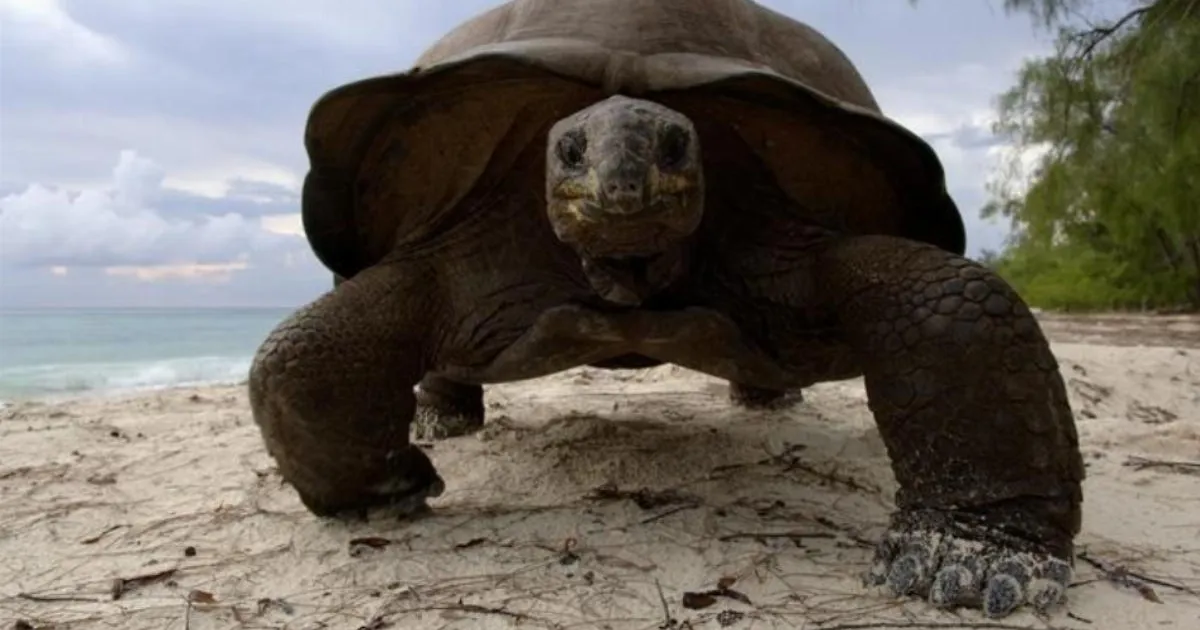
On a remote coral atoll in the Indian Ocean, something extraordinary is happening: giant tortoises are quietly taking over. Aldabra Atoll, part of the Seychelles, is now home to more than 180,000 Aldabra giant tortoises, the largest free-roaming population of these gentle giants anywhere on Earth. They amble through sun-baked grasslands, rest in the shade of dense scrub, and wade through mangrove edges with a patience that seems to belong to another era. These slow-moving, hard-shelled reptiles are not just surviving; they are thriving, and their numbers now outstrip the human population of the Seychelles, an archipelago nation of roughly 100,000 people. Just a few decades ago, this outcome would have seemed impossible. During the 19th century, heavy exploitation by sailors and settlers pushed the species to the edge of extinction, with fewer than 1,000 tortoises left on Aldabra. Now, a major new study has revealed that the population has reached its highest recorded level, with researchers estimating almost 183,000 adult and sub-adult tortoises. The only other place in the world where giant tortoises still live in the wild is the Galapagos Islands, and their population there is far smaller. For conservationists, this is not just a statistic; it is a spectacular reversal of fortune, proof that a species once written off can be brought back from the brink when people refuse to give up on it.
The new figure comes from a five-year monitoring effort carried out between 2018 and 2022 by the Seychelles Islands Foundation and the University of Exeter. It is the first comprehensive estimate to cover the entire atoll, and the first major update to the widely cited population figure of around 100,000 tortoises that had stood since the late 1990s. The findings were published in the scientific journal Ecology and Evolution, and they offer the clearest picture yet of just how many tortoises call Aldabra home. But the researchers were careful to explain that the higher number does not mean the tortoise population has nearly doubled over the past two decades. In fact, much of the apparent increase may simply be a more accurate count. Earlier surveys were limited by Aldabra’s dense and varied vegetation, which made it easy to miss tortoises that were hiding in thick scrub, mangrove swamps, or shaded patches. To overcome this problem, the team used a statistical method called Bayesian hierarchical distance sampling, a powerful modelling technique that allowed them to estimate not only the tortoises they saw, but also the tortoises they did not see. By accounting for differences in visibility across different habitats, they produced a far more reliable baseline for the species. In other words, the researchers counted what was there, and then they modelled what might have been hidden—and together, those numbers paint a rich and hopeful picture of life on Aldabra.
This is a story about patience, persistence, and the quiet power of long-term conservation. Aldabra’s tortoises were once devastated by human activity, and by the late 19th century their population had collapsed to fewer than 1,000 individuals. The recovery did not happen overnight. It took decades of protection and careful management, beginning with Aldabra being designated a strict nature reserve in 1981 and then a UNESCO World Heritage Site in 1982. Those legal protections gave the tortoises a safe haven, free from the pressures that had nearly wiped them out, and allowed the population to slowly rebuild generation after generation. Dr Frauke Fleischer-Dogley, chief executive of the Seychelles Islands Foundation, said the results demonstrate the value of sustained conservation efforts. She described how the monitoring data was collected by SIF staff who live and work on the atoll year after year, and she called the presence of more than 180,000 giant tortoises roaming freely on Aldabra “proof of what long-term commitment to conservation can achieve.” Her words carry real weight because Aldabra is not an easy place to work. It is remote, wild, and often unforgiving, and the people who study there have dedicated enormous chunks of their lives to watching over these ancient animals. Their dedication, combined with strong legal protection, has turned a near-extinction story into one of the Indian Ocean’s greatest conservation success stories.
Of course, counting giant tortoises on an island covered in dense vegetation is no simple task. The study found that tortoises are most heavily concentrated in areas of open grassland that the researchers affectionately call “tortoise turf,” followed by open, exposed areas and patches of open mixed scrub. In these open spaces, the tortoises are relatively easy to spot from a distance, their dark domed shells standing out against the green and brown landscape. But the same cannot be said for other parts of the atoll. In dense scrub, mangrove forests, and areas dominated by Pemphis, a thick coastal shrub, the tortoises become almost invisible, blending into the shadows and disappearing beneath layers of leaves and branches. Dr Nancy Bunbury, a co-author of the study, explained that Aldabra’s giant tortoise monitoring programme is one of the longest running in the region, but the dense vegetation really does make counting tortoises difficult in places. She added that by modelling what they did not see as well as what they did, the team had produced the most reliable baseline yet for this iconic Seychelles species. That baseline is crucial because it gives future researchers a fixed point against which they can measure changes in the population for decades to come. Without that level of scientific rigour, it would be all too easy to misinterpret raw counts and draw the wrong conclusions about whether the tortoises are actually increasing, declining, or staying the same.
Yet, despite the encouraging numbers, the study’s authors were quick to warn that the tortoises of Aldabra are not out of danger. The population appears stable and healthy today, but it faces mounting environmental threats that could undo decades of progress. Climate change is one of the biggest concerns. Longer and more frequent droughts are expected to hit Aldabra in the coming years, and these dry spells could reduce the availability of food and fresh water, while also reducing the shade that helps the tortoises escape the heat. Rising sea levels are another serious risk, particularly for the atoll’s low-lying areas, where rising waters could flood nesting sites and destroy critical habitat. Invasive species add yet another layer of pressure. Feral goats once caused severe damage to Aldabra’s vegetation, but they were successfully eradicated in 2012, a major victory in its own right. However, feral cats and black rats continue to prey on tortoise eggs and hatchlings, keeping the population from growing even faster than it already has. The researchers believe that eradicating these remaining invasive mammals could remove some of the biggest barriers to further population growth and make the tortoises more resilient in the face of climate change. In other words, the hard work is far from over. Protecting Aldabra’s tortoises requires constant vigilance, and the very forces that once pushed them to the brink are evolving into new challenges that demand new solutions.
For now, though, there is plenty of reason for hope, and the study offers a powerful reminder of what conservation can achieve when it is given the time and resources to succeed. Dr Dave Hudson, a postdoctoral research associate at the University of Exeter’s Cornwall campus who helped develop the statistical modelling framework, said the results are great news for the tortoises and a testament to the fantastic work done in the field. But he also stressed that the numbers should be seen as a starting point, not a finish line. “It’s important to remember that the numbers provide a baseline – not an endpoint,” he said. His hope is that the evidence will give conservation managers the tools they need to track future changes and act early as the tortoises face increasing pressures from climate change, drought, and invasive species. That is exactly the right way to think about this remarkable comeback. The Aldabra giant tortoise is not just a survivor; it is a symbol of resilience, a living reminder that even the slowest creatures can make an extraordinary recovery when they are given the chance. The tortoises of Aldabra have been wandering this Earth for millions of years, and thanks to the dedication of the people who study and protect them, they will likely be wandering for millions more. Their future is not guaranteed, but for the first time in a long time, it looks bright.