


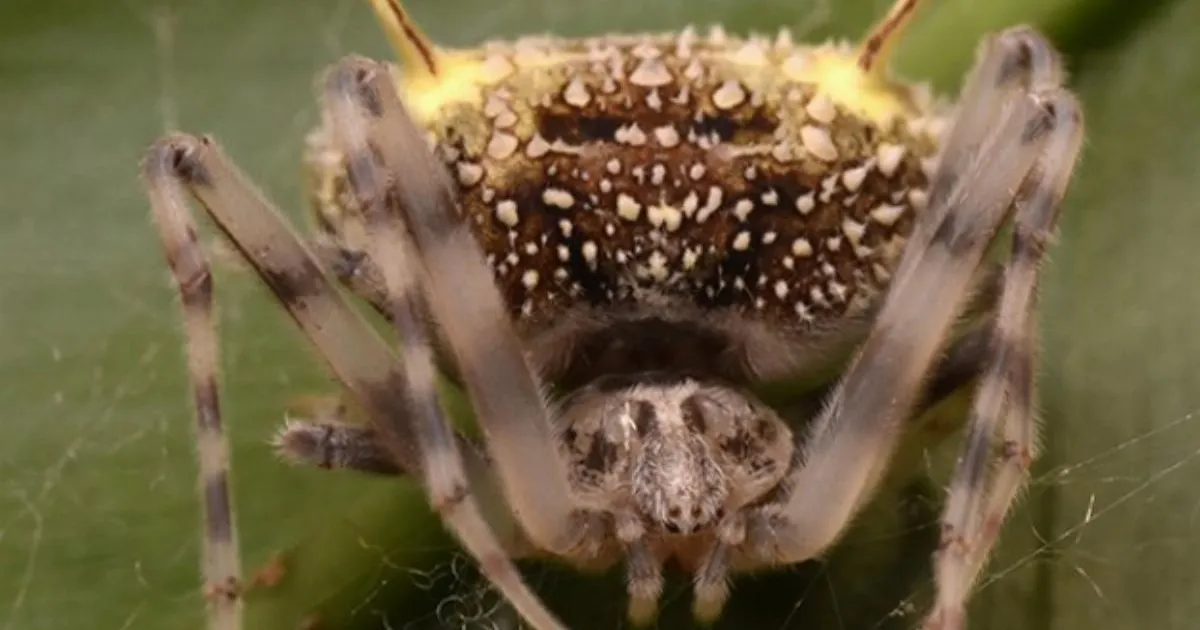
In the dense, emerald tapestry of the Ecuadorian Amazon—specifically within the Llanganates-Sangay Corridor—nature has unveiled a trick so sophisticated it feels like science fiction brought to life. Scientists have officially identified a new spider species, Taczanowskia waska, which has evolved a survival strategy that feels unsettlingly familiar to fans of The Last of Us. Much like the cordyceps fungus that famously hijacks the nervous systems of its hosts in popular culture, this tiny spider has mastered the art of disguise by mimicking the very thing that usually spells doom for its kind: a parasitic fungus. During a night-time expedition, researchers were initially fooled, mistaking the creature for a harmless fungal growth on a leaf until a closer look revealed the remarkable truth.
The brilliance of this camouflage lies in its commitment to deception. The Taczanowskia waska possesses an abdomen adorned with elongated, pale structures that perfectly replicate the texture and aesthetic of a Gibellula fungus. To complete the ruse, the spider spends its time motionless on the undersides of leaves—the exact habit and habitat where these parasitic fungi are typically found. Evolution, in its ruthless pursuit of efficiency, has turned the spider into a living “look-alike,” allowing it to hide in plain sight. By mimicking a pathogen that is avoided by predators and disregarded by potential prey, this spider has developed perhaps the ultimate “do not disturb” sign in the insect world.
This discovery is significant not just for its novelty, but for what it represents in the annals of evolutionary biology. Researchers note that this is the first documented case of a spider deliberately mimicking the parasitic fungi that prey upon its own kind. It is a bold, high-stakes game of bluffing; by appearing to be a sick, decaying organism, the spider manages to bypass the traditional predator-prey dynamic. Predators generally bypass infected individuals to avoid contagion, and prey may not recognize the spider as a sentient threat until it is far too late to escape an ambush. It is an evolutionary masterclass in turning a natural hazard into a protective cloak.
The tale of how this spider was identified is as modern as the biology itself. The discovery didn’t begin in a sterile laboratory, but on iNaturalist, a citizen science platform where nature enthusiasts share their findings. When a photo of the “fungus-spider” was uploaded, it triggered a heated debate among amateur naturalists and observers who could not decide if they were looking at a mushroom or an arachnid. This public intrigue eventually reached the ears of the international scientific community, including experts from the Leibniz Institute for the Analysis of Biodiversity Change (LIB), leading to a formal investigation that confirmed the organism was indeed a rare and previously unknown species.
Experts like Nadine Dupérré, a researcher at the Museum of Nature Hamburg, emphasize that this find highlights a shift in how we explore our planet. By combining historical scientific collections with fresh data provided by digitally connected citizens, researchers were able to classify the spider and place it within the context of the rare Taczanowskia genus, about which very little was previously known. It is a potent reminder that the age of exploration is far from over. Instead of focusing solely on distant lands, we are increasingly finding the most fascinating frontiers in our own backyards, helped along by the collective curiosity of the global public.
Ultimately, the Taczanowskia waska serves as a humbling reminder of the extraordinary ingenuity hidden within the world’s tropical ecosystems. It exposes the vast gaps in our current understanding of biodiversity and suggests that millions of other survival strategies may be hiding in the shadows of the Amazon. As we continue to lose species at an alarming rate, this little spider stands as a testament to the importance of protecting these fragile corridors of life. Through international cooperation, technological integration, and a healthy dose of public curiosity, we are finally beginning to read the complex, high-stakes stories written into the bodies of the creatures with whom we share this planet.