



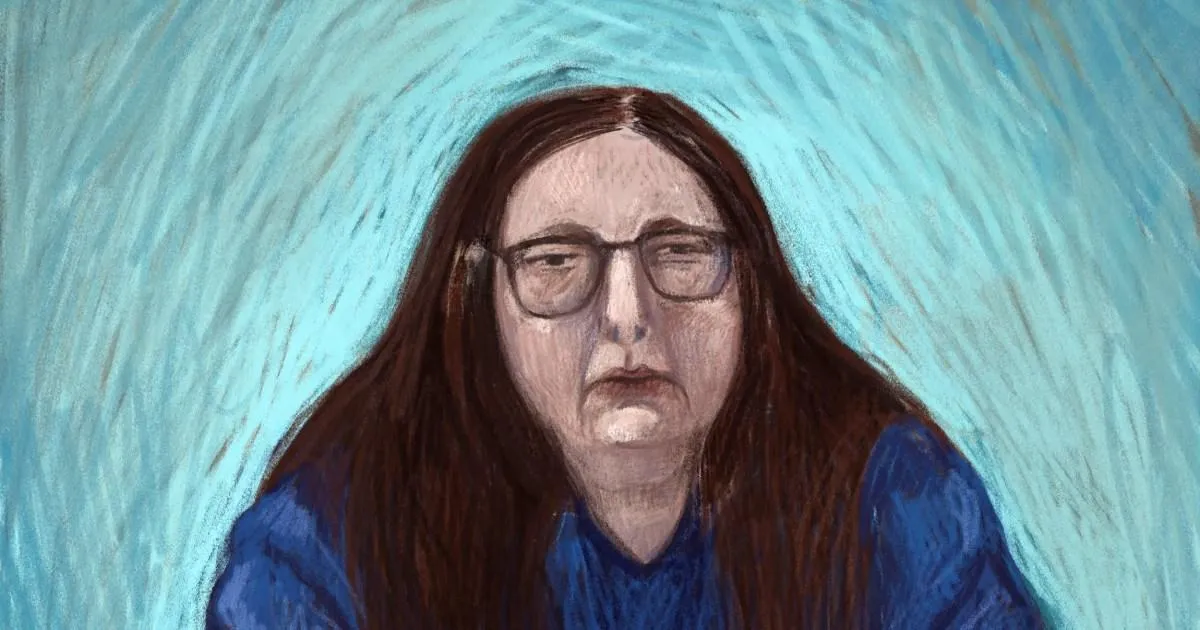
From a prison video link, Erin Patterson watched in silence as her lawyers gathered around a judge to fight for her freedom. A new courtroom sketch, released during the latest hearing in her appeal, captured the moment in striking, quiet detail: a woman in a dark prison-issue top, her face carefully composed, appearing on a screen in an Australian courtroom, thousands of miles from the small town where her life changed forever. Patterson, who was convicted of murdering three members of her estranged husband’s family with a poisonous beef Wellington, is now asking a higher court to overturn the verdict and the life sentence that came with it. Her legal team did not mince words. They told the court that her trial was unfair, so flawed that it should never have resulted in a guilty verdict. The appeal, they argued, rests on a basic principle at the heart of any legal system: justice needs to be done, but it also needs to be seen to be done. During the hearing, her lawyers were seen arguing with the judge about whether certain points of the appeal were “fair,” and Patterson watched the exchange without visible emotion. For her, the appeal is not just another legal step; it is a last, desperate hope to walk free. For the families of the dead, it is another painful chapter in a nightmare that began with a meal and ended with three funerals. And for the wider public, the case remains a dark, fascinating lesson in how a normal family gathering can become a scene of unimaginable horror.
The tragedy began in July 2023 in Leongatha, a quiet rural town in Victoria, Australia, where Patterson invited her estranged husband’s parents and extended family to her home for lunch. The meal was a beef Wellington, a dish of pastry-wrapped beef fillet, but it was not the beef that would prove fatal. Hidden within the layers of pastry and meat was a mushroom duxelle, a finely chopped mixture of mushrooms, and somewhere in that mixture were death cap mushrooms, among the most toxic fungi on Earth. Four people sat down to eat that day: Don Patterson and Gail Patterson, Patterson’s parents-in-law; Gail’s sister, Heather Wilkinson; and Heather’s husband, Ian Wilkinson. Within days, three of them were dead. Don, Gail, and Heather died in hospital after suffering catastrophic organ failure, their bodies overwhelmed by the poison. Ian survived, but only after spending weeks in intensive care, and he continues to live with lasting physical and emotional damage. The lunch was supposed to be a chance for family to reconnect, or at least an ordinary Sunday meal, but it became a crime scene, a medical mystery, and then one of the most talked-about murder trials in Australian history. The victims were not strangers; they were grandparents, parents, siblings, and in-laws. They were part of Patterson’s family by marriage, even if that marriage had collapsed. The question that would haunt the trial was not whether the mushrooms killed them, but whether Patterson knew exactly what she was serving and intended for her guests to die.
Now Patterson is fighting to overturn her conviction, and her lawyers have built their appeal on several distinct and serious grounds. The first involves what they call a “catastrophic” mistake that happened during the trial itself: the jury, the prosecutors, the witnesses, and even some journalists involved in the case were all staying at the same hotel. In a case as emotionally charged and heavily publicized as this one, the defence argues, that arrangement created an unacceptable risk of prejudice and contamination. Jurors may have overheard conversations, seen witnesses in the elevator, or been influenced by the presence of journalists and lawyers in ways that should never have been allowed. It is impossible to know what was said or seen in those casual moments, and the defence believes that lack of separation poisoned the entire trial. The second ground is about evidence that never made it into the courtroom. Patterson’s lawyers argue that key evidence which could have exonerated her was “wrongfully excluded” by the judge, forcing her to testify in her own defence when she might not have otherwise done so. That evidence included photographs from 2020 showing Patterson’s interest in foraging for mushrooms. The judge in the case ruled the photographs inadmissible, but the defence insists they were vital to painting a fuller picture of Patterson as someone who had a genuine, innocent hobby of collecting wild mushrooms, not as a cold-blooded poisoner plotting to kill her in-laws. With that evidence missing from the trial, the jury was left with a much narrower and more incriminating story. At the heart of the case, however, was a simple but terrible question: did Patterson serve the meal knowing the mushrooms were death caps, and did she intend for her guests to die? No one disputed that she served the mushrooms or that the pastries killed her guests. The only real issue was her state of mind, and that made the fairness of the trial and the availability of the evidence all the more important.
Prosecutors painted a chilling picture of premeditation. They said Patterson foraged poisonous death cap mushrooms sometime before the lunch, dehydrated them, and then used them in the mushroom duxelle that sat between the beef and the pastry. They argued that she had carefully planned the meal, not to impress her guests, but to eliminate them. One of the most striking details in the trial was that Patterson did not cook one large beef Wellington, as would be expected for a family meal. Instead, she cooked individual beef Wellingtons, one for each guest. Her explanation was simple: she said she could not find a single “log” of beef fillet at the butcher. Prosecutors, however, saw it as a deliberate ploy, a way to ensure she controlled exactly who was eating what, and to make sure she herself did not eat the poison. The court was told that Heather Wilkinson, one of the victims, noticed Patterson eating from a “noticeably different” plate than everyone else at the table. Heather apparently mentioned her concern to Patterson’s estranged husband after she began feeling unwell. That small observation would later become a haunting clue. Prosecutors also pointed to Patterson’s behaviour after the lunch as evidence of guilt. They said she lied that the food had made her sick too, in order to avoid suspicion. The day after her guests were hospitalised, she went to the hospital herself and said she felt unwell, but she discharged herself without treatment. She then told health authorities that she had used dried mushrooms bought from an Asian grocer, and later told police she had been “very helpful” in cooperating with their investigation. But perhaps the most damaging piece of evidence came a week after the meal, when Patterson dumped a food dehydrator allegedly used to dry the death caps used in the dish. She admitted dumping the appliance, but claimed she had “panicked” after her estranged husband accused her of using it to poison his parents. For the defence, the case was not a planned murder but a “terrible accident.” Patterson denied all charges, insisting she had no idea the mushrooms were deadly and that the tragedy was the result of a horrifying mistake. But the jury did not believe her, and after weeks of evidence and deliberation, they found her guilty of murder.
Behind the legal arguments, however, there is a human story that no court verdict can easily resolve. Three people went to lunch and never came home. Don and Gail Patterson had raised their family, shared their lives, and expected to grow old together; instead, they died side by side in a hospital, their bodies shutting down from a poison hidden in a home-cooked meal. Gail’s sister, Heather Wilkinson, was a beloved wife, mother, and sister who had simply been visiting family that day. Her husband, Ian, survived, but the life he knew was shattered. He spent weeks fighting for his life, and even after he was discharged, he continued to carry the scars of that meal, both physically and emotionally. The Patterson and Wilkinson families have been torn apart, not only by the loss of their loved ones, but also by the awful knowledge that the woman who served the food was part of their own extended family. Patterson’s estranged husband lost both his parents and his aunt in a single afternoon, and the grief of that loss is compounded by the betrayal of someone he once knew intimately. And then there is Patterson herself. Whatever the truth of her intentions, her life is now defined by this case. She sits in a prison cell, appearing in courtrooms by video link, her face captured by artists, her story told and retold in newspapers and online. In a strange way, all the people connected to this case are prisoners of that day in Leongatha. The community, too, has been changed forever. A small town where people knew one another, where home-cooked meals were a sign of trust, now has to live with the knowledge that a lunch table can become a place of death. No verdict, however just, can bring back Don, Gail, and Heather. No appeal, however careful, can undo the pain that their families have endured. The best that anyone can hope for is that the legal process at least arrives at a truth, and that the system itself is seen to be fair.
As the appeal unfolds, the wider public is watching with a mixture of fascination and unease. Patterson’s lawyers are not asking for sympathy; they are asking for a new trial, or for the conviction to be quashed, on the grounds that the original trial was so flawed that it cannot be trusted. This is not an argument about whether Patterson deserves punishment, but about whether the punishment was imposed in a way that was just. The phrase “justice needs to be done, but it also needs to be seen to be done” has become the central theme of the appeal, and it resonates far beyond this single case. In a democracy, public confidence in the courts matters as much as the outcome of any individual trial. If the jury was staying in the same hotel as prosecutors and witnesses, if key evidence was kept out of the courtroom, if Patterson was forced to testify because the evidence was unfairly excluded, then the integrity of the verdict comes into question. The judges now hearing the appeal must weigh all of that. They must decide whether the mistakes were serious enough to overturn a conviction for a crime as serious as murder. For the families of the victims, the appeal is another ordeal. They have already lived through the trial, heard the details of how their loved ones died, and watched Patterson be led away to prison. Now they must do it all over again, reliving the horror in a new courtroom, hoping that the appeal will not reopen old wounds without any real resolution. At the same time, Patterson has the right to challenge her conviction, and the appeal court has the duty to listen. The law exists to protect everyone, even those accused of terrible crimes, because if the process is not fair, then the justice it produces is not justice at all. Whatever the final decision, one thing is certain: there will be no easy ending. The appeal will not bring back the dead, and it will not erase the memory of that fatal lunch. It will only decide whether the previous trial was conducted with enough fairness to stand, and whether Erin Patterson will remain in prison or be given another chance to defend herself in front of a new jury. In the end, the call is not just about one woman’s guilt or innocence. It is about whether the justice system can hold itself to the standard it promises: not only punishing the guilty, but protecting the innocent, and making sure that in every case, the truth is not just hidden behind closed doors. Patterson’s future now lies in the hands of judges who were not in the room when the jury made its decision, but who must decide whether that decision was fair. For everyone involved, the waiting continues, and the search for justice, or at least for an end to the nightmare, goes on.