

The island of Sazan, a rugged relic of the Cold War situated at the mouth of Albania’s Bay of Vlorë, has recently found itself at the epicenter of an unlikely cultural and environmental flashpoint. Once a restricted military zone, this strategically positioned island is now the focus of international controversy following plans by Ivanka Trump and her husband, Jared Kushner, to transform the site into a high-end luxury resort. Backed by substantial investment from Saudi Arabian interests, the project has sparked an intense uprising known as the “Flamingo Revolution.” For many locals, this isn’t just about a hotel; it represents a deeper struggle over who gets to define the future of their landscape and whether the interests of global investors should supersede the rights of local citizens.
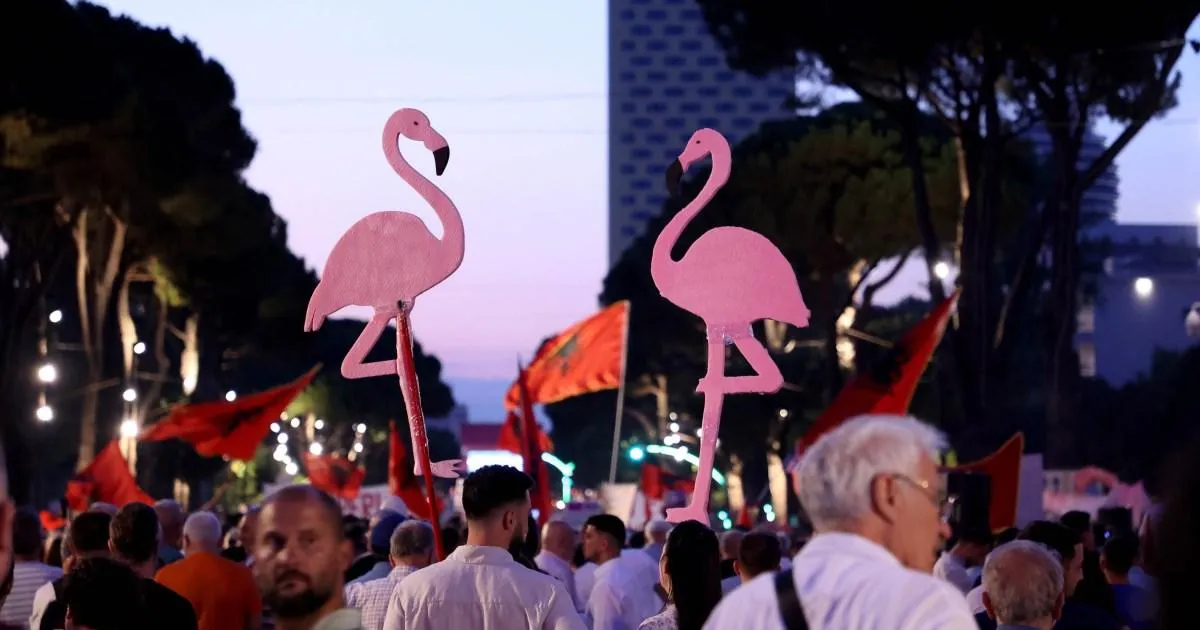
At the heart of the outcry is the island’s delicate ecological identity. Sazan is home to one of Europe’s last remaining wild river deltas, a sanctuary for critically endangered species like the Balkan lynx and the elusive Mediterranean monk seal. More visibly, the island serves as a vital habitat for thousands of pink flamingos, which have morphed into a symbol of resistance for protesters standing against the encroaching construction. Environmentalists and local residents argue that the proposed development would irreparably damage this fragile ecosystem. The sight of newly erected fences cutting off access to what was previously public land has only fueled the sentiment that the soul of the island is being sold to the highest bidder at the expense of its natural heritage.
Transparency, or the lack thereof, has been a defining frustration throughout this saga. Aleksandër Trajçe, representing the Protection and Preservation of the Natural Environment in Albania (PPNEA), has been vocal about the systemic exclusion of the public from the planning process. Activists have highlighted that no legitimate public consultations have taken place, nor has sufficient documentation been provided to explain how such a massive project was greenlit in a protected landscape. For these conservationists, the demand is clear: halt the construction, dismantle the fences, and respect the rule of law. The lack of clarity surrounding the land acquisition has been so profound that the nation’s anti-corruption office has launched an formal investigation into how the deal bypassed traditional public tender protocols.
The situation has created a profound political crossroads for the Albanian government and Prime Minister Edi Rama. Rama has attempted to strike a conciliatory tone, suggesting to the media that the core challenge is not to “pour concrete over the heads of flamingos,” but to foster a symbiotic relationship where development and environmental preservation coexist. However, this rhetoric has failed to quell the unrest. Citizens, weary of the government’s shift toward favoring high-end, luxury tourism, have taken to the streets in protest. The “Flamingo Revolution” has become a release valve for broader public anger regarding land access, economic disparity, and the government’s recent legislative changes that permit “five-star” developments within environmentally sensitive protected areas.
The tension between global commerce and local stewardship was further highlighted when Ivanka Trump spoke on a recent podcast, noting that developers must avoid imposing themselves on a culture and should instead seek to understand a country in a “meaningful way.” For many Albanians, these words feel disconnected from the reality of bulldozers and exclusion zones that have appeared on their shores. Experts like Melitjan Nezaj, an environmental biologist, argue that the project is fundamentally destructive, deliberately targeting some of the most intact and valuable wetlands remaining in the Mediterranean. To those who value the island as a natural treasure rather than a real estate opportunity, the project is a fundamental violation of the public interest.
As the standoff continues, the island of Sazan stands as a stark case study in the modern struggle for environmental justice. Whether the project will proceed as planned or be forced into a radical redesign remains uncertain. What is clear is that the people of Albania are no longer willing to silently watch their natural landscapes being partitioned off. For protesters chanting, “Sazan belongs to the Albanian people,” the island is a testament to the idea that some things, like biodiversity and public sovereignty, are far too valuable to be traded for the convenience of global luxury tourism. The world is watching to see if the flamingos—and the people who protect them—will win this fight.