



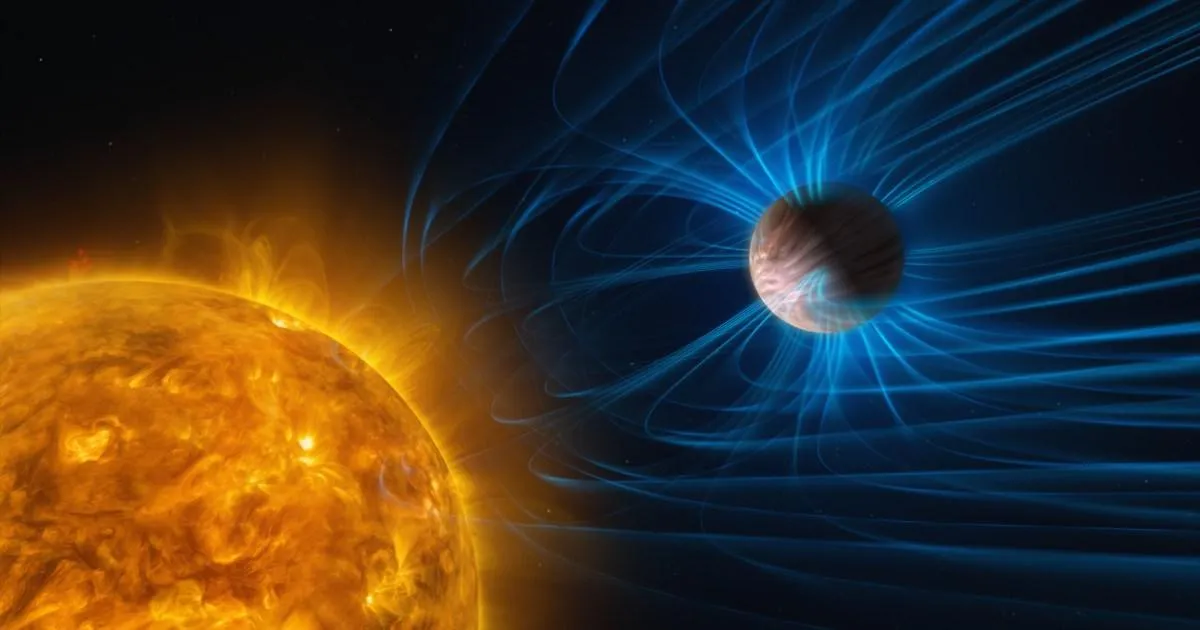
Astronomers have finally cracked one of the most persistent mysteries in space exploration: the existence of magnetic fields on planets outside our own solar system. While we have long understood that magnetic fields are fundamental to the safety and stability of Earth—acting as an invisible shield against harsh space weather—detecting these same invisible forces on distant, alien worlds has remained frustratingly out of reach. Recently, a team of researchers using the Very Large Telescope in Chile and the Gemini North telescope in Hawaii managed to bridge this gap. By observing seven massive, scorching “hot Jupiter” exoplanets, they discovered the first robust evidence of magnetism in deep space, a major leap forward that changes our fundamental understanding of how planets evolve and behave.
The journey to this discovery began quite unexpectedly. The research team wasn’t initially setting out to map magnetic fields; they were fascinated by the extreme weather patterns on these seven gas giants. Because these planets are “tidally locked”—meaning they are permanently caught in a stare-down with their host star, with one side constantly baking in daylight while the other remains frozen in perpetual night—they experience massive atmospheric turbulence. The heat difference between these two sides drives blistering winds, some reaching speeds of up to 25,000 kilometers per hour. When the scientists started mapping these winds, they noticed something that defied their scientific intuition: the hotter the planet, the slower the winds tended to be.
This realization sent the team into a period of deep investigation, as the laws of thermodynamics suggested that hotter planets should theoretically possess more energy to whip up even faster gales. Since the data showed the exact opposite, the researchers had to look for a “braking” mechanism. They concluded that only a powerful, global magnetic field could exert enough drag on the charged particles in the atmosphere to slow these massive winds down. By calculating this braking effect, the team was able to estimate the magnetic strength of these distant worlds. Remarkably, these fields proved to be quite substantial—in some cases, roughly half the strength of Jupiter’s own magnetic field.
Humanizing this finding, we can start to picture these alien worlds in a much more vivid way. It isn’t just about cold data points and astronomical charts; it’s about understanding the environment of these distant giants. On Earth, we marvel at the northern and southern lights, those ethereal curtains of green and purple light triggered by our own magnetic field interacting with solar wind. Scientists believe that these distant, extreme planets likely host their own version of these cosmic light shows. These findings suggest that beneath the chaotic, high-speed winds of these gas giants, there are silent, powerful magnetic forces shaping a sky that might be filled with dazzling, intense auroras unlike anything we have ever witnessed firsthand.
This discovery serves as a vital turning point, opening a new window into the study of exoplanets. As lead author Julia Seidel explained, being able to compare the magnetic environments of other worlds is a “key step” in our search for habitable territory. A magnetic field is essentially a prerequisite for a stable, long-term climate; without one, a planet is often left vulnerable to the erosion of its atmosphere by its host star. By identifying how these fields function on gas giants, we are slowly building the tools necessary to gaze at smaller, rocky, Earth-like planets to see if they, too, possess the magnetic protection required to keep their water and potentially foster life.
Looking ahead, the horizon is filled with even more promise. With the next generation of equipment, such as the Extremely Large Telescope, astronomers hope to transition from studying massive gas giants to identifying atmospheric signatures on smaller, terrestrial worlds. There is something profoundly poetic about the mission ahead:, using sophisticated physics to verify the invisible shields that preserve the conditions for life. As Bibiana Prinoth, one of the study’s co-authors, noted, it is easy to imagine these distant worlds not just as alien gas balls, but as vibrant, dynamic environments where vast, colorful light displays dance across a planet defined by its eternal divide between day and night.