



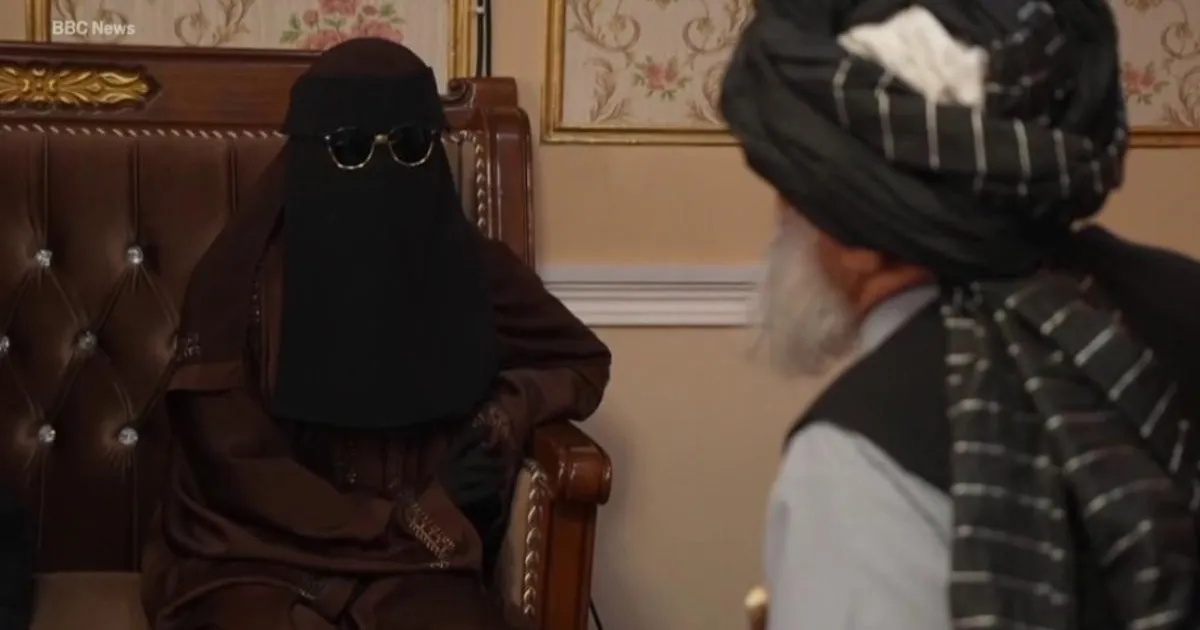
In a cramped provincial office in northern Afghanistan, a young woman barely out of childhood sat hidden beneath a floor-length veil and dark sunglasses, her voice trembling but her words ferociously clear. She was 18 years old, and she had come to ask a Taliban governor for something that should have been unremarkable: the right to leave her husband. Instead, she was met with disbelief, mockery, and a room full of men who laughed at her pain. The year is 2025, and Afghanistan is entering its fifth year under Taliban rule after the militant group seized Kabul in August 2021 as American and NATO forces withdrew. In that swift collapse, the Western-backed government crumbled, and with it, nearly every safeguard that women and girls had managed to build over two decades. Suddenly, girls were locked out of classrooms beyond the sixth grade, women were barred from most jobs, and the modest public freedoms they had won were stripped away one by one. In this climate of institutionalized cruelty, one unnamed young woman in the province of Jawzjan decided she would rather face execution than continue living with a man she said had beaten and abused her for months. Her desperate plea for a divorce, witnessed by the BBC, captures in a single scene the terrifying reality of being female in Taliban-run Afghanistan: a place where even the most basic right to bodily autonomy is treated as a crime, and where the men who hold power respond to a woman’s suffering with condescension, laughter, and contempt.
The details of her story are harrowing. The young woman, whose real name has been withheld for her protection, told Taliban Governor Abdullah Sarhadi that she had endured abuse and beatings for months. Sitting before the governor, she did not beg. She asserted. “If there was any chance to live together, I wouldn’t be here… I have taken my decision,” she said. Then, in words that should have silenced every man in the room, she added that she was “ready to be executed but not live with him.” This was not hyperbole. For a woman in Afghanistan under the Taliban, defying a husband is not merely a personal dispute; it is a challenge to the entire patriarchal order. The governor, Abdullah Sarhadi, is himself a veteran of the Taliban’s insurgency and is said to have been detained by the United States at Guantanamo Bay for years. That history only deepens the irony of the scene: a man once held in one of the world’s most infamous prisons now sat in judgment over an 18-year-old girl who was asking for freedom. The BBC’s cameras captured the encounter, and the image is almost unbearably stark. The woman is entirely covered, her face hidden, her voice coming from somewhere behind the veil. The governor is surrounded by men, bodyguards and officials, all of them part of the machinery that decides whether she has the right to exist independently. And yet she spoke with a dignity that none of them seemed able to recognize.
Rather than take her suffering seriously, Governor Sarhadi tried to coax her back into the marriage by appealing to the very concepts of shame and honour that had already been weaponized against her. “Ask yourself: ‘Who would marry me after I get my divorce?’” he told her, as if her value as a human being were entirely dependent on being claimed by one man after another. “You’ll have to compromise a lot or you’ll lose your dignity and honour.” It was a cruel, circular logic: she should stay with a man who beat her because leaving would make her undignified in the eyes of men. But the young woman refused to be silenced. “Mr Governor, my honour and dignity have already been ruined,” she replied. The statement lands like a thunderclap. She was telling the governor that he and his system had already stripped her of whatever protection those words were supposed to offer. What more could she lose? The governor, however, was unmoved. According to the BBC, he responded by remarking that women are “mindless” and “deficient in intellect,” and his words were met with laughter from the male officials, bodyguards, and others gathered around him. There is no more direct illustration of the Taliban’s worldview than this: a woman pleads for safety, and the men in power laugh. Meanwhile, her husband sat nearby, waiting for his turn to speak, listening as his wife’s fate was debated as though she were property with a voice that did not matter.
The economic dimension of her predicament makes the situation even more tragic. In Afghanistan, divorce is rarely a simple legal matter; it is deeply entangled with money, family honour, and the interpretation of Sharia law. Under that law, a woman who requests a divorce may be required to return the dowry that was paid to her family when she was married. In this case, the husband demanded four times the original dowry amount, a sum that her family refused to pay. And so the governor attempted a compromise that reveals how hollow the justice system has become: he suggested that the woman be given her own room in the marital home, and he instructed that the husband should not beat her “or otherwise he’d be jailed.” It is difficult to imagine a more grotesque solution. The woman had said she would rather die than live with her abuser, and the official response was to offer her a separate bedroom. There was no acknowledgment of her right to safety, no recognition that a man who beats his wife is a criminal, and no path toward freedom that did not require her to pay a ransom to the man who had terrorized her. Her family later told the broadcaster that they would try to obtain a divorce through the Taliban courts, but under the rules imposed by the regime, a woman cannot easily dissolve a marriage without the consent of her husband. The law, if it can be called that, is stacked against her at every turn.
This single story is not an outlier; it is the everyday reality for millions of Afghan women and girls. Since returning to power, the Taliban has issued dozens of edicts that systematically erase women from public life. Girls have effectively been banned from attending school beyond the sixth grade, an act of intergenerational violence that will take decades to undo. Only an estimated 7 percent of Afghan women work, compared to 84 percent of men, leaving women economically dependent and trapped in their homes. According to UN Women, around one in two Afghan women leaves her home no more than twice a month, so confined that the outside world has become almost unreachable. Women are blocked from gyms, parks, and many other public spaces. The regime has made it more difficult for women to leave marriages, and in doing so has implicitly allowed child marriage to continue; in 2023, almost 30 percent of Afghan girls under 18 were married, including 10 percent of girls under 15. Access to healthcare has also eroded under Taliban rule, and the country now suffers one of the world’s highest maternal mortality rates, with women dying in childbirth because they cannot get help in time. Each statistic represents a daughter, a sister, a human being with dreams and fears. For Afghan women, the Taliban’s return has been a slow-motion catastrophe, a suffocation of possibility that is measured not only in laws but in the haunting stillness of empty schools and the silence of women who no longer leave their homes.
In the end, the 18-year-old woman in Governor Sarhadi’s office is more than a symbol. She is a reminder that the Taliban’s rule is not an abstract political issue but a lived horror made of flesh and bone, of women locked in homes, of girls forced into marriages, of teenagers who must choose between endurance and death. Her decision to stand before the governor and speak, even as the men around her laughed, is a testament to a courage so profound it defies language. She knew she might lose. She knew the room was hostile. She knew that her fate would likely be decided not by justice but by power. And yet she spoke. She asked for the simplest of things: the right to control her own life, to refuse a man who hurt her, to be seen as more than an object in someone else’s honour. The governor’s mockery—“mindless,” “deficient in intellect”—was not a reflection of her intelligence but of his own brutality, and of the system he represents. For five years, the world has watched Afghanistan fall backwards into a nightmare, and for five years, Afghan women have continued to resist in small and extraordinary ways. Their resistance takes many forms: a girl studying in secret, a mother teaching her daughter to read, a young woman who dares to ask for a divorce knowing that the answer may be laughter. The international community has been largely powerless, or unwilling, to do anything meaningful. But stories like this one must not be forgotten. They must be told, and retold, until the men who laugh are forced to hear the echoes of their own cruelty. Because the woman in that room was not insane or simple. She was right. And her dignity, despite everything, was never really lost. It was simply beyond the reach of anyone who could not see it.