


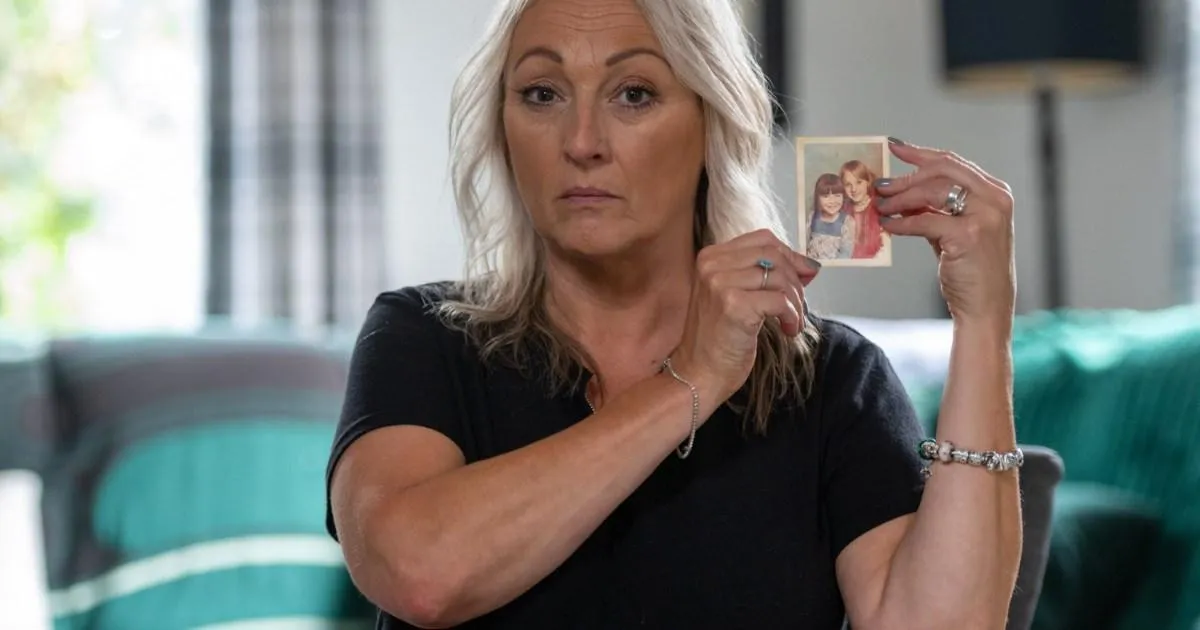
For more than two decades, the Carrick family has lived inside a nightmare that refuses to end. When Gemma Simpson vanished in May 2000, she was just 23 years old, a young woman from Leeds with her whole life stretched out before her. For fourteen agonizing years, her family held onto the faint and fading hope that she might somehow be found alive. But the truth, when it finally emerged in 2014, was more monstrous than any of them could have imagined. Gemma had been killed in the very first days after her disappearance by a man named Martin Bell, who had just been released from a psychiatric hospital. He had struck her with a hammer, stabbed her in the back and the back of the head, and, after realizing she was still alive, left her lying face-down in a bath for days before dismembering her body and burying her remains at Brimham Rocks, a beloved National Trust beauty spot. Now, with Bell potentially moving into open prison conditions ahead of possible release, her sister Naomi Carrick has issued a desperate and terrifying warning: she believes with all her heart that Bell will kill again. Naomi’s voice trembles with more than grief; it carries the weight of a family failed by the justice system, a sister who has spent half her life fighting for accountability, and a woman who lives just ten miles from the man who took her sister’s life in the most brutal way imaginable.
The details of that May 2000 attack are almost impossible to process, and yet Naomi has had to carry them with her every single day. Bell convinced Gemma to come to his flat in Harrogate, a town that now sits uncomfortably close to Naomi’s home in Otley, West Yorkshire. He had been released from psychiatric care just days before, and something inside him had turned violently against her. He would later claim that God had told him to kill her, a delusion that formed the basis of his legal defense. But before that claim would ever be tested in a courtroom, Bell did something that still chills anyone who hears the case: after hitting Gemma with a hammer and stabbing her repeatedly, he realized she was still breathing. Instead of showing mercy, instead of calling for help, he dragged her into the bathroom and left her on the cold floor, face-down in the bath, where she lay for days until death finally came. Then he dismembered her body and scattered her remains in one of the most scenic and peaceful locations in North Yorkshire. For the next fourteen years, as Gemma’s family searched, prayed, and grieved, Bell moved to Scarborough, became a taxi driver, and lived what Naomi describes as a completely ordinary life. He attended to customers, drove through the streets, and went about his days as if he had never lifted a hammer against another human being. The sheer cognitive dissonance of that reality—a man capable of such unspeakable violence simply sliding back into normal society—remains one of the most haunting aspects of this case.
The confession came out of nowhere in July 2014, when Bell walked into a police station in Scarborough and calmly told officers that he had killed Gemma Simpson and where he had buried her. It was a moment that should have brought closure, but for the Carrick family, it only opened a deeper wound. A psychiatric assessment diagnosed Bell with a psychotic mental illness, and rather than facing a murder trial, he was allowed to plead guilty to manslaughter on the grounds of diminished responsibility. Leeds Crown Court heard how he had told Gemma that God wanted him to kill her, and in December 2014, he was sentenced to life imprisonment. But the minimum term was set at just twelve years, later reduced to eleven years and 205 days to account for time already spent in custody. For Naomi, that sentence was an insult to her sister’s memory and a betrayal of everything the family had been promised. She says they knew from the moment he was charged with manslaughter rather than murder that he would never do significant time. And now, with the Parole Board recommending in 2025 that Bell be moved from a closed jail into open conditions ahead of his eligibility for release, her worst fears are materializing. She has written what she calls a “pleading letter” to the then Justice Secretary Shabana Mahmood, begging her to stop the transfer. But the machinery of the prison system is grinding forward, and Naomi feels powerless to stop it.
Naomi’s fear is not abstract or distant. It is a fear that lives in the space between her front door and the local supermarket, in the quiet streets of Otley, in the knowledge that Bell’s crimes took place in nearby Harrogate and that he could, if granted day release from open conditions, be moving through the same world she and her family inhabit. She has been warned that open conditions often come with day release privileges, and the thought of accidentally coming face-to-face with the man who slaughtered her sister is enough to make her blood run cold. But more than her own safety, Naomi is terrified for the wider public. She has said plainly, “I honestly believe it could happen again. It terrifies me to think of how many people we’ve got walking around in society like that – just so they can free up spaces in prison. He is capable of stabbing, hammering and dismembering someone – and then moving on with his life for 14 years.” Those words are not the rhetoric of vengeance; they are the assessment of a woman who has watched the system fail her sister from the very beginning. She and her family have been left in the dark about Bell’s mental state, about the progress he is said to have made, and about the evidence that supposedly shows he is safe to reintroduce into society. She argues that a man who did what Bell did, and then concealed it for fourteen years without a flicker of guilt, is not someone who can be rehabilitated with a few years of therapy and good behavior. To Naomi, the Parole Board’s decision feels like a technical box-ticking exercise, a cold assessment of risk that treats her sister’s life as a statistic and Bell’s future as a project.
The Parole Board, for its part, insists that its decisions are made with public safety at the center. Its panels consider the original offence, the prisoner’s conduct in jail, reports from probation officers, prison staff, psychiatrists, and psychologists, and victim personal statements. The theory is that open prison conditions act as a bridge to gradual reintegration, allowing long-serving prisoners to prove they can be trusted with more freedom before release. But to families like the Carricks, that theory has never accounted for the human cost. Every time a decision-maker looks at Martin Bell and sees a man who has served his minimum term and deserves a second chance, they are asking Naomi to relive her sister’s murder all over again. They are asking her to accept that a man who hammered and stabbed a young woman, watched her die, dismembered her body, and then went on with his life for fourteen years, should be allowed to walk the same streets as her nieces, her friends, her community. Naomi has said that she feels failed from the very beginning, and it is impossible to argue with that. She was 26 when Gemma disappeared; she is now in her late forties. Her sister’s remains were hidden in the ground for longer than Bell has spent behind bars. The imbalance is staggering. Bell has served his time, at least nominally, but Gemma will never come back. She will never laugh, never grow old, never have children. Her life was not a sentence to be measured in years; it was a whole universe of potential that was snuffed out by a man who now sits in a cell waiting for the next step toward freedom.
What makes this story so deeply human is not just the horror of the crime, but the stubborn, aching love that refuses to let it be forgotten. Naomi Carrick is not a politician or a legal expert; she is a sister who still carries her grief in every word she speaks. She has spent years trying to get someone in power to listen, to understand that Martin Bell is not a theoretical case study in rehabilitation. He is a man who committed one of the most depraved acts imaginable and then demonstrated an almost chilling ability to compartmentalize it and move forward. In her pleading letter, in her interviews, in her quiet insistence that Bell will kill again, Naomi is speaking for every family that has ever felt ignored by the justice system. She is asking society to recognize that public safety is not just about risk assessments and open prison places; it is about believing survivors and victims when they say something is wrong. She is asking for Gemma to be seen not as a case file, but as a daughter, a sister, a friend, a 23-year-old woman whose life was stolen in a bathroom in Harrogate. And she is asking, perhaps in vain, for the people in charge to look at Martin Bell and see what she sees: a man capable of unimaginable violence, who has already shown that he can hide it from the world for more than a decade. Whether the Parole Board or the Justice Secretary will listen remains to be seen. But Naomi’s warning is clear, and it comes from the deepest place of love and fear. She does not want revenge. She wants what every family of a murder victim deserves: the simple, fundamental assurance that the person who destroyed their lives will never be given the chance to do it again. As Bell’s potential release draws closer, her voice grows more urgent, a final desperate plea to a system that has already let her down too many times. Gemma Simpson cannot speak for herself anymore. Her sister is doing it for her, hoping against hope that someone, finally, will hear her before it is too late.