


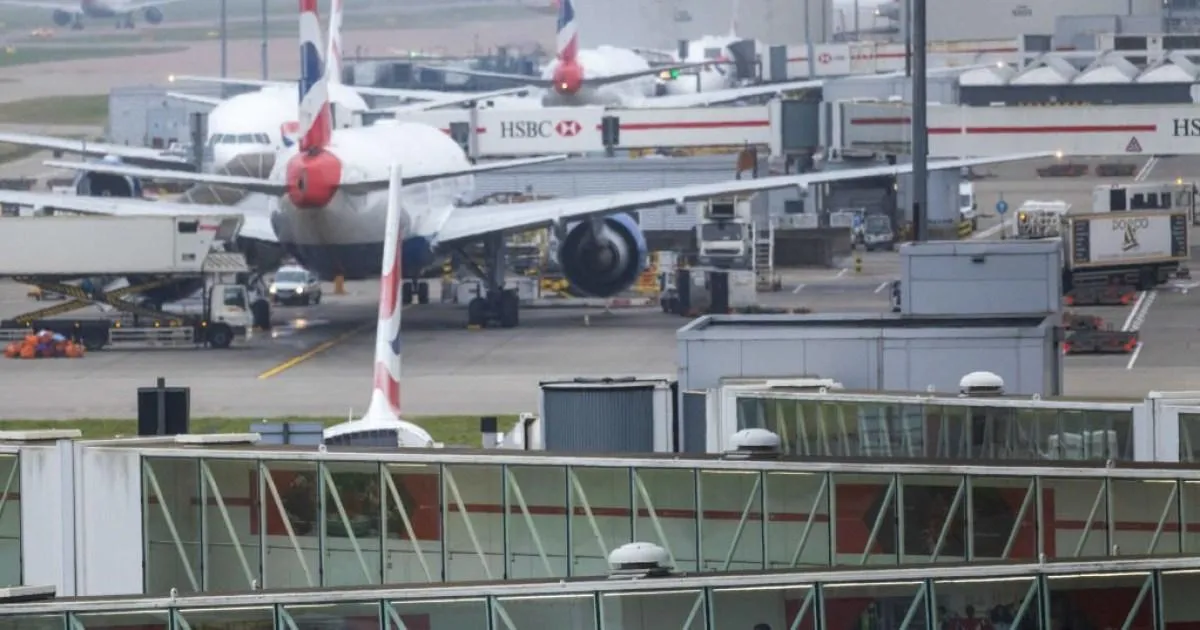
The peak of the summer holiday travel season took an unexpected and stressful turn at London’s Heathrow Airport this evening, as a rapidly spreading grass fire forced an emergency shutdown of one of its primary runways. For thousands of passengers, what was meant to be the start of a well-earned vacation or a smooth business trip turned into an evening of uncertainty, as the sight of flames licking at the perimeter of the UK’s busiest travel hub necessitated immediate action. The fire, which broke out shortly after 5:30 p.m., quickly consumed roughly one hectare of grassland, forcing authorities to ground aircraft and effectively paralyze half of the airport’s operational capacity.
The atmosphere at the terminal was undoubtedly tense as the Southern Runway (S7L) was cordoned off to allow emergency responders to address the blaze. The London Fire Brigade, working in tandem with the airport’s own specialized fire teams, arrived with impressive speed, managing to bring the situation under control within just half an hour. While the swift containment of the fire prevented a much larger catastrophe, the impact on airport logistics was immediate and severe. Heathrow’s reliance on its dual-runway system means that even a minor disruption can ripple outward; with one runway out of commission, the airport was forced to divert incoming flights, leaving those on the ground facing a cascade of delays and cancellations.
For passengers caught in the fallout, the evening became a frustrating exercise in patience. Airlines, most notably British Airways, were forced to ground a string of departures to major European hubs including Marseille, Geneva, Lisbon, and Frankfurt. Even as the airport announced that both runways had resumed full operations, the “knock-on” effect remained very much alive. In the aviation world, a disruption of this nature is never truly over the moment the fire is extinguished. Because crews and aircraft are governed by strict legal time limits, once a schedule is shattered, it becomes a mathematical puzzle that often results in the total cancellation of services, leaving travelers scrambling to rebook flights or find accommodation.
This incident serves as a stark reminder of the fragile nature of modern air travel, where a small patch of burning grass can cause international disruption. For the passengers left staring at departure boards showing “Cancelled” in red letters, the primary concern shifted from their original destination to the complexities of their legal rights. Understanding these rights is essential in moments of chaos: under UK regulations, passengers facing long delays or cancellations are entitled to specific support, including food, drink, and, in some cases, overnight accommodation. However, the legal definition of “extraordinary circumstances”—which often includes events like fires or strikes—can make claiming additional financial compensation a complex, and often unsuccessful, endeavor.
The legal framework surrounding flight disruption is designed to protect consumers, yet it remains a source of frustration for those stuck in limbo. If a flight is cancelled, passengers are entitled to choose between a full refund or a replacement flight, along with a duty of care from the airline. However, the nuance lies in the cause of the disruption. While the airport and the fire brigade were successful in their rapid response, the reality for the traveler is often a long wait at a customer service desk. It is a vital lesson for any frequent flyer to keep a record of all expenses and receipts during such events, as these documents are the only leverage a passenger has when seeking reimbursement for the costs incurred by an unexpected and uncontrollable emergency.
Ultimately, while Heathrow and the fire services deserve credit for their decisive response, the incident serves as a poignant example of the volatility of summer travel. The sight of flames near the tarmac was a dramatic end to the afternoon, and while the fire was short-lived, the emotional and logistical toll on passengers will linger for much longer. As the dust—and smoke—settles, the focus now shifts to the recovery efforts of the airlines involved, as they work to clear the backlog and get thousands of stranded passengers to their final destinations. It is a sobering reminder that, regardless of how sophisticated our aviation technology becomes, we remain entirely at the mercy of the environment and the unexpected challenges it can pose to our global connectivity.