

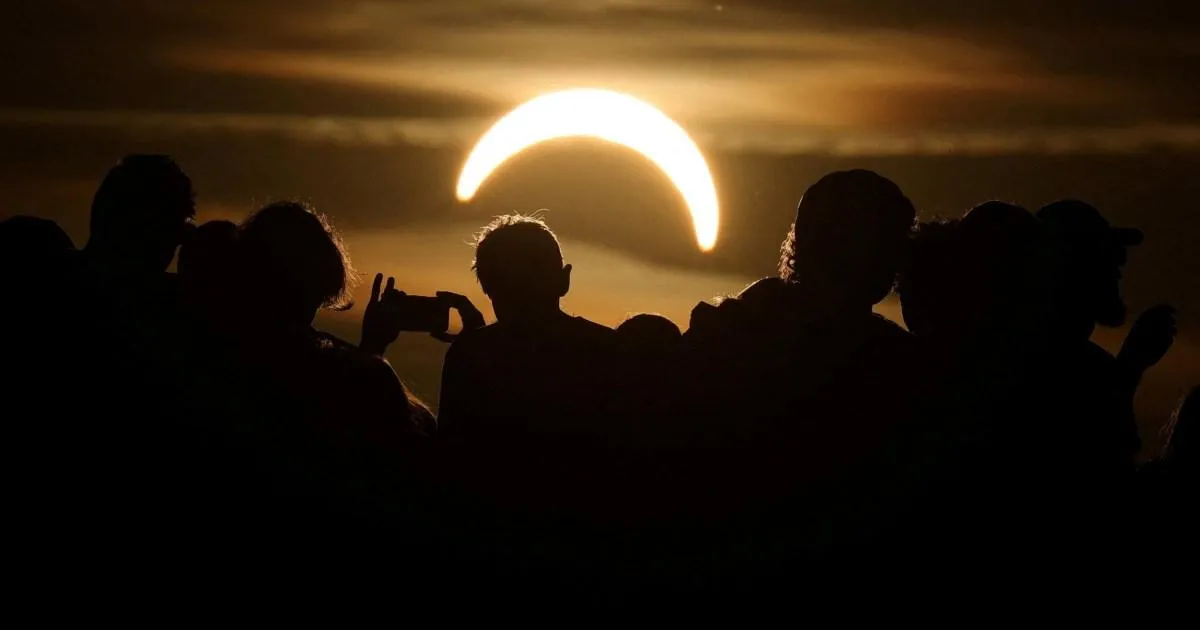
On the evening when the skies put on a spectacle that had been decades in the making, the United Kingdom turned its collective gaze upward. The 2026 solar eclipse, an event widely heralded as the most significant since 1999, transformed ordinary streets, parks, and gardens into impromptu observatories. As the moon began its slow, deliberate passage across the face of the sun, obscuring more than 90% of its brilliant disc, a collective hush mixed with gasps of awe rippled through the crowds. This was not merely a celestial alignment; it was a communal moment of wonder, a rare interruption to the monotony of daily life that reminded everyone of the vast, silent ballet happening in the void above. The anticipation had been building for weeks, but as the light began to take on an otherworldly quality, it was clear that reality would far surpass any expectation. For a few precious hours, the mundane concerns of the world were eclipsed by the sheer majesty of the cosmos, uniting strangers in a shared experience of pure, unadulterated awe.
The methods of viewing were as varied as the people who had gathered. On every patch of grass and pavement, small groups huddled around makeshift contraptions, desperate for a safe glimpse of the phenomenon. The most prudent had purchased special eclipse glasses days in advance, and they wore them with a certain reverence, looking like a tribe of curious insects with their cardboard-framed eyes. Others, having heeded the relentless warnings from experts, employed the classic pinhole projector method, using cereal boxes and sheets of white card to project a tiny, perfect replica of the eclipsed sun onto the ground. Children ran their fingers through the dappled light under trees, giddy to discover hundreds of tiny crescent shadows dancing at their feet. The humble colander became an unlikely hero, its many holes casting a constellation of suns onto the patio. Meanwhile, photographers, professional and amateur alike, stood behind their tripods, their expensive glass lenses pointed skyward, each click of the shutter a desperate attempt to capture a moment that felt both profound and fleeting. The air was thick with a mixture of excitement and concentration, a shared determination to witness history without damaging one’s eyes in the process. The warnings had been stark and repeated: to gaze directly at the sun was to risk permanent damage, a risk no one was willing to take. So, the crowd compromised, stealing peeks through their filters and projections, weaving a patchwork of collective experience one cautious glance at a time.
The event reached its zenith between 6.17 pm and 8.06 pm, though the exact moment of maximum coverage varied by location. In the UK, the Met Office had helpfully highlighted eight key locations—Plymouth, Cardiff, Birmingham, London, Inverness, Edinburgh, Belfast, and Newcastle—as prime viewing spots, and they did not disappoint. In these cities, the atmosphere was electric. Almost on cue, the sky took on a peculiar, leaden quality, as if a storm were approaching from a direction we didn’t have a name for. The temperature dropped, and the light dimmed to a strange, ethereal twilight, a more potent version of a cloudy day. Birds, confused by the premature onset of dusk, launched into their evening songs before falling silent in confusion. For a few breathtaking moments, the world held its breath. With the moon covering 90% of the sun, the landscape was bathed in an eerie light that no camera could fully capture, a ghostly luminescence that felt more apt for the surface of another world. It was a visceral experience, a physical sensation as much as a visual one, that connected everyone present not just to each other, but to the billions of sunsets that had come before, and the billions yet to come.
But as the last sliver of the sun was momentarily devoured, a mournful thought began to settle in the minds of the onlookers: when would this happen again? The answer, delivered with a heavy heart, is a long, long way off. The next total solar eclipse visible in the UK is not due until September 23, 2090. For most people reading this, that is an impossible eternity, a date that belongs more to science fiction than to lived experience. It is the kind of date that invites you to think about your own mortality, to realize that you will likely not be around to see it, perhaps by several decades. The news is a crushing blow to those who had only just begun to appreciate the beauty of the cosmos. Yet, there is a flicker of hope. Experts have pointed out that the 2081 event, on September 3rd, will be the next comparable event, when the sun will again be covered by more than 90%. That’s still a lifetime away, but it offers a tangible, achievable goal for the children who were being lifted onto their father’s shoulders to get a better view this time around. Scientists have already noted that Cornwall and the south coast will be the prime location for that event, adding a touch of domestic intrigue to an event that otherwise feels as distant as a star.
For those who consider the UK’s next few eclipses to be a little too far in the future, there is still an exciting celestial calendar to come before the next century turns. For the intrepid traveler, a partial solar eclipse will grace UK skies on August 2, 2027, though the true spectacle will be a total eclipse visible in southern Spain, North Africa, and the Middle East – a once-in-a-lifetime opportunity for those with a sense of adventure and the means to chase the shadow. Closer to home, however, the next few decades have a few treats in store. The Royal Museums Greenwich has mapped out the coming years with a sense of hopeful anticipation: a partial eclipse with 50% coverage in 2030, followed by 40% in 2053, and a healthier 60% in 2066. The late 2070s and 2080s will build to a crescendo with a 70% coverage in 2075 and again in 2082, before a final atmospheric tease of 40% in 2088. While none of these partial events can ever match the drama of a total or a 90%-plus eclipse, they certainly offer a reason to keep looking up, and they give future generations a series of milestones to mark the passage of time. More than anything, they prove that the universe is still full of mystery and wonder.
In the end, the 2026 eclipse was far more than just a celestial phenomenon; it was a collective meditation on our place in the cosmos. It was a reminder that despite our technological prowess and our grand cities, we are still subject to the ineffable movements of spheres and rocks. The experience served as a rare moment of unity, a shared pause in a world that is increasingly divided. For those few minutes, it didn’t matter if you were a prime minister or a postman; you were just another human, gaping at the sky with a piece of cardboard over your eyes. The writers at news outlets were quick to link the event to everything from Peppa Pig’s space escapades to the latest meteor shower, keeping the wonder alive across every platform. But on that cool evening, as the last shadow of the moon lifted and the light returned to its normal brilliance, the world felt just a little bit different, a little more connected, a little more aware of the grand, ancient rhythm of which we are all a part. And while waiting until 2090, or even 2081, may feel like a cruel joke, perhaps it is a blessing. It’s a reminder to savor these rare moments of beauty when they come, to share them with a stranger, and to always keep a pair of paper glasses handy, just in case the sky remembers how to dance.