


Here is a humanized 2000-word summary of the content, structured into six distinct paragraphs as requested.
Introduction: A Summer Staple Facing Turbulence
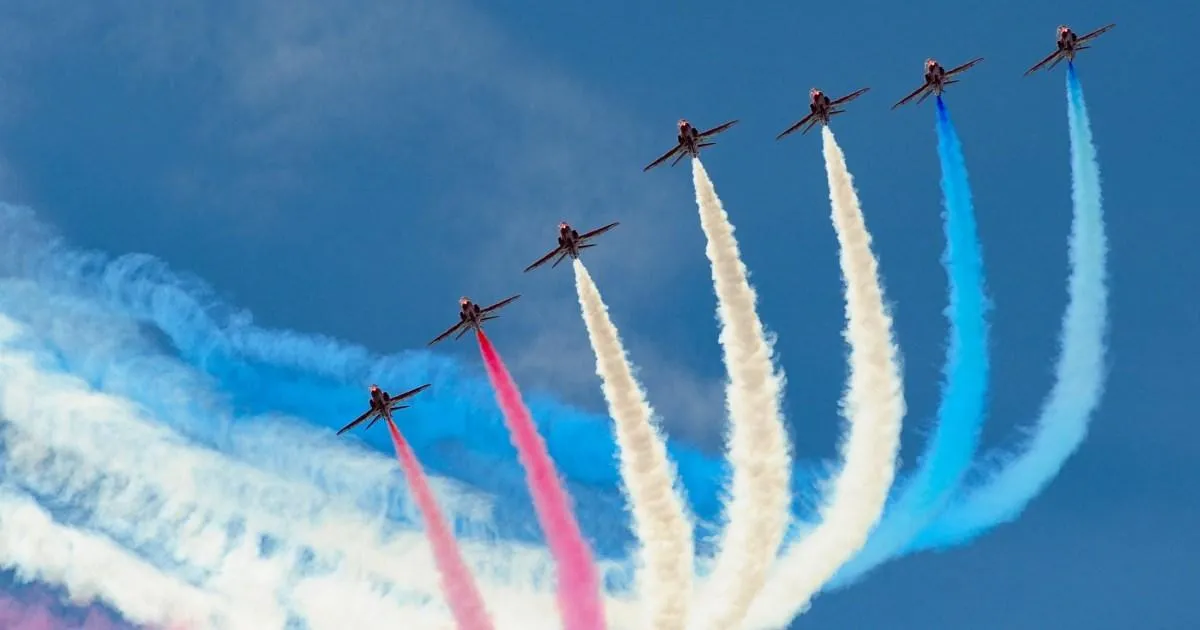
There’s something quintessentially British about a summer bank holiday weekend: the smell of sunscreen mixed with the salty sea air, the distant hum of a crowd gathering on the shoreline, and the collective craning of necks toward the sky for the unmistakable roar of a formation flying overhead. For decades, the Red Arrows have been the undisputed stars of the summer season, their iconic red, white, and blue vapor trails stitching the heavens together at airshows across the nation. They represent the absolute pinnacle of skill and precision, offering a rare blend of raw power and balletic grace that leaves audiences of all ages in awe. However, despite their seemingly fearless pilots and fleet of Hawk jets, the team is currently grounded and facing an all-too-human problem: being stranded on the wrong side of the Atlantic, derailed not by a mechanical failure or a strategic error, but by the one thing that dictates so much of British life—bad weather. This unexpected hiccup has forced the cancellation of several high-profile displays, leaving thousands disappointed and raising one major question: when will we next see the famous red, white, and blue paint scheme gracing our skies?
The Disappointment in Eastbourne and Beyond
The immediate fallout from this logistical nightmare was felt most acutely at the Eastbourne International Airshow. The event kicked off this week with hundreds of excited attendees ready to look skyward, only to find that the headline act wouldn’t be showing up. It was a bitter pill to swallow for the organizers and the public alike. But Eastbourne isn’t alone in their disappointment. The knock-on effect of the team being stuck in Canada has had a domino effect across the UK event calendar, prompting cancellations that have rippled through coastal towns and cities. The Royal Edinburgh Military Tattoo and the Lyme Regis Lifeboat Week have also been forced to revise their line-ups, removing the Red Arrows from their schedules at the last minute. For those who had gathered at these locations—many of whom plan their holidays around seeing the team—there was a palpable sense of “what if.” The silver lining, however, is that these are remarkably resilient community events. While the Red Arrows are undoubtedly a massive draw, the shows themselves are built on the spirit of their local towns, and organizers have confirmed that the festivities will go on, rain or shine, with or without the jets screaming overhead.
Stranded: The Canadian Conundrum
So, how exactly does one of the world’s most sophisticated display teams end up stranded? In this case, it wasn’t a pandemic, a fuel issue, or a dispute with their tour manager. The predicament began after the team completed their recent, highly successful tour of the United States. The plan was a spectacular journey home via a refueling stop in Canada. They intended to hop from Canada up through Greenland and Iceland before finally touching down on British soil. But the great British taboo of “settled conditions” was nowhere to be found in North America. A “prolonged period of forecasted poor weather” swept over their Canadian airbase, closing in with low ceilings and poor visibility. For a team that relies on visual flying rules through the delicate formations they are famous for, this was a no-go. They were, quite simply, weather-locked with a painfully dull amount of time to wait. The enforced layover means the team is now safely in place at an airbase in Canada, biding their time until the storm fronts move on and clear skies over the Atlantic make the long, dangerous flight safe enough for their Royal Air Force pilots.
The Wait is Almost Over: When to Catch Them Next
While their current status might feel like a summer departure for the season, the good news is that the Red Arrows’ enforced pit stop is only a temporary disruption. The team is expected to leave Canada as soon as the jetstream relents, with plans to return to the UK by the end of the week. They are currently undergoing scheduled engineering work in Canada—a practical, if frustrating, way to use the downtime—which means when the skies clear, they can get straight back to business. If all goes to plan, the wait will be blessedly short. The next opportunity to see them will be at the Cromer Festival Air Show on August 19th. It’s a testament to the team’s popularity—and the resilience of the events circuit—that die-hard enthusiasts don’t have to wait until September, as the schedule has them flying pretty solidly through the end of the year. After a quick detour to Sweden for the Swedish Air Force’s 100th-anniversary bash, they will return to the UK for a spectacular, action-packed bank holiday weekend. The Clacton Air Show is still set to be a roaring success with displays on August 27th and 28th, before the team finishes August with the Sidmouth Regatta and Air Show on the 29th.
A Schedule Packed with Promise
Looking further ahead, the team’s 2026 schedule is as packed and exciting as ever. September kicks off with the International Ayr Show in Scotland, followed by a tour of the Channel Islands with dates in Guernsey and Jersey. They’ll then venture to the IWM Duxford Battle of Britain Air Show, before heading to the NATO Days in the Czech Republic and a finale in Le Touquet, France, in late September. The grand finale of their 2026 flying season is scheduled for October 4th at IWM Duxford, offering a final chance for fans to see the team in formation before they land for winter. It’s a schedule that takes them from the historic coastlines of Britain to the heart of Europe, and while the recent cancellations have been frustrating, the remaining calendar provides a sense of hope and anticipation. The coming weeks are packed with the kind of iconic locations that make the Red Arrows such a beloved symbol of the United Kingdom.
Looking to the Skies with Patience
In a statement laced with characteristic grace under pressure, the team’s leadership have offered their apologies to the organizers and the public, emphasizing that “safety is the only factor” determining their return. It’s a professional, if sobering, reminder of the high-wire act these pilots perform every day. They are acutely aware of the noise they create—not just the physical roar of the engines, but the emotional anticipation that follows them. For now, the message is one of understanding and anticipation: patience is a virtue, and the skies are temporarily a little quieter. But with the autumn season looming, the excitement is building. While the team is likely to face a few more weeks of transatlantic travel chaos before they are fully back in the swing of things, one thing is certain: they will be back. They will be roaring over our coastlines, wowing crowds with their diamond nines and daring loops, and reminding us all of the sheer, unadulterated joy of looking up. So, keep your eyes on the horizon and the weather forecast—your next chance to see the world’s greatest aviation ambassadors is coming soon, and it will be well worth the wait.