


There is a particular kind of quiet that settles over Bishop’s Lane in Cranbrook, Kent. It is the sort of rural lane where birdsong carries and the only footsteps on the pavement are those of neighbours who have known each other for decades. But for the twelve households tucked along this private stretch of land, that peace has been replaced by something far less welcome: a grinding, daily struggle over something most of us never think twice about. Their rubbish, quite simply, is no longer being collected from their doors. After the local council decided the road was too dangerous for bin lorries, the residents were told they must drag their own wheelie bins nearly half a mile uphill to a single communal dumpster at the top of the lane. For a community made up largely of elderly and vulnerable people, this is not an inconvenience — it is an ordeal. The road has potholes, ruts, and uneven ground, and the council argues that a heavy refuse vehicle could be damaged or could cause harm. But the people who live here, some of whom have done so for more than thirty years, are refusing to accept the decision quietly. They are demanding a rethink, and they are asking a simple question: if an ambulance can come down this lane twice a week, if the postman can manage it, if Amazon delivery vans navigate it daily, why can a bin lorry not do the same?
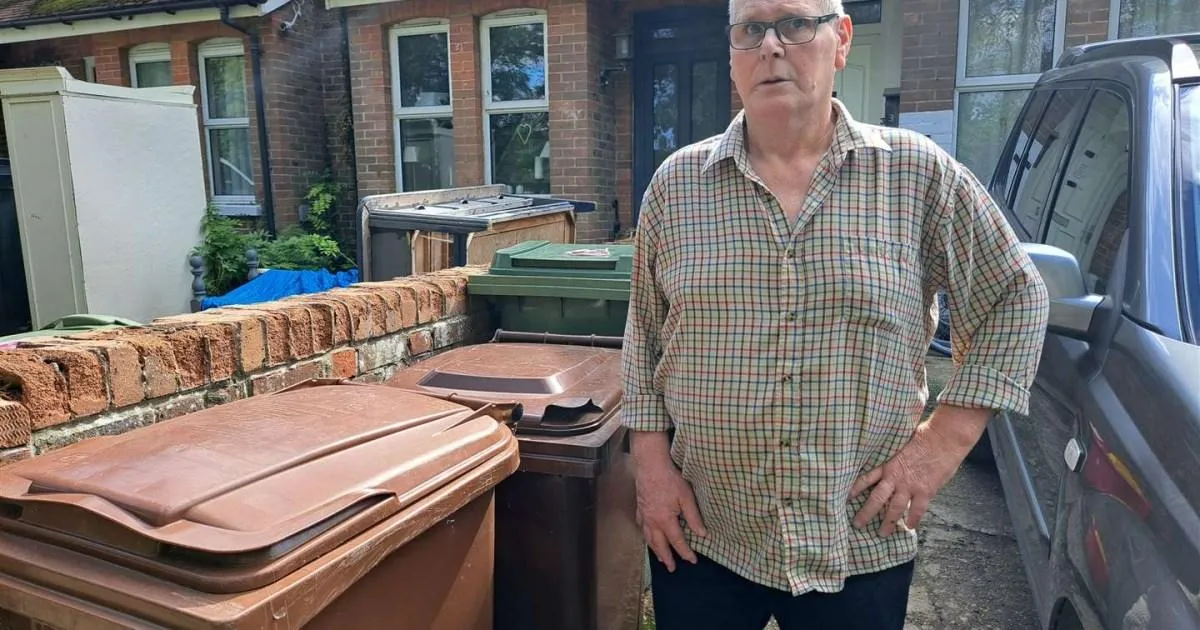
For Chris Dodson, the situation has become personal in the most painful way. Mr Dodson has lived on Bishop’s Lane for 32 years, and he has never known a time when waste collections were a problem. Then, about five or six weeks ago, a letter arrived that changed everything. The council informed residents that their private road had been assessed and found to present an unacceptable risk to refuse collection operatives and vehicles. Collections would stop. A communal bin had been placed at the top of the lane, and it was up to each household to get their rubbish to it. Mr Dodson, who has been fighting cancer since 2021 and also suffers from polymyalgia rheumatica, a condition that causes severe muscle pain and stiffness, says the demand is simply impossible for him. He described the moment he read the letter as one of disbelief. There had never been a problem, he said, until a new driver was put on the route. The regular waste truck driver had come down the lane without issue for years. It was only when that driver went on holiday and a relief driver complained that the council decided to take action. Mr Dodson pointed out that even his neighbour, a fit, football-playing young man, tried wheeling his bin up the lane and said it nearly killed him. The distance is roughly 900 yards — around half a mile — much of it on an incline, with the surface broken into potholes and ruts. For someone already battling serious illness, the prospect of navigating that terrain with a heavy bin is not just physically daunting; it is degrading. It strips away a basic dignity that should be guaranteed to every citizen, regardless of the condition of the road outside their home.
The council, for its part, says its decision was based on a formal route risk assessment carried out in July. The letter sent to residents explained that the private access track had deteriorated due to potholes, uneven and unstable ground, weather-related damage, and the absence of remedial repairs. It concluded that this posed an unacceptable risk to both refuse collection operatives and the vehicles themselves. On paper, that may sound reasonable enough. No one wants a bin lorry to overturn, and no one wants a refuse worker injured on the job. But the residents of Bishop’s Lane are not convinced, and their frustration is rooted in a long history of being overlooked. They admit that the road is in need of repair. They have said so themselves for years. But they argue that the surface has always been imperfect, and that services which are far more essential than waste collection have continued to use it without complaint. An ambulance visits twice a week to collect one resident for kidney dialysis. The postman comes every day. Delivery drivers of all kinds — Amazon vans, couriers, food deliveries — have no trouble navigating the lane. If the road were truly as dangerous as the council claims, these vehicles would surely have faced the same concerns. Instead, the residents say, the council seems to be using the condition of the lane as a convenient excuse to cut a service, rather than as a problem to be solved. Adding insult to injury, the lane is a private road. The residents have a right of way, but they do not own it, and they have no power to commission repairs, even if they could afford to do so. They are expected to live with a poor road, but they are also expected to accept the consequences of that road alone. The question on many of their lips is a bitter one: what are we paying our council tax for, when the most basic services are being withdrawn without a workable alternative?
The human cost of this decision is visible across the twelve homes, and it is impossible to ignore. Take, for example, the resident with kidney dialysis, a man described by his neighbour as having to be collected by ambulance twice a week. His health is fragile, his energy is limited, and his days are already consumed by treatment. Now he is expected to carry his own rubbish to a bin half a mile away. Or consider the elderly woman, described as very frail, who lives alone and moves slowly. For her, the walk up the lane is not a health walk; it is a terrifying risk of falling. There is no street lighting on the lane, so in the darker months, even the daylight hours are short. If she were to slip on the uneven ground with a bag of rubbish in her hand, who would know? Who would help? The fear among residents is not exaggerated; it is the plain reality of asking vulnerable people to do something their bodies cannot manage. And the communal bin provided by the council is not even a proper solution. There is only one, and with twelve households all trying to use it, it fills up almost immediately. Peevor described it as overflowing within a matter of days. Residents who are physically able to make the journey often arrive at the top to find the bin already full, meaning they must either leave their rubbish beside it, hope for an extra collection, or take the waste home again. The result is a system that is not only undignified but unhygienic, attracting flies, foxes, and the unmistakable smell of decay. The council may have believed it was offering a compromise, but to the people living on Bishop’s Lane, it feels less like a compromise and more like an abandonment.
Younger residents are being affected too, and their voices add a further layer of anger and frustration. Michal Peevor, 31, lives in one of the houses on the lane and has become something of a spokesperson for the group, partly because he is young enough to be physically capable of the trip but also because he is desperate to move forward with his life. He is trying to sell his house, and the rubbish situation has thrown the sale into limbo. No buyer, he says, is going to want a property where the bins are not collected and where the road is considered too dangerous for a refuse lorry. He described how the road’s condition had been raised with the council a couple of years ago, and for a while, the council had responded by sending a smaller collection vehicle down the lane. That worked. The problem was manageable. But then, about a year ago, for no obvious reason, they switched back to a larger vehicle. Now the council has swung to the opposite extreme, skipping collections altogether. Peevor wonders whether the smaller vehicle could simply be reintroduced. It would solve the logistical concerns, it would keep residents safe, and it would restore a basic service. Instead, the council has offered a single shared bin at the top of the lane and left them to get on with it. Rex Goldfinch, 19, who lives with his parents at one of the houses, described the new routine as a real pain. He and his family have resorted to driving their rubbish up the lane and putting it in the car boot, one bag at a time. He pointed out, as others have, that delivery drivers come down the lane with no problem at all. To him, the council’s explanation seems lazy. It is, he said, using the condition of the lane as an excuse not to provide a service, rather than finding a way to make it work.
Beneath the everyday frustrations of bins and potholes lies a deeper issue that resonates far beyond this one lane in Kent. This is a story about what happens when bureaucracy loses sight of the people it serves. It is about the gap between risk assessments on paper and the lived reality of vulnerable citizens. It is about the elderly and the ill being left behind, not through malicious intent, but through a failure of imagination. The council has a duty to protect its workers, and that is not to be dismissed lightly. But it also has a duty to serve its residents, and nowhere is that duty more pressing than when those residents are struggling to manage the most basic tasks of daily life. A dignified waste collection is not a luxury. It is a public health measure, a mark of respect, and a service that should not be withdrawn without a genuine, collaborative solution. The residents want the road repaired. They have wanted that for years. They are not blaming the council for the potholes alone. What they are blaming the council for is refusing to engage with them, refusing to offer a workable alternative, and refusing to acknowledge that for some of their neighbours, the journey to the top of the lane is a journey they simply cannot make. They are not asking for special treatment. They are asking for the same treatment they have received for decades, adapted to a situation that could be resolved with a smaller vehicle, a temporary arrangement, or a genuine conversation rather than a letter. The council has so far not responded, and the silence only deepens the sense of betrayal. But the residents of Bishop’s Lane are not giving up. They have lived here long enough to know that quiet persistence can move mountains, or at least, it can move a council. And so they will keep telling their story, not because they want sympathy, but because they want change. They want their lanes swept, their bins emptied, and their elderly neighbours treated with the care they deserve. That is not too much to ask. It is, in fact, the very least that any community should expect.