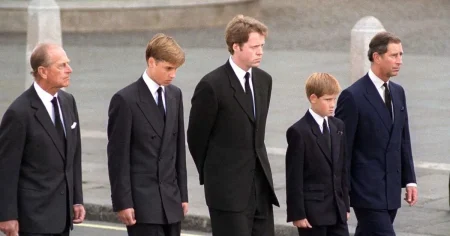
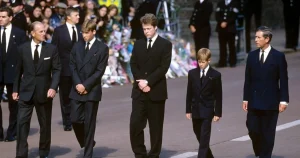

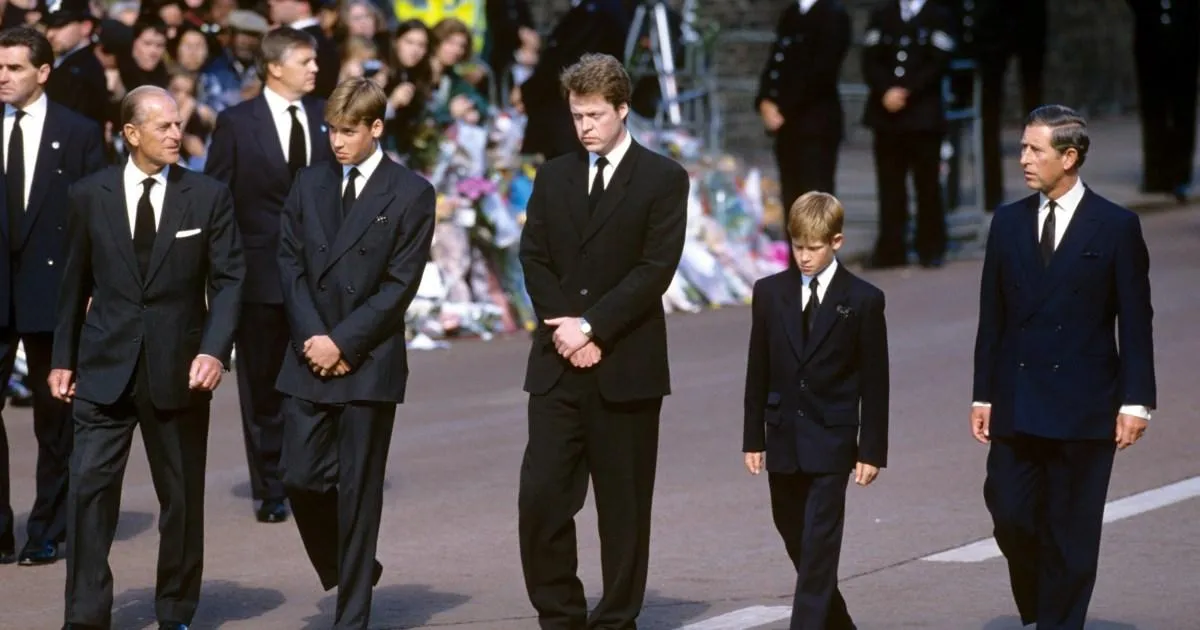
Few figures in modern British life have remained as emotionally present as Princess Diana, and that enduring presence is once again rattling the monarchy. The latest tremor comes not from a new documentary or a tell-all interview, but from Diana’s own brother, Earl Spencer, whose upcoming book contains a claim that cuts straight to the heart of the royal family’s most painful chapter. According to Spencer, just days after Diana died in that Paris car crash in 1997, Prince Charles—now King Charles—allegedly said to him, “Rest assured, we’ll forget her soon enough.” Those words, if true, are devastating. They seem to capture a moment of raw, unguarded bitterness from a man whose public role demanded compassion, and they arrive at a time when the King is already navigating a difficult relationship with the public. The context makes it all the more charged: the world had just witnessed the image of two young princes walking behind their mother’s coffin, their faces hollow with grief, while their father stood beside them. For decades, Diana’s voice has lingered, whether through her Panorama interview, where she famously said, “There were three of us in this marriage, so it was a bit crowded,” or through the countless tributes that followed her death. Now, her brother’s words threaten to reopen that wound all over again, reminding everyone that the drama of the House of Windsor is never fully buried, and that the ghost of Diana still has the power to unsettle the Crown.
The Palace’s reaction has been telling. Usually, when a royal book makes headlines, the institution responds with a shrug and the familiar phrase, “We do not comment on private conversations.” Not this time. Before the book even reached the shelves, Buckingham Palace issued a striking statement, suggesting that Earl Spencer’s grief may have clouded his reason and coloured his memory. The statement read: “While we do not comment on books as a matter of principle, His Majesty is mindful that the pain of fraternal grief can cloud reason, affect judgment and colour memory in ways others do not recognise, even many years after such a loss.” That is a carefully worded denial, but to many royal watchers, it feels less like a dismissal and more like a sign of alarm. Royal expert Duncan Larcombe told Metro that this episode poses a “real problem” for King Charles. Larcombe noted that Earl Spencer is still remembered lovingly by the public for his emotional speech at Diana’s funeral, when he spoke of his sister as “the essence of compassion, of duty, of style, of beauty.” To have that same man accuse the King of being ruthless and uncaring, so soon after such a terrible tragedy, is not something the Palace can simply wave away. The very speed and unusual tone of the Palace’s response, Larcombe argues, shows how seriously Charles is taking the threat. The public has long sided with Diana, and any hint that her grieving brother was met with coldness could reignite old hostility toward the King.
At the centre of the controversy is a painful, intimate memory about the funeral procession that no one who saw it will ever forget. Princess Diana died on August 31, 1997, at the age of 36, after a car crash in Paris that also killed her companion Dodi Fayed and their chauffeur, Henri Paul. Her sons, William and Harry, were just 15 and 12, and the world watched in heartbreak as they walked behind her coffin through the streets of London. In his book, serialised in the Daily Mail, Earl Spencer describes how he tried to stop that from happening. He says he told one of the Queen’s aides that it was “not going to happen,” arguing that the boys were far too young to endure such a public ordeal. But then, according to Spencer, Prince Charles called him back, insisting that he himself had walked in the funeral procession of Lord Mountbatten, his beloved “Uncle Dickie,” and that William and Harry should do the same. Spencer reminded Charles that he had been 30 years old at the time, not a child. Then, in his account, there was a pause on the phone—the kind of silence that feels loaded with unspoken emotion. Spencer wrote that he assumed the pause was Charles trying to bring himself under control, but instead, the future King unleashed what Spencer took to be “his pent-up contempt for Diana, and his horror that the world was so bowled over by her death.” Then came those chilling words: “Rest assured, we’ll forget her soon enough.” Whether or not the conversation happened exactly as described, the story rings painfully true to many because it speaks to the tension at the heart of Charles and Diana’s marriage—a marriage that had been broken long before her death.
To understand why this claim cuts so deeply, it helps to remember the messy, public collapse of Charles and Diana’s relationship. By 1992, rumours of Charles’s continuing relationship with Camilla Parker Bowles had exploded into the mainstream. Andrew Morton’s explosive biography, Diana: Her True Story, had revealed the affair in stunning detail, and then Diana herself confirmed the betrayal in her 1995 Panorama interview, with that haunting line about three people in a marriage. The couple separated in 1992, but their divorce was not finalised until August 1996, just over a year before Diana died. In that time, the public’s sympathy shifted overwhelmingly toward Diana. She was the people’s princess, the woman who hugged AIDS patients and walked through minefields, the single mother raising two sons with warmth and spontaneity, while the monarchy seemed stiff, distant, and defensive. Charles, by contrast, was often portrayed as the cold-hearted heir who preferred hunting and gardening to understanding his wife’s emotional needs. The allegations in Earl Spencer’s book tap directly into that old narrative. Whether intentional or not, the claim that Charles would say “we’ll forget her soon enough” evokes the image of a man eager to move on, while the rest of the world was weeping. It also raises questions about how Diana’s sons were treated in the aftermath of their mother’s death. William and Harry were barely more than children, and the idea that their father was more concerned with protocol than with their fragile emotional state feels deeply uncomfortable. The fact that Harry has remained close to his uncle over the years only adds another layer of significance to Spencer’s words.
The timing, too, could hardly be worse for King Charles. Next year marks the 30th anniversary of Diana’s death, a milestone that will inevitably prompt a fresh wave of reflection, documentaries, and tribute pieces. Royal expert Duncan Larcombe described Earl Spencer’s allegations as a “cataclysmic” start to that anniversary year, and warned that the current quiet may be the calm before the storm. Diana, he reminded us, was the biggest threat the British establishment faced for decades, because she had the unique ability to draw the public’s love away from the institution and toward herself. Her brother, with his aristocratic pedigree, his stirring funeral speech, and his long memory, is in a powerful position to keep that threat alive. Larcombe suggested that the royal family is deeply worried that Spencer may continue to speak out publicly and criticise the institution again. His book suggests that he has not let bygones be bygones; rather, he has been, in Larcombe’s words, “a ticking time bomb waiting to go off.” In the days following the allegations, senior royals were set to appear in public carrying out official engagements, going through the motions of duty while the story swirled around them. It must be a strange experience for Charles, to step out and smile at well-wishers knowing that another chapter of his past, one he may remember very differently, is being told to the world. But the palace is clearly aware of the stakes. The King’s reputation has already been through years of turbulence, from the fallout of his divorce from Diana to the recent estrangement from Prince Harry and Meghan Markle. Now, with the 30th anniversary approaching, he must once again confront the idea that part of the public will always see him through Diana’s eyes.
Ultimately, this story is about more than one alleged phone call. It is about memory, grief, and the strange way that the royal family remains both a living institution and a repository of unresolved pain. Earl Spencer has every right to tell his own account of what happened, and the Palace has every right to defend the King’s version of events. But the emotional truth of the situation is that Diana’s death was a rupture not just for her family, but for the entire nation, and nearly three decades later, the cracks still show. For Charles, the challenge is not simply to deny Spencer’s claims, but to prove, through his actions, that he has changed. For William and Harry, who have both spoken openly about their own mental health struggles in relation to their mother’s death, this must be a deeply personal moment. The image of them walking behind the coffin, heads bowed, remains one of the most painful images in modern British history, and any suggestion that their father was heartless about it stings all the more. The palace’s unusual response, with its carefully chosen words about fraternal grief, suggests that Charles and his advisers are well aware that Spencer’s words carry a weight that cannot be dismissed. They know that the British public does not need to hear more evidence to remember why they loved Diana; they only need to be reminded. And so the question lingers: will the approaching anniversary reopen old wounds, or can the monarchy find a way to honour Diana’s memory and move forward without looking cruel? For now, Earl Spencer has lit the fuse, and the palace is bracing for whatever comes next.