


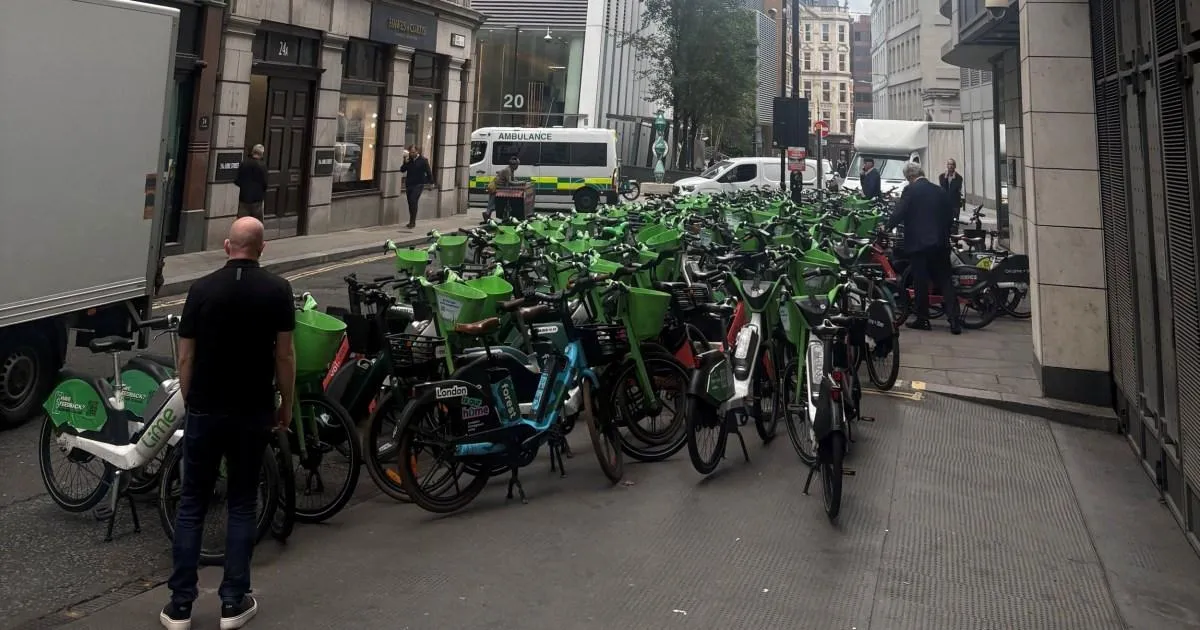
There is a special kind of irony in the scene that unfolded on Lime Street in central London this week, and it wasn’t lost on the people who stopped to stare. The street, whose name suggests something orderly, clean, and perhaps even a little citrusy, had been completely overwhelmed by electric bikes. Not just one or two, but dozens of bright green Lime bikes had been left scattered across the pavement and the roadway, creating a tangled, metal obstacle course that made it almost impossible to walk through. Benedict Simms, a 28-year-old insurance worker, was leaving his office just after 2pm on Tuesday when he found himself confronted by the chaos. He estimated that there were between 50 and 70 bikes parked on the street, some leaning against lampposts, others lying on their sides, their wheels locked and their frames packed so tightly together that pedestrians had to squeeze through gaps barely wide enough for one person. “People could barely walk round the mass of bicycles,” he said. And the photograph he took? That was maybe half of the bikes. The rest stretched further along the road, turning a busy central London street into something that looked less like a public thoroughfare and more like an unofficial bike depot that nobody had ever planned, organized, or cleaned up.
For Benedict, the frustration was not abstract. It was right outside his door. He said that when he tried to leave his office, there were four bikes parked directly in front of the doors, blocking his exit. He could barely get out, and when he finally managed to step into the street, he looked to the right and saw the full extent of the problem. The mornings, he explained, are especially bad. The street is always “hectic,” but at rush hour, dozens of Lime riders arrive at roughly the same time and try to park their bikes in the designated area all at once. The result is a chaotic pile-up that leaves late commuters scrambling, office workers sighing, and locals rolling their eyes. “You hear a lot of sighs if you stand around that little spot for five minutes. You hear the locals getting pissed off,” he said. But the frustration wasn’t limited to pedestrians. Benedict described watching a lorry driver who was forced to stop, get out of his vehicle, and physically move four bikes just to clear a path so he could continue on his way. “There’s always delivery drivers parked up even though they’re not meant to,” he added, highlighting the constant tension between deliveries, cyclists, and pedestrians all trying to use the same narrow strip of city street. It’s a scene that plays out across London every single day, and Benedict’s photograph captured it perfectly: the tangled handlebars, the discarded helmets, the bikes lying in gutters, and the quiet frustration on the faces of people just trying to get to work.
Lime, the company behind the bikes, did not try to dodge the criticism. In response to the photo, a spokesperson acknowledged that “obstructive parking is an issue we take very seriously.” They pointed to a wider shift in how Londoners are moving around the city: cycling is at record levels, with more than one in ten trips now made on shared e-bikes. That is an extraordinary transformation for a city that has historically been dominated by cars, buses, and the Underground. But it has also created a serious problem: infrastructure has not kept up with demand. “Designated parking for e-bikes has not kept up with this rapid growth in demand,” the spokesperson said. To help address this, Lime says it has invested more in parking than any other e-bike operator in London, helping fund more than 3,400 bays. And according to the company, since last year, the increase in parking locations has helped reduce overcrowding at some bays and eased the burden in certain areas. Teams also work every day to move misparked bikes and relocate bikes from overcrowded locations. But the company was also honest enough to admit that the work is not finished. As several commenters in the Reddit thread pointed out, more parking is still needed. On Lime Street, the app now shows that the area at the south of the street has been made a “no parking zone,” with a warning that users may be fined if they leave a bike there. It is a small but significant acknowledgment that some locations simply can no longer bear the weight of the volume.
This is not an isolated problem. E-bikes strewn across pavements have become one of the most familiar sights in London in recent years, and the calls for a solution have grown louder with every dropped bike, every blocked doorway, and every frustrated sigh. In Islington, the situation escalated to the point where the borough threatened to kick e-bike operators out entirely if they didn’t address issues like obstructive parking and nighttime noise. That threat was not just political posturing; it reflected the real exhaustion of local councils that have watched their streets become informal storage spaces for private companies. In Westminster, a new deal was signed with Lime specifically designed to keep pavements clear of badly parked dockless bikes. Pressure has also been turned on the riders themselves. Lime announced fines for anyone who flouts the parking rules across London, with penalties ranging from £2 to £10 for riders who repeatedly park outside the permitted spaces. Repeat offenders could even be banned from using Lime bikes altogether. These measures are positive steps, but they also reveal a deeper issue: the very convenience of dockless bikes—the freedom to leave them anywhere—is what makes them popular, and also what makes them so messy. Without the physical constraint of a docking station, riders are left to make their own choices. And when dozens of riders make the same easy choice in the same place, the result is exactly what Benedict photographed: a street overwhelmed.
For all the benefits that shared e-bikes bring, the human cost of bad parking is real. A blocked pavement is not just an eyesore; it is a barrier. For wheelchair users, it can mean being forced into the road. For elderly residents, it can mean an anxious, uncertain journey just to get to the shops. For parents with prams, it can mean lifting a heavy stroller over a pile of bikes or turning around and walking in the opposite direction. It’s also about dignity—the feeling of not being able to move freely through your own city because someone else decided their convenience mattered more than your right to pass. It’s the frustration of being trapped in an office because bikes are blocking the doors. It’s the irritation of being woken up at night by the clatter of bikes being moved outside your window. And it’s the quiet, daily grind of navigating a slalom course on the pavement every time you step outside. Benedict’s photo is a snapshot of that frustration, but it’s also a reminder that these bikes are, in their own way, a vision of a better future. They are green, affordable, and shared. They reduce car journeys, lower emissions, and help keep the air cleaner. The problem isn’t the bikes themselves. The problem is the way we manage them. No one wants to return to the days of smog-filled streets and gridlocked traffic. But no one wants to trip over an abandoned e-bike on their way to work either. The demand is clearly there. What’s missing is a system strong enough to support it.
So where do we go from here? Lime says it is committed to working with councils across London to expand parking capacity, and the company’s own initiatives show that some progress is being made. But the pace needs to accelerate. E-bike parking bays need to become a standard part of the urban landscape, not an afterthought. That means more physical infrastructure, more enforcement, and more thoughtful urban planning. It also means a cultural shift among riders—a sense of personal responsibility that doesn’t end the moment the ride does. Leaving a bike neatly in a designated bay takes seconds. Leaving it in the middle of a pavement takes no effort at all. The difference between those two choices is the difference between a city that works for everyone and a city that constantly stumbles over itself. Benedict’s story is not unique, and that is exactly why it matters. It captures a moment that thousands of Londoners experience every week. It gives voice to the frustration that has been building for years—the sighs, the eye rolls, the photographs taken in disbelief. The e-bike boom is not going anywhere. Shared bikes are here to stay, and in many ways, they are making the city better. But London needs to grow up around them, and fast. Perhaps one day, Lime Street will be known for its smooth flow of foot traffic, its well-designed parking bays, and its calm, orderly streets. Until then, Londoners will keep dodging, keep sighing, and keep snapping photos to say the same thing: look at this. Surely we can do better.