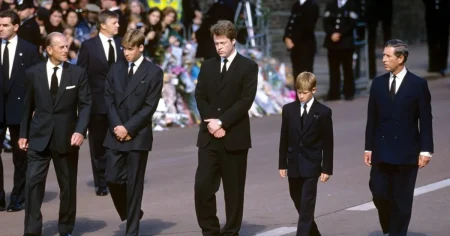


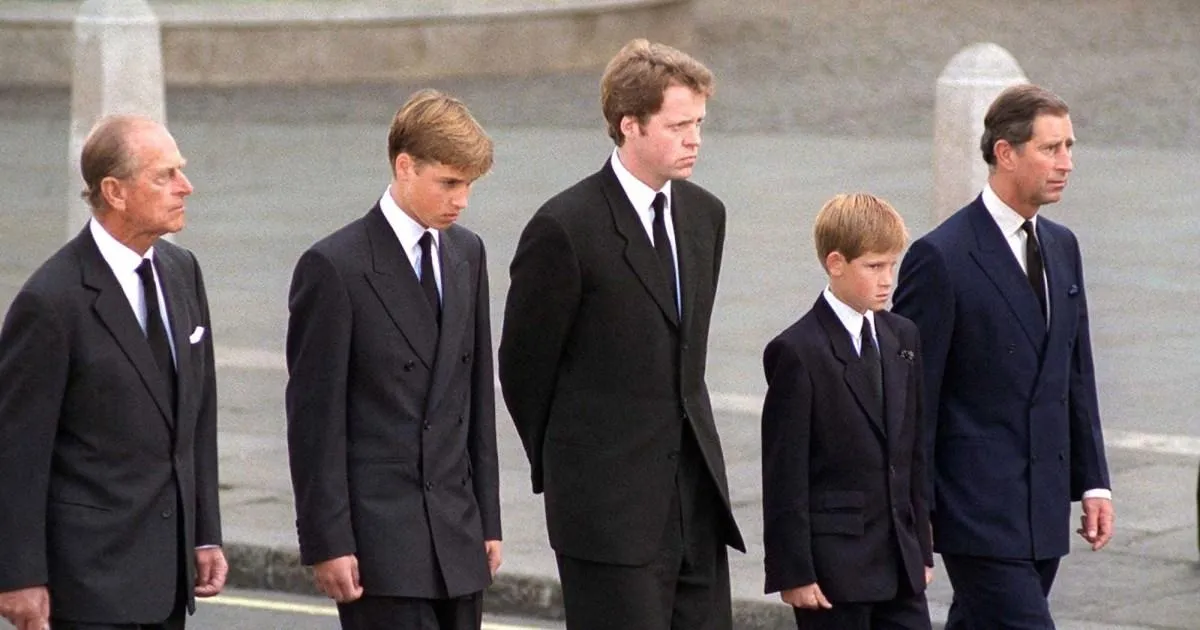
Nearly thirty years after Princess Diana’s death, her younger brother has placed the royal family at the center of a painful and deeply personal storm. In an upcoming book, Earl Charles Spencer claims that King Charles—then Prince of Wales—said something so cold, so dismissive, that it has reignited uncomfortable questions about how the institution truly regarded the woman the world still mourns. According to Spencer, just days after Diana was killed in a Paris car crash in 1997, he told Charles that Diana would not have wanted their sons, William and Harry, to walk behind her coffin in a public funeral procession. Charles, he says, rang him back to argue that he himself had walked in the funeral procession of Lord Mountbatten, his beloved “uncle Dickie.” Spencer replied that Charles was thirty at the time; Diana’s boys were just fifteen and twelve. Then came a pause. Spencer writes: “I assumed the pause signalled an effort to bring himself under control, but then he unleashed down the phone what I have always taken to be his pent-up contempt for Diana, and his horror that the world was so bowled over by her death.” The words that followed, he claims, remain burned into his memory: “Rest assured,” Charles hissed, “we’ll forget her soon enough.”
If those words were spoken, they are devastating. But to understand them, one has to sit with the strangeness of that moment—two men, both in grief, caught on opposite sides of a chasm. Charles had lost the woman he had once been married to, the mother of his sons, and the future Queen he had chosen not to keep beside him. Spencer had lost his only sister, the woman who had been hunted, adored, and ultimately destroyed, in his view, by the very world Charles represented. The world’s agonizing public grief for Diana was not neutral; it placed both men in impossible positions. For Spencer, it confirmed that she had been treated terribly in life and worshipped in death. For Charles, the frenzy likely felt like a verdict against him and his family. Spencer’s account is not just a complaint about a rude phone call; it is a charge that Charles was not only indifferent to Diana’s death, but relieved that the world’s fascination with her would finally fade. Spencer’s memory of that pause is telling. He says he initially believed Charles was trying to control his emotions—perhaps to offer sympathy, perhaps to say something decent. Instead, Spencer believes, the pause was a crack in a carefully maintained mask, releasing years of resentment. It may be unfair to interpret an awkward silence as the beginning of a cruel outburst, but Spencer has spent more than two decades interpreting it that way. Grief can sharpen certain moments into permanent monuments. This phone call, as Spencer remembers it, has become one of those monuments—a single exchange that encapsulates everything he believes about how the royal establishment saw his sister.
Who is the man making these claims? Charles Edward Maurice Spencer, the 9th Earl Spencer, was born in London on May 20, 1964. He is the youngest of John Spencer, the 8th Earl Spencer, and Frances Shand Kydd’s four children—and Princess Diana’s only brother. His godmother was Queen Elizabeth II, which means he has always stood at the edges of the royal world, close enough to know its inner workings but never truly part of it. Educated at private schools, Eton, and later Oxford, he inherited the Spencer earldom in 1992 after the death of his father. He worked as a journalist for NBC News in the late 1980s and early 1990s, and he has written several books. His personal life has been as public as his family’s tragedy. He married Victoria Aitken in 1989, and they had four children together: Lady Kitty Spencer, twin daughters Lady Eliza and Lady Amelia Spencer, and son Louis Spencer, Viscount Althorp. They divorced in 1997, the same year Diana died. He married Caroline Freud in 2001, and they had two children, Edmund and Lady Lara Spencer, before their marriage ended in 2007. In 2011, he married Karen Spencer, who later became Countess Spencer; they had a daughter, Lady Charlotte Diana Spencer, a name that clearly honors the sister he lost. Their marriage ended in divorce in 2025. Karen’s friend allegedly accused Spencer of bullying Karen and “dumping her by text message,” something he denied. Through all of his personal and professional chapters, Spencer has carried one central identity: the brother of Diana, the man who stood up at her funeral and refused to let her be reduced to a royal footnote.
But for all his life’s turnings, Spencer’s public identity has been defined by one moment: the funeral of Princess Diana on September 6, 1997. Standing in Westminster Abbey, in front of a watching world, he delivered a eulogy that was widely read as a rebuke to the royal family and an act of protection for his nephews. He called Diana the most “hunted person” of the modern age. He pledged, on behalf of her mother and sisters, that her blood family would do everything possible to continue the imaginative way she had been raising William and Harry. “We will not allow them to suffer the anguish that used regularly to drive you to tearful despair,” he said. “And beyond that, on behalf of your mother and sisters, I pledge that we, your blood family, will do all we can to continue the imaginative way in which you were steering these two exceptional young men so that their souls are not simply immersed by duty and tradition but can sing openly as you planned.” His use of the phrase “blood family” was not an accident; it drew a line between Diana’s relatives and the institution of marriage and monarchy that had, in his eyes, failed her. The speech was raw, angry, loving, and deeply human. It transformed him overnight from a relatively private aristocrat into a global figure. In the years afterward, he remained a presence in William and Harry’s lives—more visibly for Harry, who has spoken warmly about having an uncle who understood the strange pressures of royal grief. Spencer’s daughter being named Charlotte Diana is a quiet reminder that Diana never left him, and neither has the pain of her death.
Now, with his upcoming book, Spencer has chosen to put that pain on the record. The Palace has responded not with a direct denial, but with something more careful and, in its own way, more devastating. A statement said: “While we do not comment on books as a matter of principle, His Majesty is mindful that the pain of fraternal grief can cloud reason, affect judgment and colour memory in ways others do not recognise, even many years after such a loss.” That sentence is a diplomatic masterpiece. It does not say Spencer is lying. It says his grief has made him unreliable. It turns the accusation back toward the grieving brother, suggesting that what he remembers may be less a fact and more a scarred emotion pretending to be fact. It is also, perhaps, an acknowledgment that the royal family cannot simply ignore Spencer; he is not a gossip columnist or a tabloid sensation. He is Diana’s brother. Royal expert Duncan Larcombe told Metro that this moment is “the calm before the storm.” He explained that Diana was “the biggest threat the British establishment had for decades.” In his view, the royal family has long been worried that Spencer might speak out publicly against the institution, and this book reveals that he never really moved on. “This book shows that rather than him letting bygones be bygones,” Larcombe said, “he was a ticking time bomb waiting to go off.” That image—of a man carrying an explosive charge for decades—suggests that Spencer’s book will not be a gentle reflection. It will be a reckoning, as he sees it, with a monarchy that he believes treated Diana cruelly in life and was eager to forget her in death.
The book, titled “Swan Song: Diana, My Sister,” is set to be released later this month. The title itself carries a sense of finality, as though Spencer is offering his last and most complete testimony about his sister’s life and death. It is not likely to be a tidy royal memoir; it is a book written by a brother who has admitted, in his own words, that the phone call with Charles left him believing that the then-Prince possessed “pent-up contempt” for Diana and “horror that the world was so bowled over by her death.” For readers, it will be impossible to separate the claims from the emotions behind them. Spencer’s memory may be imperfect. The Palace statement is right that grief can color memory in ways even the mourner does not understand. But that does not mean Spencer’s memories are worthless; it means they are haunted. And for many people who remember Diana, being haunted is exactly the right state. The claim about Charles will be debated for years. Yet at its core, this is not really a story about palace politics or royal feuds. It is a story about a brother who has never stopped missing his sister—a sister who was also a princess, a mother, a global icon, and a woman who was often loved more by strangers than by the institution she married into. Whether the exact words on that phone call were said as remembered, Spencer has clearly carried them for nearly twenty-eight years. He did not forget Diana. The world did not forget Diana. And in that sense, the cruelest words he says he heard from Charles did not come true. This book is Spencer’s reminder that she will never be forgotten—and an announcement that, for him, the grief is still as alive as ever.