


It was one of those moments when the ordinary rhythm of a south London street suddenly breaks apart. In Brixton, near the famous Electric Avenue, traffic had been crawling along as normal when the wail of sirens began to rise. A convoy of emergency vehicles, lights flashing and horns cutting through the air, snaked through the congestion and pulled up outside a modest-looking shop that sold phones, electricals and watches. It was not a dramatic Hollywood swoop from the sky, but it had the unmistakable weight of official purpose. Officers in protective gear moved quickly, one carrying an “enforcer” — essentially a handheld battering ram — ready to smash through the door if needed. But as they reached the entrance, they found it open, as if the day had not yet turned suspicious. The team piled inside, their boots thudding against the floor, and immediately began the slow, meticulous work of searching through cabinets crammed with smartphones. Every iPhone and Android device was lifted, turned over, inspected. The air was thick with the quiet concentration of people who had done this before and knew exactly what they were looking for. Outside, a crowd began to gather, drawn by the flashing lights and the unmistakable sight of a police raid in progress. Some of them were simply curious; others were worried, because they had left phones there for repair and now feared the worst. For the officers, this was not just a raid on a single shop. It was one visible moment in a much larger, more patient battle against the trade in stolen goods — a fight that takes place across London every day, often hidden in plain sight.
Inside the shop, the search became something almost forensic. The officers did not rely solely on serial numbers or paperwork. They used ultraviolet torches, sweeping the beams across the surfaces of phones to reveal what the naked eye could not see. Many newer smartphones have a special coating, a kind of chemical DNA that is invisible in ordinary light but glows under UV. This coating can carry traceable details about where a handset came from and who it is registered to, giving law enforcement a powerful way to link a device back to a theft. One by one, the phones were examined under the eerie purple glow. Some devices lit up with information that suggested they had been stolen — one of them, it would later emerge, had apparently been taken years before and had somehow survived on the secondary market until ending up here. It was a painstaking process, but it was yielding results. When the officers were satisfied, they bagged up the phones in evidence sacks, each one carefully labelled. The cabinets that had once displayed a gleaming row of second-hand and new handsets began to look emptier, and the scale of the alleged operation became harder to ignore. This was not just a stray stolen phone or two sitting in a drawer. This appeared to be a business model built on handling property that belonged to other people — property that had been taken, in many cases, from ordinary Londoners going about their lives.
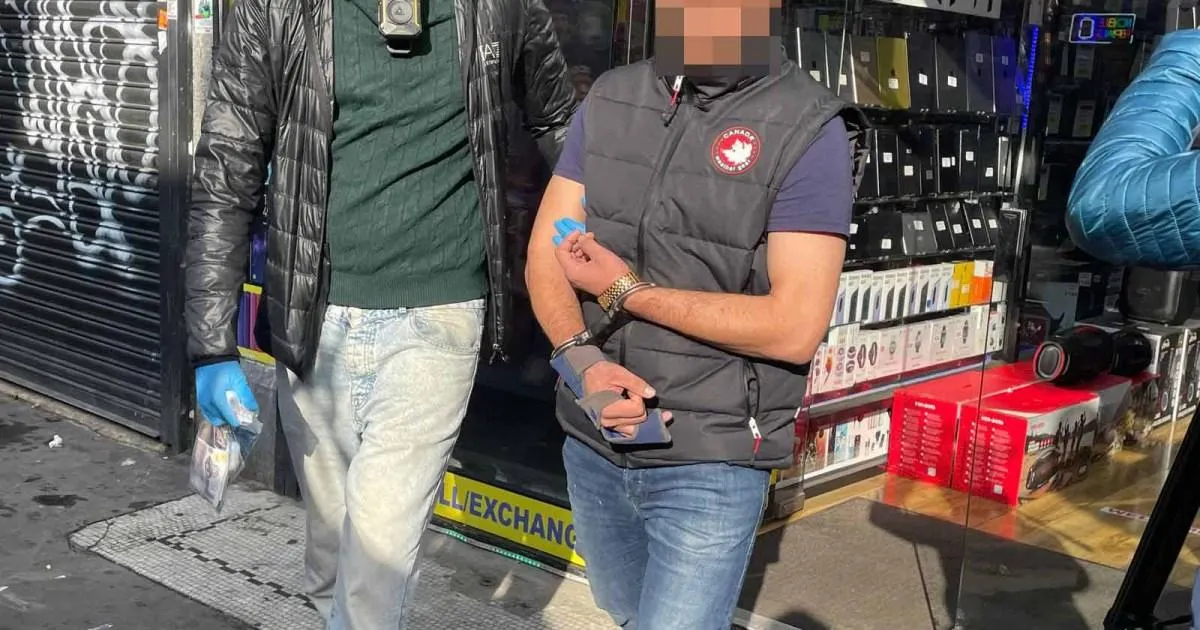
The human drama of the raid intensified when three members of staff were handcuffed and arrested on suspicion of handling stolen goods. They were led out of the shop and taken away for questioning, their faces a mixture of confusion, defiance and resignation. But outside, the scene was more complicated. A small crowd had formed, and among them were people who had genuinely left their phones at the shop for legitimate repairs. One man, visibly frustrated, pleaded with an officer: “Come on, bruv, I need my phone. It’s not stolen.” It was a moment that cut through the official procedure and showed the difficult reality of policing this kind of crime. The officers were not unmoved. They explained, patiently, that the law allowed them to seize potentially stolen goods for examination, and that anything found not to be linked to a crime would be returned to the shop once the checks were complete. That explanation did not fully calm the man, but it was a reminder that the raid was not simply about punishing the people inside — it was about untangling a web of stolen property, identifying victims, and returning what could be returned. It was also a reminder that behind every stolen phone is a person: someone who lost photographs, contacts, messages, a piece of their digital life. The police were not just taking products off the street; they were trying to give those people some measure of justice.
The operation had a name, Zoridon, and it had been running for two weeks before this raid. It was part of a wider push by the Metropolitan Police to address a problem that Deputy Commissioner Matt Jukes said was high on the agenda at Scotland Yard. Jukes had spent time touring all of London’s boroughs, speaking to local people about how crimes like shoplifting and the selling of stolen goods made them feel unsafe in their communities. He heard stories of street thefts, phone snatches, and the unsettling knowledge that stolen items were being openly resold in shops and markets. He also heard from legitimate retailers who were being undercut by businesses that did not have to pay for their stock because it had been stolen in the first place. “These shops are undercutting legitimate businesses and the public are concerned about it,” Jukes said. The raid in Brixton was therefore not an isolated stunt. It was a visible example of a deliberate strategy: disruption, detection, and deterrence. By going into a busy street in the middle of the day, with cameras rolling, the police were sending a message to anyone involved in the stolen goods trade — and, just as importantly, to the public, who wanted to see that their concerns were being taken seriously.
What made this strategy particularly interesting was its reach beyond the traditional high street. Jukes told the assembled officers and representatives of the retail industry that the police were not only targeting shops. They were also looking at car boot sales, where stolen goods often mingled with legitimate bargains. He described seeing premium goods, chocolates and cosmetics appearing at such markets, goods that had clearly not come from a distributor’s official supply chain. In some cases, thieves were being handed “shopping lists” — requests for specific items to steal, which would then be turned around and sold on. This was not opportunistic, low-level crime; it was a networked economy of theft, with its own logistics and distribution channels. The British Transport Police were also part of the wider effort, because so many phones were stolen on the transport network, snatched from hands or pockets as trains pulled away from stations. The police were trying to follow the chain all the way from the street thief to the display cabinet. Chemical DNA was one tool; intelligence was another. By working with retailers and market regulators, they hoped to make it far harder for stolen property to find a quiet place to be sold. The operation in Brixton was a snapshot of this larger effort — one raid, one shop, three arrests — but it stood for a much broader commitment to reclaiming public spaces from the shadow economy of stolen goods.
At its heart, this story is about more than police tactics. It is about the strange, often invisible loss that theft creates. A stolen phone is not just a piece of hardware; it is a record of one’s life — photos of children, messages from loved ones, banking details, memories. And when that phone is sold to a shop that pretends not to ask questions, the victim is victimised twice: once in the theft itself, and again in the daily reminder that the criminal justice system has failed them. That is why the sight of officers bagging up phones in Brixton felt so significant to the people watching. It was a rare moment when the system seemed to be working, when the authorities were not just talking about concern but doing something visible about it. The three arrested staff were a small part of a much larger story, and the shop itself was just one node in a network that stretches across the city. But the raid also showed restraint: the law insists on checks, on the return of goods that turn out to be legitimate, on the protection of the innocent as well as the prosecution of the guilty. The man who needed his phone for his own reasons was listened to, even if he could not have it back that day. In that tense, uncertain moment, there was still a human thread — a reminder that policing, at its best, is not just about enforcement but about balance. The investigation continues, the phones are being checked, and the people of Brixton are left with a question that is also a hope: whether this moment will lead to lasting change, and whether the streets will feel just a little safer because of it.