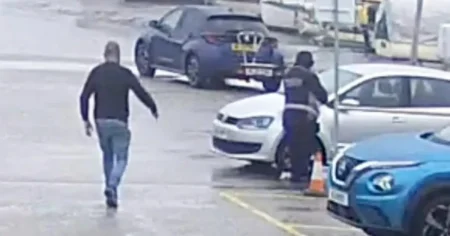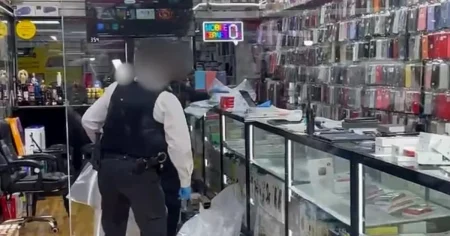
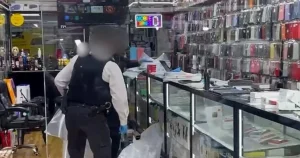

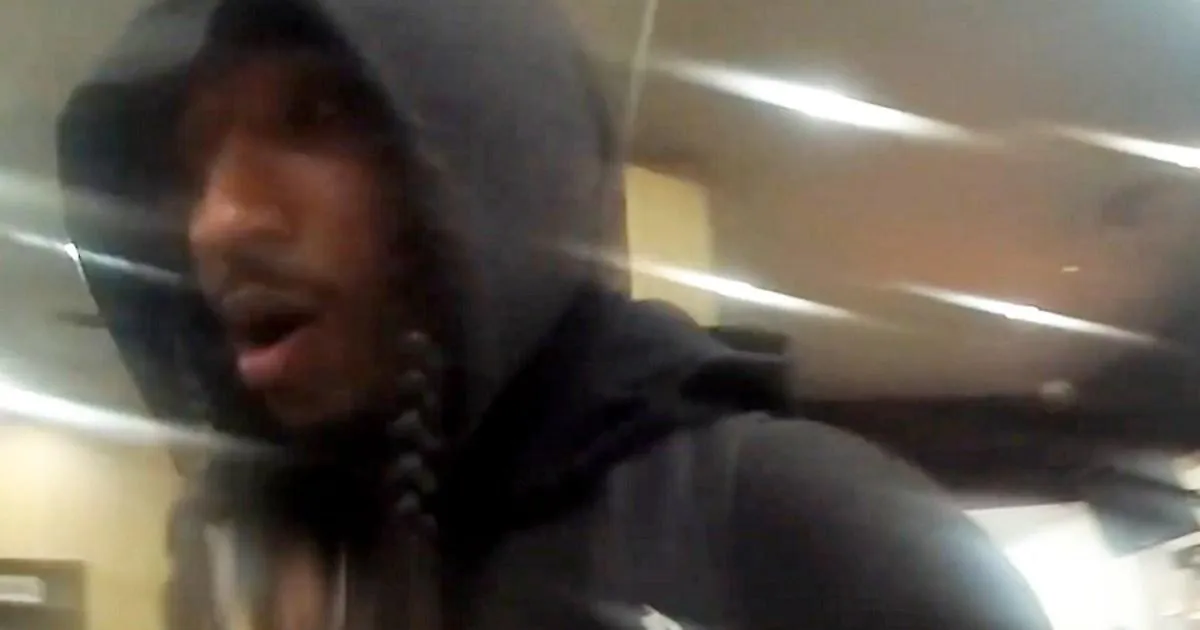
On an ordinary afternoon, the kind that usually passes without note, the McDonald’s on Clumber Street in Nottingham was doing what it always does: serving burgers, fries, and coffee to a mix of shoppers, office workers, and students. No one in that queue could have predicted that within minutes, the fast-food restaurant would become the stage for a frantic and violent arrest. The scene, captured in dramatic bodycam footage later released by police, shows a shirtless teenager wrestling with four officers, his body twisting and thrashing as he tries to break free. He has already lost his shirt in the struggle. He lunges for the door, desperate to escape, but one officer is quicker. A Taser is deployed. The teenager drops to the floor, his body going rigid, and as he falls, a huge machete slides out of his trousers and clatters across the linoleum. The weapon is impossible to ignore: a long, red-handled blade, roughly three feet in length, the kind of menacing object that belongs nowhere near a city street. For the customers who had been waiting for their lunch, the sudden eruption of violence must have been terrifying. For the officers, it was confirmation that they had caught someone far more dangerous than a typical shoplifter or pickpocket. The young man was Theo Gottshalk, 19, and he had been on the run for weeks after committing a robbery so brazen and so violent that it had launched a citywide manhunt. This was not a random stop. It was the end of a trail that began with a terrified teenager and a machete on a quiet lane in Nottingham.
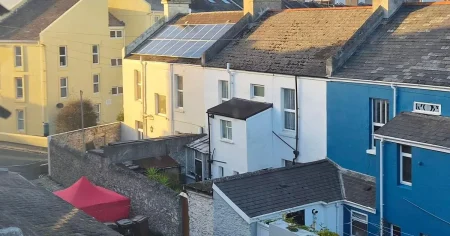
Go back two weeks before the McDonald’s arrest, and the scene was very different. It was around midday on September 9 last year, and a teenager was walking along Woolpack Lane, a public route in Nottingham, probably running errands or heading home. It should have been safe. It was broad daylight. But Gottshalk had other plans. Armed with a machete, he confronted the teenager and delivered a threat so chilling that no one could forget it: if the victim did not hand over his phone, Gottshalk would chop his arm off. There is no way to measure the fear that must have flooded through that teenager’s mind in that moment. The sight of a three-foot blade, held by a stranger with violent intent, is the stuff of nightmares. Helpless and desperate to survive, the victim handed over his phone. Then he was made to hand over more: his bracelet and his chain, personal items that in a normal context might hold sentimental value, but in that instant were just objects to be stripped away by force. Gottshalk fled, leaving his victim shaken and damaged, and taking with him not only a few valuables but also the victim’s sense of safety. The robbery was reported to police, and immediately a manhunt began. Detectives had a detailed description of the attacker and of the weapon, a distinctive red-handled machete. They released CCTV images and appealed for information. For two weeks, Gottshalk managed to slip through the net. Each day that passed meant another day he might strike again. The victim was forced to relive the terrifying encounter, wondering if justice would ever arrive. Woolpack Lane, a place that had once been ordinary, had become associated with one of the most frightening moments of his life.
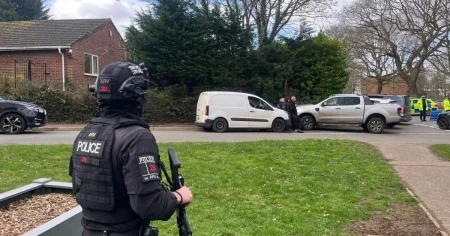
The breakthrough came on October 23, exactly two weeks after the robbery. A member of the public spotted Gottshalk on a bus in Nottingham and immediately reported it to police. This was a crucial moment. Instead of arriving with sirens blaring, officers decided to follow him discreetly, waiting for the right moment to move. Gottshalk got off the bus and walked into the McDonald’s on Clumber Street, perhaps thinking he could blend in or lose anyone who might be following. But the officers were right behind him. As they closed in, the arrest began. What should have been a straightforward apprehension quickly turned into a violent struggle. Bodycam footage shows Gottshalk refusing to comply, his body writhing and twisting as four officers try to restrain him. He is young and strong, and his only thought is escape. In the chaos, his shirt is torn off, leaving his torso bare, and he makes a break for the door. For a split second, it looks as if he might get away, bursting out into the busy street and causing even more danger. But one officer makes a split-second decision: the Taser. The electric probes hit their target, and Gottshalk crashes to the floor. Then the machete falls from his trousers. It is exactly the weapon described by the victim, with its distinctive red handle and long, sinister blade. The sight of it lying on the floor of a fast-food restaurant is a stark reminder of how lucky everyone is that he was stopped. If he had managed to get free, brandishing that weapon in a crowded area, the outcome could have been catastrophic. The officers who made the arrest had no time to think about that; they had to act. In the chaos, they protected themselves and the public. For the people in McDonald’s, the sudden intervention of police and the crack of the Taser must have been bewildering, but it would not be long before they understood the gravity of what had just happened.
Once Gottshalk was on the ground and handcuffed, the evidence began to pile up. The machete that had fallen from his trousers was immediately recognised as the weapon from the September robbery. Its red handle was an unusual detail that the victim had given to detectives, and now it sat in plain sight, a physical link between the man on the floor and the terrifying threat to chop off a teenager’s arm. But that was not all. When officers searched Gottshalk, they found several deal bags of cannabis, indicating that he was not just a violent mugger but also involved in drug supply. The combination of a machete and drugs painted a clear picture of a young man who was deeply embedded in criminal activity, willing to carry a weapon and use it to get what he wanted. Police also seized the clothing he was wearing, and when they compared it to CCTV footage from the robbery, it matched. The same jacket, the same distinctive items, the same body shape. There was no plausible way for Gottshalk to explain away the evidence. The victim, who had lived through two weeks of anxiety, was finally able to see that the person who had threatened to mutilate him was no longer on the streets. Forensic work and careful investigation turned what might have been a simple arrest into a definitive case. It is one thing to be caught with a weapon; it is another to be tied so conclusively to an earlier crime. The machete, the cannabis, and the clothing all formed a chain of proof that left no doubt. For the detectives, this was the culmination of days of work, tracing a dangerous offender and making sure he could not cause any more harm.
The legal process followed, and last Friday, Gottshalk appeared at Birmingham Crown Court to learn his fate. He is a resident of Forest Fields, Nottingham, just a short distance from where he terrorised his victim. At 19 years old, he stood in the dock facing the consequences of his actions. The sentence was severe: 13 years in prison as part of an extended custodial sentence. This is not a standard fixed term; it means that even after he serves the custodial portion, he will remain under supervision for an extended period, with the possibility of being returned to prison if he poses a risk. The judge involved clearly took the case seriously, recognising the terrifying nature of the robbery and the dangerousness of carrying such a large machete in a public place. The threat to chop off the victim’s arm was not an empty boast; it was a genuine statement of intent from someone armed with the means to carry it out. The victim, who had to stand in court or at least know the outcome, can now begin to move forward with some sense of closure. The sentence sends a message to others who might consider carrying weapons or committing violent robberies: the streets are not a playground, and those who bring machetes and threats of mutilation into public spaces will be held accountable. For the officers who made the arrest, it was a validation of their work. They had risked their own safety to stop a fleeing suspect, and the result was a substantial prison term. In the wider context of knife crime, which continues to wreak havoc in towns and cities across England, this case stands as an example of the justice system responding with seriousness. Gottshalk, barely out of his teens, will spend his formative years behind bars. He has lost the freedom that most young people take for granted. But that is the choice he made when he picked up a machete and approached a helpless teenager in daylight.
Behind the statistics and court reports, there are human stories that deserve to be remembered. There is the victim, whose daily life was interrupted by an act of violence he did nothing to deserve. There are the police officers, who put themselves in harm’s way and made a split-second decision to use a Taser rather than let an armed man escape into a crowded city centre. There is even Gottshalk himself: a nineteen-year-old who, by any measure, has thrown away his youth. But the greatest weight in this story lies with the community. Nottingham residents were served by the public-spirited person who spotted Gottshalk on the bus and called it in. They were protected by the officers who followed him calmly into a McDonald’s rather than allowing him to disappear again. They were spared the possibility of a future robbery, a future victim, or worse. The bodycam footage matters, too, because it shows the public exactly what police face in the line of duty. It is raw, chaotic, and difficult to watch, but it is also honest. It demonstrates why the officers used the Taser, and it reveals the hidden weapon that could have been turned on them. The footage is not entertainment; it is a vital record of a dangerous situation coming to an end. Cases like this often fade quickly from the news cycle, but their consequences do not. A young man is in prison, a victim is trying to heal, and a city has been made slightly safer. The red-handled machete, once a symbol of terror, is now evidence in a closed case. It will not be used to threaten anyone again. The final image of this story should not be the chaos in McDonald’s, but the quiet relief that follows a successful arrest and sentence. In the fight against violent crime, moments like this remind us how important it is to care: to report what we see, to trust the police, and to hold accountable those who choose cruelty over decency. For everyone involved, especially the victim, justice has been served.