


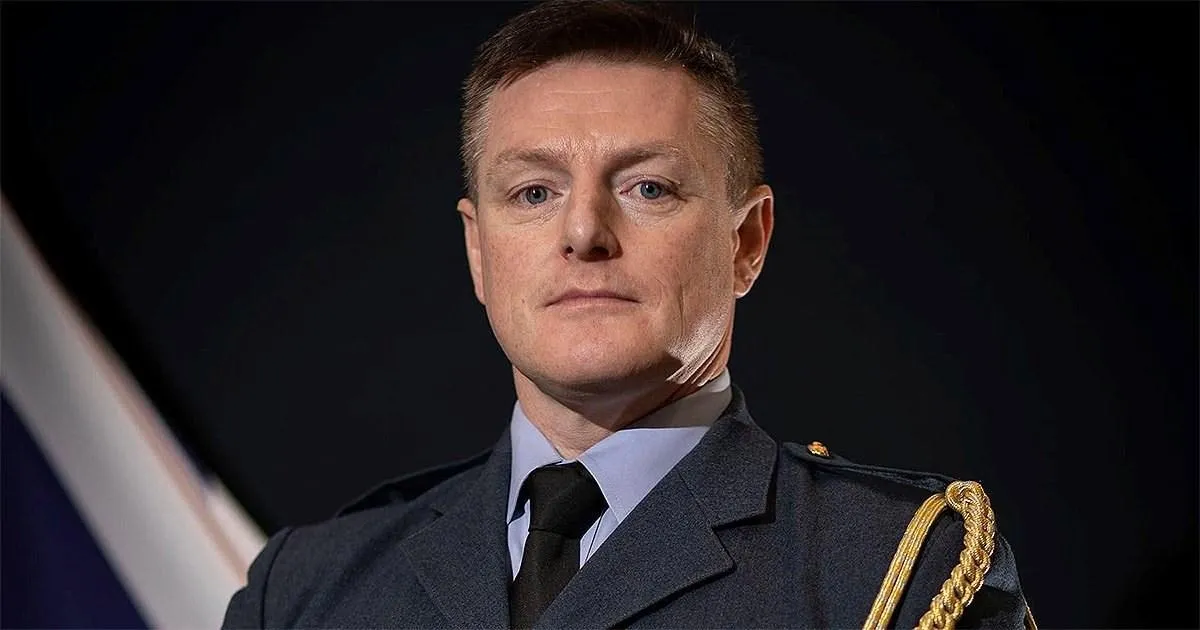
Few things are more jarring than when a story emerges from the quiet corridors of military command and reminds us how complex, fragile, and deeply human public life can be. The recent suspension of Air Vice-Marshal Jamie Thompson, head of the United Kingdom Space Command, is one of those moments. Thompson, a senior officer with decades of service, has been suspended as part of an investigation into allegations involving a serious sexual offence and theft. The Royal Air Force confirmed the move, using the phrase “without prejudice” — a small but significant detail that signals the suspension is not a verdict, but a precaution. For many, the news will have landed like a jolt. Thompson is not a distant, anonymous name on an organisational chart; he is a commander, a colleague, a mentor, and someone who has spent more than twenty-five years in uniform. He joined the RAF in 1997 as a weapons technician and rose through the ranks to lead operations in space, one of the most technically demanding and strategically vital domains of modern warfare. Now, his career sits suspended between principle and allegation, while investigators piece together what happened. The shock is not only institutional but personal. The same military community that celebrates advancement and leadership must now watch one of its own navigate a profoundly difficult moment—one that could reshape lives, reputations, and the trust on which military service depends. Even in a profession built on discipline, order, and clear chains of command, human beings remain human. Ambition, achievement, and service can all be overshadowed in a single moment of accusation, and the process that follows can be as testing as the allegation itself.
The details that have been made public are serious and should not be minimised. The Ministry of Defence’s Defence Serious Crime Command confirmed that a member of the RAF had been arrested in connection with reports of theft and a serious sexual offence involving an adult. The arrest itself is only one step in a longer process. According to the official statement, the theft investigation has concluded and has been referred to the Service Prosecuting Authority for a charging decision. That means prosecutors will now decide whether there is enough evidence to bring formal charges. The investigation into the alleged serious sexual offence, however, remains ongoing, and officials have said it would be inappropriate to comment further while that work continues. The Sun reported that the allegations involve attacking an employee and stealing from the Ministry of Defence, but no such claims have been tested in court. What is known is that Thompson has been suspended “without prejudice” — a phrase that should give us pause. In employment and military law, this kind of suspension is not meant to punish or to presume guilt. It is designed to protect the integrity of the investigation, to safeguard any evidence, and to ensure that the accused can step back from duties while the process unfolds. It is also a reminder that, however high a person rises, they remain subject to the same rules and the same legal scrutiny as anyone else. For the alleged victim, if there is one, the courage to report such matters should not be underestimated. For the accused, meanwhile, the burden of waiting through an investigation, with reputation hanging in the balance, is a heavy one. The military justice system is built to balance these competing interests, but it cannot do so without a commitment to fairness, patience, and respect for all involved.
To understand the weight of this moment, it helps to understand what UK Space Command actually does. Headquartered in Buckinghamshire, the command brings together personnel and capabilities from the Royal Air Force, the British Army, and the Royal Navy, creating a unified, tri-service organisation dedicated to protecting Britain’s interests in space. Space is no longer the distant frontier of science fiction; it is a crowded, contested, and increasingly dangerous environment. Satellites provide navigation, communication, intelligence, and surveillance that underpin almost every modern military operation. They also support civilian life in ways many people rarely consider, from banking and weather forecasting to global internet connectivity. As head of Space Command, Air Vice-Marshal Thompson was responsible for running Britain’s military operations in orbit, monitoring threats, and protecting satellites from hostile action, debris, and interference. That is not a ceremonial role. It is a high-stakes command position where decisions can ripple across the entire defence enterprise. The organisation is relatively young, having been established to adapt the armed forces to a new era of strategic competition. To lead it requires technical knowledge, strategic vision, and the ability to inspire confidence across multiple services. In the interim, Air Commodore Darren Whiteley has stepped in as Commander of UK Space Command. That continuity matters. Military operations cannot simply pause because of a personnel matter. The work of monitoring threats, protecting assets, and planning for contingencies continues, and the institution must remain ready even as it grapples with an internal crisis. The command’s mission, in other words, is bigger than any one individual, however senior.
For those who have followed Thompson’s career, the suspension is particularly striking because of how recently and enthusiastically he stepped into the top job. He took charge of UK Space Command earlier this year, after previously serving as its deputy commander. In that sense, he was not arriving as a stranger. He was returning to familiar ground, to colleagues he had worked alongside for years. He assumed the role from Major General Paul Tedman, who announced his retirement in June. At the time of his appointment, Thompson’s public words were full of optimism and a sense of purpose. “I am delighted to be joining such a vibrant and exciting command at a time of unparalleled operational activity and capability growth,” he said. “It is great to be back with friends and colleagues I have worked with for over two decades.” Those are not the words of someone expecting to be at the centre of a criminal investigation. They are the words of a career professional looking forward to a new challenge, eager to contribute to something larger than himself. That gap between promise and reality is part of what makes this story so human. People do not expect their mentors, commanders, or public figures to become the subject of allegations. Yet it happens, and when it does, the people around them are left to reconcile the person they thought they knew with the accusations on paper. Colleagues may feel disbelief, sadness, anger, or confusion. The institution may worry about morale and public confidence. And the individual at the centre must face a process that will ultimately determine not only his legal fate but how his legacy is remembered.
It is important to remember that arrest and suspension are not proof of wrongdoing. The legal process is designed to establish facts, and that process must be allowed to run its course. The Defence Serious Crime Command is the part of the Ministry of Defence responsible for investigating serious criminal offences involving service personnel. Its investigators do not make charging decisions; they gather evidence and pass cases to the Service Prosecuting Authority, an independent body that decides whether prosecution is in the public interest and whether there is a realistic prospect of conviction. In this case, the theft investigation has already reached that stage, meaning a charging decision may come soon. The sexual offence investigation, however, remains live, and because of that, officials are understandably keeping their cards close to their chest. Commenting further could risk prejudicing the investigation, undermining any future trial, or causing further harm to those involved. This restraint is not evasion; it is the responsible exercise of discretion. For the military, this is also a test of its values. The armed forces expect service personnel to demonstrate integrity, respect for others, and adherence to a high standard of behaviour. When those standards are alleged to have been breached, the institution must show that it can hold its own people accountable, regardless of rank. At the same time, it must protect the legal rights of the accused and avoid treating anyone as guilty before a court has decided otherwise. That balance is difficult, especially in an era of intense media scrutiny and social media judgment. The phrase “suspended without prejudice” is a quiet attempt to preserve that balance—acknowledging that a serious issue exists while leaving the outcome to due process.
In the end, this story is not only about a senior officer and an investigation. It is about how institutions respond when the people entrusted with power are accused of failing to live up to the very standards they are expected to uphold. It is a reminder that rank, achievement, and public service do not place anyone above the law. It is also a reminder of human fragility. A reputation built carefully over twenty-five years can be placed under a cloud by an accusation, however unresolved that accusation may remain. For Thompson, the coming months will almost certainly be a period of personal uncertainty, isolation, and waiting. For the alleged victim, if the reports are true, there is an urgent need for justice, support, and closure. For the men and women of UK Space Command, there is the challenge of continuing a vital mission while navigating the emotional fallout of a leadership crisis. And for the wider public, there is the uncomfortable truth that we often do not know the full story behind a headline. We see names and ranks and allegations, but we do not see the evidence, the legal arguments, or the lives behind the case. That is why fairness matters. It is why “alleged” must remain a meaningful word. It is why due process must be allowed to work, however slow and imperfect it may seem. Human beings deserve to be judged by facts, not by rumour. The military understands that better than most. Now, like everyone else, it must wait for the truth to emerge—and do so with compassion for all those whose lives have been touched by this distressing turn of events.