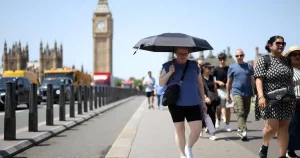


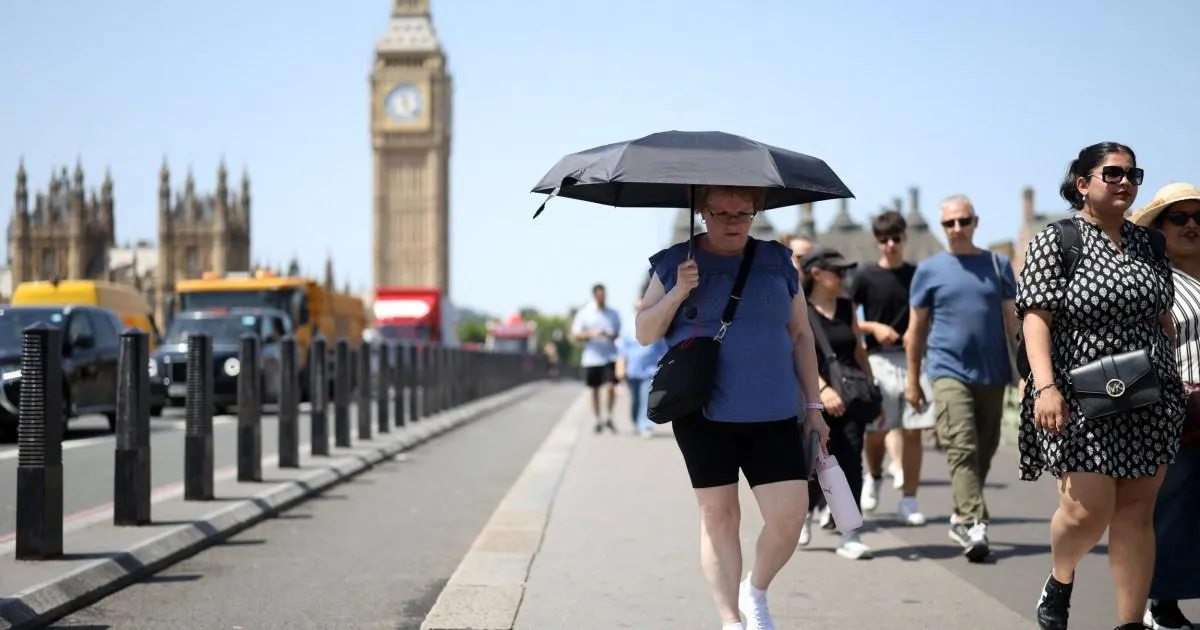
The United Kingdom finds itself in the grip of a relentless and record-breaking heatwave, with the country waking up groggy after yet another “tropical night” of stifling, inescapable humidity. As the scorcher enters its fourth day, the Met Office has extended its extreme heat warning through midnight, as temperatures continue to push toward a dizzying 39°C. Yesterday, the mercury hit a new national high of 36.7°C in Merryfield, Somerset—a figure that surpasses typical temperatures in tropical locations like Manila and Addis Ababa. With the air refusing to cool even after sunset, and overnight temperatures struggling to drop below 24°C in places like Surrey, the public is finding little to no respite from the punishing conditions.
The severity of the situation cannot be overstated, as a rare, “danger to life” red heat warning remains in effect for London and across the South East and South West of England. This is not merely a matter of physical discomfort but a broader systemic strain; the UK’s infrastructure is buckling under the weight of the heat. Rail operators have issued stark warnings, advising the public to travel only if absolutely essential, as buckling tracks and cooling system failures cause widespread disruption. Meanwhile, the Mayor of London has openly admitted that the capital is fundamentally ill-equipped to handle such extreme thermal stress, leaving commuters to navigate sweltering, airless transit lines that have become a focal point of public frustration.
The environmental fallout of this heatwave has been equally harrowing. Emergency services are stretched to their absolute limit as they battle wildfires across the country. In Derbyshire, a blaze has been tearing through the tinder-dry Tintwistle Moor for over 24 hours, requiring a massive response involving fire engines and water-dropping helicopters. Similarly, in South London, a major fire at a department store in Peckham Rye sent plumes of thick black smoke across the skyline, forcing residents to shelter indoors. These incidents highlight the precarious nature of the landscape, where a single discarded cigarette or stray ember from a barbecue can quickly escalate into a life-threatening, large-scale emergency.
Tragedy has also marred the heatwave, as the high temperatures drive people toward rivers and lakes in search of relief, often with devastating results. Reports from the Netherlands and Leicestershire highlight the dangers of open-water swimming during a heat dome, with authorities confirming the deaths of two young people who vanished beneath the surface while trying to cool off. These heart-wrenching incidents serve as a grim reminder of how quickly the pursuit of physical cooling can turn fatal. Parallel to these human tragedies, pet owners are being urged to exercise caution; the RSPCA has issued a vital correction to common advice, warning that draping wet towels over dogs can actually trap body heat and worsen their condition rather than bringing it down.
The sheer intensity of the heat is observable not just in the air, but in the very ground beneath our feet. Greenpeace recently conducted thermal testing across London, revealing that concrete surfaces and platforms reached agonizing temperatures of up to 65°C—effectively turning the city into a giant oven. Such data has catalyzed a fierce debate about public health and responsibility. Climate experts are pointing to these abnormal spikes as undeniable evidence of human-induced climate change, arguing that the government has been caught off guard and must move beyond temporary crisis management to create a more resilient, better-shaded, and greener urban future that protects the most vulnerable citizens.
As the country waits for the heatwave to finally taper off this weekend, the feeling of exhaustion is palpable. While the Met Office expects the extreme temperatures to shift eastward, the disruption to transport, the trauma of fire-damaged communities, and the ongoing alerts for widespread thunderstorms suggest that the “new normal” of British weather is increasingly volatile. This week has been an uncomfortable wake-up call for a nation built for temperate skies, forcing a difficult national conversation about how to adapt infrastructure, protect health, and mitigate the fossil-fuel-driven emissions that are making these record-shattering events commonality instead of abnormality.