
A Night of Tragedy on the A66: The Full Story Unfolds
In the heart of a quiet English night, the silence of the A66 was shattered by a sequence of events so sudden and so tragic that its echoes would ripple far beyond the tarmac. What began as a suspicious incident quickly escalated into a high-speed chase, a catastrophic collision, and a nightmare that would claim the lives of seven people, including the very officers tasked with protecting the public. This was not a random accident; it was a stark, brutal moment that laid bare a hidden and dangerous underbelly of crime, leaving a community in mourning and a police force thrust into a complex, painful investigation that was as much about seeking justice as it was about coping with profound loss.
The scale of the tragedy could not be overstated. Within a matter of seconds, families were shattered, friendships were severed, and a police force lost two of its own to the very dangers that are inherent in its service. The initial shock of the crash gave a way to a growing, horrifying understanding: this was an act of reckless, criminal deviance with a tragic outcome. The response turned from immediate rescue and recovery to methodical deduction, as police worked to piece together the puzzle of what had happened and, crucially, why. The community reeling from the scale of loss found itself facing an even darker reality: this was no mere accident; it was the violent culmination of a series of criminal actions.
The investigation, led by the Cleveland Police, revealed a chilling prelude to the tragedy. The crash occurred when a car, believed to be a Volkswagen Passat, was being driven the wrong way along the A road.
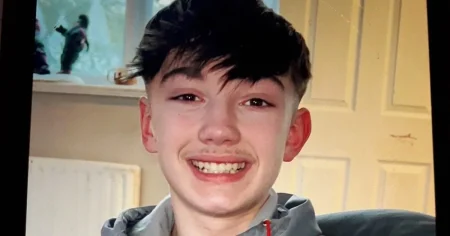
The victims were not just numbers on a page; they were vibrant individuals with stories and connections. PC Matthew Blades and PC Tom Clough were the officers who lost their lives in the line of duty, their sacrifice while actively trying to uphold the law and protect society a stark example of the risks taken daily by those who serve. The other victims, five young men and teenagers – Michael Robert Cahill, 23, Theo Rae, 17, Cole Robert Worthy, 16, Jacob Matusiak, 23, and Makai Saddington, 18 – were part of a tapestry of youth, in their full life, yet to be fully written. The sheer youth of the victims, especially the 16 and 17-year-olds, makes a deep reading of how lives can be so tragically cut short when they are caught in the ripple effects of choices made by others, or by their own affiliations, that they may not have fully understood.
The police released a statement that was both a promise and a warning. They confirmed that their investigation was rapidly evolving, uncovering significant links to serious and organized criminal activity. This led to a series of arrests, a dozen people – nine men and three women aged between 19 and 61. The timeline suggested that the events were not a random act of madness but a calculated series of maneuvers with a trail leading toward Middlesbrough. The police had received reports of two vehicles being driven dangerously, one of which, a Volvo XC60, was witnessed “ramming properties” in the area. This was not a of road rage; this was a coordinated operation of vehicle-based crime, involving both the crashed Passat and the recovered vehicle, both which were tracing back to the same group.
This revelation that both vehicles were operating with cloned number plates added a chilling layer of premeditation. The individuals in the car were using deception to avoid detection, a classic trademark of organized crime. That they were picked up by the force’s automated number plate recognition technology suggests they were not just committing random acts, but were flagged as individuals of interest, operating within a criminal matrix. The fact that police have suspected “participating in the activities of an organized crime group” and that other suspected offenses include the possession of a firearm, a means you are not dealing with petty criminals. This was a hard-edged, dynamic of a criminal network, and the officers who were killed, and those who survived, were facing a level of danger that was truly significant.
The aftermath of the incident placed Cleveland Police in the epicenter of a deep, painful vortex. Chief Constable Victoria Fuller spoke to the media, her words heavy with grief and resolve. The force had to carry out multiple roles simultaneously: investigate the deaths of their members, comfort the victims’ families, address the community’s fear, and bring to justice those responsible. The case was led by Assistant Chief Constable Wayne Fox, who, in a strong statement, tried to convey the deeply integrated nature of the work. He acknowledged the tragic loss and the “profound impact” on the Cleveland area, but his tone was unswerving. The statement revealed the full scale of the challenge at hand: the collision was the result of a serious criminal activity, and it was the police’s job to dismantle that world.
Four of the deceased young people who had been in the car had previous convictions. This is a concerning, complicated detail that strips away any notion of innocence. It suggests that some members of the car were not merely passersby but had a history of engaging in criminal behavior. The presence of previous convictions does not diminish the tragedy of their lives, but it does frame the context of the incident as one rooted in a world of re-offending and a disconnection from the normal safety of the outside. It raises difficult questions about their choices, their environment, and the pathways of influence that led to them being in that car on that night, with the police officers and a Volvo car racing through the dark.
The investigation has been a multi-part effort. The police’s role using technology to track the cars, the recovery of the Volvo in Middlesbrough, and the duration of the arrests all point to a forensic, tapping, purposeful approach. The fact that the police team which lost its own members, has pushed forward with such dedication speaks to the professionalism of the force. As one officer noted, “Officers and staff across Cleveland have shown incredible resilience in continuing their work in the face of tragedy.” That they have continued to manage, to be professional and to dismantle the same criminal network that likely decided to be a part of this, is a testament to their courage and their commitment to the duty they have sworn to uphold.
The crash has also introduced a sense of vulnerability. It presents the dual nature of the machine that is meant to protect the public. The officers were not just enforcing the law from a distance; they were on the frontline, actively involved in a pursuit that resulted in their deaths. The news of officers killed in the line of duty invokes a deep sense of loss not just within the force, but within the public consciousness. The tragedy turns from a mere report of a crash into a symbol of the daily risks those in uniform take to ensure public safety. This incident will forever be a dark day in the history of the force, and its memory will be a weight that the police department carries for years to come.
As the days pass, the investigation will continue to unearth new information, to bring to those responsible to account, and to find the reasons for why a night of crime suddenly turned into a catastrophic accident. The wreckage on the A66 serves as a chilling reminder of the unpredictable but pervasive nature of crime. It seems to have left an ecosystem of violence, where a vehicle used in a ram raid or a dodgy activity can quickly become a weapon of mass destruction. The fact that these serious and organized criminals are operating with a level of resources that includes cloning plates and possibly even firearms shows a dangerous level of capability that poses a direct threat to society.
In the aftermath, the community has been left to grapple with a mix of feelings: the grief for the officers, the young lives lost, and the fear that such darkness can unfold on their own roads. Floral tributes will be laid at the Cleveland Police HQ Memorial Garden in Middlesbrough, in what will be a physical and spiritual sign of their affection and respect. The funerals will be marked by blue lights and a sea of epaulettes, a sign of a police force in a desire to honor their fallen. But as the public mourning continues, the investigation continues, quiet and insistent, driving through the web of criminals to bring some sense of order to the chaotic loss.
The events on the A66 have ultimately forced a younger conversation about the nature of crime and consequence. The young victims, with their previous convictions, represent a life that was a part of a cycle of offending, maybe even overlapping with the very same world that would lead to their death. The police, alongside their families, will have to face the question that will never have a truly satisfying answer; what if a different approach could have been taken, what if this night could have been altered? Yet, the grim truth is that this was not an accident that just happened by chance; it was the violent, dangerous, and criminal actions of a group of people that escalated to a point of no return.
The full weight of the investigation will be stressful, but it is likely that we will start to see many of the same names and charges in the coming days. The role of the twelve arrested is still a matter of intricate investigation, but their significance is the main fact remains that a whole network is being scrutinized. The police have made a promise to take apart serious and organized crime in the area, and this has been a rapid, decisive move to do it. They will aim to show that they can withstand the loss of the officers, use it as a hard driving force to root out the very people; someone who are not just involved in this crash, but those who are embedded in the wider machinery of wrongdoing.
The legacy of this tragedy will be a complex one. PC Blades and PC Clough will be remembered as heroes, men who ran towards danger when others would run away. The young people may be seen as victims as well, but those with a clouded history. The overall narrative, however, highlights that in the face of this, there is an authority that is strong enough to prosecute the work of those who have lost, while maintaining the public’s trust. The message from the police is clear: they are not backing down. They are “robust in their response” and will continue to tackle those who threaten the community’s safety, even when that threat comes for them directly.
In the end, the tragedy on the A66 is a story of a community shaken to the core. It will be forever a tale of dangerous drivers, stolen plates, and a criminal web that turned a potential Saturday night into a graveyard. And yet, in the actions of the police service who have lost their own, the cause of justice, the determination to seek a resolution, and, in the spirit of those who laid down their lives for the safety of others, the story is also one of resilience, strength, and the perpetuation of the fight to protect the public. The investigations will conclude in courtrooms, but the long-lasting effects, the emotional weight, and the memories of that night will have a permanent home in the lives of all those she touched.