


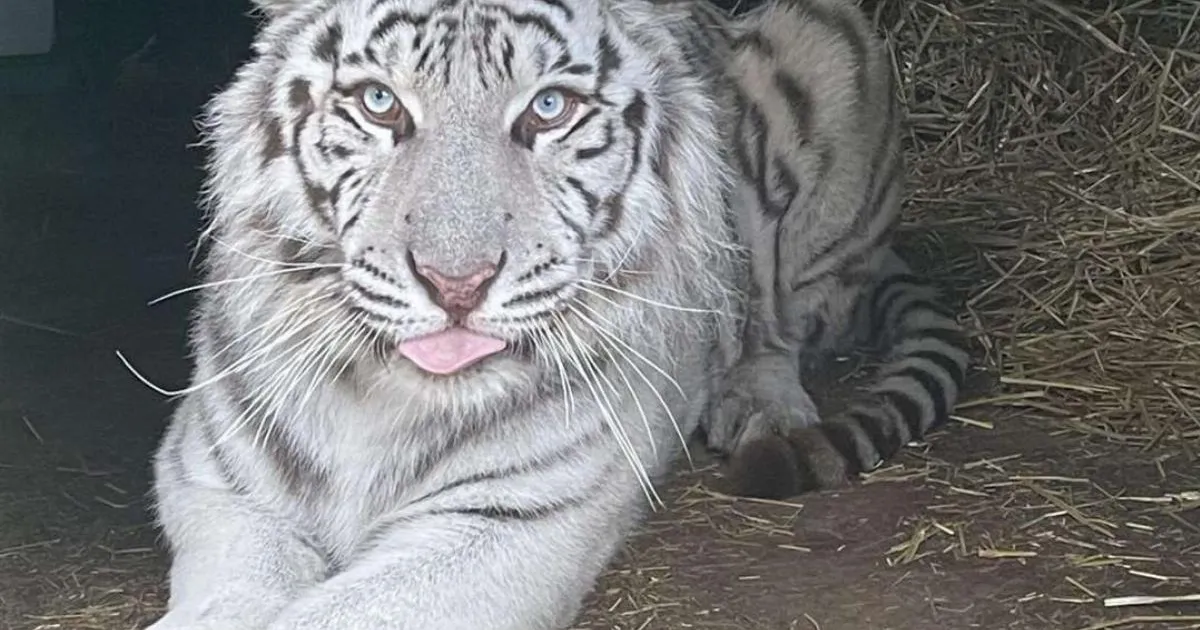
Two years ago, the life of Aleks, a majestic white tiger, was hanging by a thread amidst the terrifying chaos of a war-torn Kharkiv. Discovered by military volunteers in a residential yard—his original owner tragically presumed dead—Aleks was little more than a shadow of his true self. He was emaciated, suffering from severe parasitic infections, and trapped in a state of physical decline that left him unable to stand on his own hind legs. For eighteen months, he lingered in a makeshift rescue center in Ukraine, confined to a small concrete pen where the deafening, constant roar of nearby bombing shattered his nerves and left him deeply traumatized.
The path to salvation for Aleks was arduous, requiring eighteen months of diplomatic maneuvering to secure the permissions necessary to transport him across 1,630 miles of borders to safety. In February of this year, he finally arrived at the Lincolnshire Wildlife Park in the United Kingdom. Upon his arrival, the extent of his suffering became painfully clear to his new caretakers. Steve Nichols, the CEO of the park, recounted the heartbreaking condition of the tiger, noting that his skin was raw, his fur was patchy, and his digestive system was in a state of total collapse due to a tapeworm of such staggering size that it later became a subject of scientific study at Lincoln University.
Beyond the physical wreckage, Aleks arrived bearing the invisible scars of war. The team at Lincolnshire quickly realized that the tiger was suffering from acute Post-Traumatic Stress Disorder. Having lived in a war zone, he was perpetually hyper-vigilant; even the most benign environmental triggers, such as the rustle of the wind, the sound of a door clicking shut, or the call of a common bird, would send him into a state of visible, petrified panic. The park staff had to approach his recovery with extreme patience, recognizing that they weren’t just nursing a physical body back to health, but attempting to heal a broken spirit that had only known the volatility of conflict.
Five months of dedicated, specialized care have started to rewrite Aleks’ story, leading to a profound breakthrough this week: the tiger felt grass beneath his paws for the first time in years. This seemingly simple moment was a monumental victory in his rehabilitation. Observers noted a palpable shift in his demeanor; as his physical health improved through nutrition and medical intervention, the constant fear in his eyes began to soften. The once-gaunt animal is now filling out, his coat is regaining its health, and his transformation from a shell-shocked victim to a curious, active animal is a testament to the power of a safe and stable environment.
There is a newfound light in Aleks’ daily life that his keepers cherish deeply. Watching him engage with his surroundings—playing with a ball, splashing in his personal swimming pool, or basking in the waterfall—serves as a poignant reminder that even the deepest traumas can be navigated with time and kindness. Steve Nichols noted that the joy now visible in the tiger’s expressions and his evolving personality makes every ounce of effort from the staff worthwhile. It is a slow, steady progression, but Aleks is finally being afforded the luxury of being a tiger rather than a survivor of a war zone.
As Aleks moves forward, the team at Lincolnshire Wildlife Park is cautiously optimistic about his future. Estimated to be between five and six years old, he has many good years ahead of him, and the staff plans to eventually introduce him to other tigers at the facility to provide him with social companionship. While he will not be used for breeding, the goal is to provide him with a “friend” who can help him continue his integration into a peaceful life. His journey from a concrete yard in a war-torn city to the lush, safe grounds of a British sanctuary serves as a powerful reminder of resilience and the incredible impact that dedicated care can have on a life once thought to be lost.