
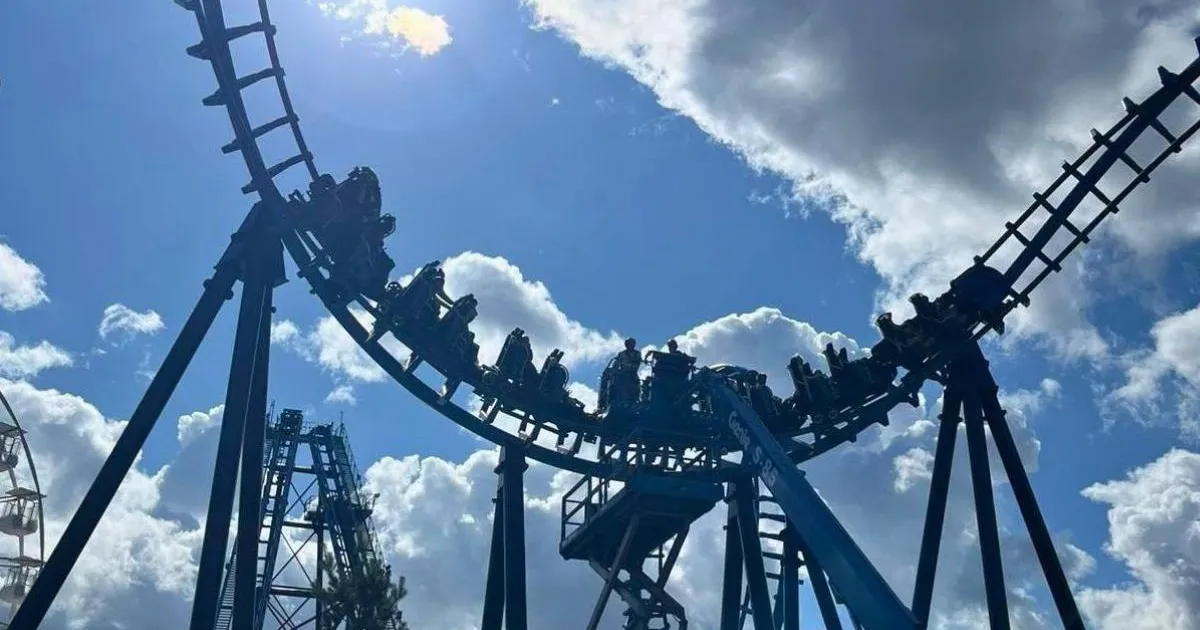
On what should have been just another bright, blustery afternoon in the seaside town of Lowestoft, the familiar sounds of a theme park—laughter, screams, the mechanical clatter of a rollercoaster climbing its track—suddenly took on a much more anxious tone. At Pleasurewood Hills, a much-loved family attraction in Suffolk, the Wipeout rollercoaster had ground to a halt with nearly 30 riders trapped high above the ground. For more than three hours, those thrill-seekers remained suspended in open air, about 50 feet up, clinging to the harnesses that had just moments before been there to keep them safe. What had started as an exciting ride, one that promised the rush of loops and inversions, became a frightening, static ordeal. The incident unfolded just before 1:30 p.m., turning an ordinary outing into a situation that no family had prepared for. Parents on the ground stared upward in disbelief, their hearts pounding as they tried to count heads and spot their children among the stranded passengers. The rollercoaster, designed to surge through a terrifying cobra roll and a vertical loop, now sat motionless on its track, its carriages far from the loading platform. For those trapped, every minute must have felt like an hour; for those waiting below, the silence between rescue updates was unbearable. The carefree energy of a day at the park had evaporated, replaced by something far heavier.
The emergency response was swift, though the rescue itself was never going to be quick. Suffolk Fire and Rescue Service received the call and sent crews from three different stations to the scene, understanding immediately that this was not a routine false alarm. The Wipeout’s carriages had come to rest on the track at a height of approximately 15 metres—roughly 50 feet—and while the ride was not upside down, the passengers were completely unable to get themselves down. For people who had boarded anticipating a brief, adrenaline-filled adventure, the reality of being locked into a rollercoaster seat for hours was deeply unsettling. Firefighters arrived and began working methodically to bring everyone to safety. They used an aerial ladder and a scissor lift, carefully positioning equipment beneath the stranded carriages and helping each passenger climb or be guided down. It was a painstaking process, requiring patience, precision, and strong nerves. The fire service later confirmed that all 27 passengers had been rescued and brought safely to the ground. “No one was injured,” a spokesman said, offering the first real relief to the families who had spent the afternoon in a state of fear. The rescue was a testament to the professionalism of the emergency services, who refused to rush something that demanded care and caution. Each person brought down was reuniting with loved ones, some in tears, others embracing in silent relief. The fact that no one was physically hurt did not erase the emotional toll, but it transformed the story from one of disaster to one of deliverance.
One of the most powerful perspectives came from a passenger who posted on Facebook, speaking not only for herself but for every parent who had stood helplessly on the ground. “My children were on the ride and whilst it was a terrifying experience for them and me, the park and fire services did a great job,” she wrote. Her words capture a strange duality: the obvious fear of seeing your children stranded high above the ground, and the gratitude that comes when strangers rise to the occasion and bring them back safely. She also offered a rare and valuable technical account of what went wrong. The ride, she explained, did not simply stall in the way people might imagine. “It got stuck on the back straight and when they released it the back brake didn’t stop it from travelling very slowly back onto the loop, swinging back and forth and coming to rest on the middle section.” That description paints a vivid picture: the coaster creeping backward, the passengers feeling the unexpected reverse movement, the gentle but unnerving sway as the carriages settled into an unnatural position. For the riders, this must have been particularly disorienting—not a clean stop, but a slow, lurching glide into jeopardy. Yet even in the middle of that fear, the passenger chose to praise those who helped. That instinct to find gratitude amid trauma is deeply human. It speaks to the resilience of the people involved and the comfort that comes from knowing someone is working hard to help you, even when you cannot control what is happening around you.
The Wipeout is not just any rollercoaster; it holds a special place in the landscape of British theme park attractions. It opened at Pleasurewood Hills in 2007, bringing a surfing-themed ride to a park that had long been known for family-friendly fun. What made it even more distinctive was its design: it was, and remains, the only Vekoma Boomerang in the country. For those unfamiliar with rollercoaster engineering, a Boomerang is a fascinating and intense experience. The train is launched backward up a lift hill, then released and allowed to hurtle forward through the circuit, passing through a cobra roll and a vertical loop before the entire sequence is reversed. That combination of speed, inversion, and reversibility makes it a favourite among adrenaline seekers. For many teenagers in that part of Suffolk, riding the Wipeout was a rite of passage—a test of courage, a shared memory, a photo taken with shaking hands. The fact that such an exciting machine could become the site of a prolonged rescue is not a commentary on the park’s safety so much as a reminder that all mechanical things can behave unpredictably. The passenger’s account suggests that the ride’s braking system did not engage as intended, causing the train to roll slowly backward into a section of track where it eventually stopped. In the aftermath, questions will rightly be asked about maintenance and inspections, but for the families involved, the immediate concern was always the people, not the machinery. The Wipeout will likely be examined thoroughly before it carries anyone again, but the ride’s legacy in the community will now include this story of survival and rescue.
This incident also resonates beyond the park gates because it touches on a universal fear: being trapped in a confined space, helpless and exposed, while life below continues without you. Theme parks are built around the promise of controlled danger—a safe way to feel afraid. When that illusion is broken, even briefly, it is unsettling for everyone. But there is also something deeply reassuring about the way such incidents unfold. The emergency services responded not with panic, but with procedure. Firefighters from three stations came together, combining their skills and equipment to solve a problem that had no quick answer. The scissor lift and aerial ladder used in the rescue were not just tools; they were bridges between fear and relief. Meanwhile, the park’s staff worked alongside the firefighters, doing what they could to manage the situation and comfort those waiting below. The Facebook comments and local conversations that followed were filled with messages of support, thanks, and shared memories of the ride. Strangers who had never met the stranded passengers felt their anxiety and shared their relief. In that sense, the incident became a community moment, a reminder that even in moments of crisis, people have an instinct to care for one another. The fact that no one was injured is, of course, the central joy of the story, but the experience itself will linger for those 27 passengers and their families. They will remember the fear, but they will also remember the hands that helped them down, the voices that encouraged them, and the embrace of a parent or friend once their feet touched solid ground.
In the end, this is a story about vulnerability and rescue, about a day that went wrong and a response that went right. The Wipeout may have earned its name in the most ironic way possible, but the people trapped on it were not left to face their fear alone. For three hours, they hung in the air, suspended between the ride they expected and the experience they never wanted. Around them, firefighters worked steadily, refusing to be overwhelmed by the difficult circumstances. Below them, anxious families and park staff waited, hoping and praying for a safe outcome. And when the last passenger finally stepped out of the scissor lift, the collective sigh of relief must have been almost audible. The mother who wrote about her children’s ordeal summed it up best when she acknowledged both the terror and the gratitude. There is no shame in being scared, and there is no shortage of grace in thanking those who respond to danger with courage and skill. The park has promised to review the incident, and the ride will no doubt be scrutinised before it reopens. But in the memories of the people involved, the rollercoaster might never feel quite the same again. Perhaps that is okay. Sometimes the most important lesson from an event like this is not about machinery or maintenance, but about human connection. When the ride stopped moving, everyone around it moved closer. When the carriages finally came to rest, the people inside them were carried down with care. And when it was all over, the greatest comfort was simply this: the ride failed, but the people did not.