


Paragraph 1: The Shattered Routine at Gatwick
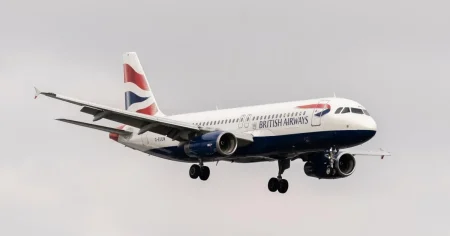
The ordinary rhythm of a summer morning at London Gatwick Airport was shattered by a discovery that turned a routine international arrival into a heartbreaking tragedy. On a Tuesday in June, an Air Arabia aircraft touched down from Tangiers, Morocco, carrying passengers and crew who were simply relieved to be on solid ground after their flight. However, as the plane taxied to a standstill and the ground crew moved in to perform their standard post-flight checks, a sharp-eyed engineer noticed something deeply wrong. A packing strap—the kind used to secure cargo or personal belongings—was hanging loosely from the sealed recess of the landing gear compartment. As he moved closer and peered into the cramped, mechanical void, the engineer’s world narrowed to the grim reality of what lay within. There, tucked among the hydraulic lines, wheel struts, and heavy metal fittings, was the body of a man. He was unresponsive, utterly still, and clearly long past the point of any possible medical intervention. The alarm was raised immediately, but it was already too late. What had begun as a standard international arrival had transformed into a grim crime scene and the subject of a formal inquest. This was not a mechanical failure or a traditional security breach; it was the final, frozen chapter of a desperate journey undertaken by someone whose identity would remain a profound and troubling mystery. The man, who has yet to be identified, had somehow evaded the intense security screening that surrounds airfields, climbed into one of the most dangerous places on any aircraft, and traveled thousands of feet above the Earth’s surface without a ticket, without a passport, and without protection from the merciless conditions outside. His discovery sent shockwaves through the airport community, forcing everyone from baggage handlers to airline executives to confront the brutal reality of human desperation. The engineer who made the find did not simply report a technical anomaly; he had stumbled upon a human life that had slipped through the cracks of the world, ending silently in a dark, unfeeling space designed for machinery, not for people.
Paragraph 2: The Brutal Physics of His Final Moments
The post-mortem examination, conducted in the days following the discovery, painted a stark and clinical picture of a death that was tragic but tragically unsurprising given the circumstances. The pathologist attributed the man’s demise to a cardiac arrest, which was itself precipitated by two brutal physiological realities: hypoxia, or the severe lack of oxygen available at high altitude, and hypothermia, the catastrophic drop in core body temperature. As the Airbus climbed to its cruising altitude, likely somewhere in the range of 30,000 to 40,000 feet, the temperature outside plummeted to around minus 50 degrees Celsius or lower. The wheel well, while offering a hiding spot, provides virtually no protection from the elements. It is not pressurized like the main cabin, meaning the air is thin and unbreathable once the plane ascends. In such an environment, the body’s systems rapidly begin to fail. The brain, starved of oxygen, causes confusion and lethargy, while the freezing temperatures attack the extremities and eventually the core organs. It is a silent, agonizing descent into unconsciousness. One can imagine the man’s final moments—perhaps he had prepared himself for the cold, wrapping himself in layers of clothing or hugging his knees for warmth, but there is no preparation for the sheer, unrelenting brutality of the upper atmosphere. Perhaps he drifted into a merciful sleep as his blood thickened and his heart struggled to beat against the chilling assault. Eventually, his heart simply gave out, ceasing its rhythm as the wheels prepared to lower for the descent into England. The landing gear itself, which would have deployed for the final approach, probably meant nothing to him at that point; he was already gone. The flight from Tangiers, which takes roughly three hours, had been a journey into the void for him, a gamble with death where the odds were overwhelmingly stacked against survival. He did not merely freeze to death; he was structurally isolated from humanity, invisible to the pilots, passengers, and air traffic controllers who were thousands of feet away, completely unaware of the life ebbing away in the shadows of the undercarriage.
Paragraph 3: A Life Without a Name
The most heartbreaking aspect of this case is that the man remains unidentified. He is a person without a name, a face without a history, a life without a narrative. The inquest, formally opened by West Sussex Brighton and Hove Area Coroner Joseph Turner, was based on the somber conclusion that there was “reason to believe this death was unnatural.” But in the absence of identification, the coroner and the police are left to piece together a story from a pile of cold evidence. Who was this man? Was he a young migrant desperate to reach the United Kingdom to escape poverty or political turmoil in North Africa? Was he a seasoned traveler who had lost his documents and made a drastic, fatal choice? Or was he simply a soul in such a state of profound despair that he saw the undercarriage of an airplane as a viable mode of transport, a desperate lottery ticket for a new life? For the people of Tangiers, the port city from which the flight originated, the story is likely one of a local person who vanished without a trace. Perhaps his family in Morocco is still waiting for him, still wondering why he never called, never returned, never sent word. The tragedy is doubled—they do not know he is dead, and while they search for answers, a coroner in England is trying to give him back his name. The investigation will rely on fingerprints, DNA samples, dental records, and any personal effects tucked into his clothing. But without identity, there can be no closure. There is no next of kin to notify, no funeral to arrange in his hometown, no obituary to mark his passing. He exists only as a statistic in aviation lore—a tragic footnote in the annals of stowaway fatalities. The silence surrounding his identity is a testament to how many people live on the margins of the world, disconnected from the digital and social networks that define modern life. He might have been in the country illegally, or he might have been a citizen of nowhere. His story illustrates the cruel paradox of our interconnected world: we can fly across continents in hours, yet there are still men and women who disappear from the record, found only by chance when their bodies are discovered in unconventional places.
Paragraph 4: The Aftermath and the Human Cost at the Airport
The immediate aftermath at London Gatwick was handled with a quiet, professional efficiency that belies the deep human shock of the incident. The discovery triggered a full emergency response. Airport ambulances, police units, and fire crews converged on the aircraft just after 11:30 AM, cordoning off the area and shutting down the immediate vicinity to allow investigators to work. A spokesperson for London Gatwick addressed the public with a statement heavy with solemnity: “Our teams subsequently supported Sussex Police and the coroner. Our thoughts are with everyone affected.” The statement, while formal, hints at the deep unease that ripples through an airport when the machinery of travel collides with human mortality. Airports are places of transit, of rapid movement, of bustling crowds and tight schedules. They are not designed for endings. For the ground engineer who made the discovery, the memory of finding a body in the landing gear will likely never fade. It is a psychological burden that no amount of training can prepare a person for. The plane itself, once the scene of such a tragedy, was taken out of service for examination, grounded while teams meticulously documented the scene. The other passengers who had been aboard the flight were likely debriefed or simply released, unaware that they had spent hours in the air with a dying man beneath their feet. The collective emotional impact on the airport workforce cannot be overstated. Baggage handlers, mechanics, and security staff all share an unspoken duty to keep the sky safe, but when a human life slips through the cracks, it serves as a stark reminder that their duty transcends the mechanical. It forces a pause, a moment of reflection on the lengths people go to for a chance at something better. The airport’s official response was swift, but the emotional recovery for those directly involved would be a longer, more private process. It is a story that will be talked about in hushed tones in the break rooms of Gatwick for years to come, a testament to the fragility of life and the unseen stories that fly with us in the sky.
Paragraph 5: The Slow, Melancholy Wheel of Justice
The formal legal process began when Joseph Turner, the area coroner for West Sussex Brighton and Hove, opened the inquest. His declaration that he had reason to believe the death was “unnatural” set the wheels of justice and investigation in motion. The coroner’s office will lead a meticulous inquiry into the circumstances surrounding the man’s death. How did he gain access to the aircraft in Tangiers? Was there a security lapse at the Moroccan airport, or did he exploit a weakness in the perimeter fencing during a stopover? The airline, Air Arabia, will be compelled to cooperate, examining their security protocols and airport procedures. The inquest is not merely a legal formality; it is a search for accountability and understanding. The post-mortem details—cardiac arrest due to hypoxia and hypothermia—will form the bedrock of the medical evidence, establishing the exact timeline of his demise. Following the initial hearing, which was brief and procedural, the coroner adjourned the inquest until February 24, 2027. This lengthy adjournment underscores the complexity of the case. It provides time for the investigation to run its course, for forensic analysis to be completed, and, crucially, for any potential leads regarding the man’s identity to emerge. Yet, the date on the calendar also carries a note of melancholy. In a routine death, the inquest brings a swift conclusion. Here, the process is stretched out across months, an acknowledgment that the mystery may never be fully solved. The man lies somewhere in a mortuary, kept in a state of suspended animation, waiting for a name to be attached to his case file. The coroner’s court, a place usually associated with dry legal terms and clinical procedures, becomes a stage for this profound human mystery. The inquest will eventually be resumed, perhaps to close the case with a verdict of misadventure or an open conclusion, but the core question—who was he, and why did he do it?—may forever remain unanswered, leaving the legal system to do its best with a case that lacks even the most basic identifying information.
Paragraph 6: A Silent Parable of Desperation and Hope
The story of the unidentified stowaway at Gatwick is far more than a news item about a body found in a plane. It is a profound, silent parable about the human desire for escape and the terrifying price of desperation. Every year, dozens of people around the world attempt to cross borders by hiding in the landing gear of aircraft, and tragically, most of them do not survive. The survival rate for such attempts is grimly low, often estimated at around 20 to 25 percent. They are acts of desperation born from environments where the future seems so bleak that freezing to death in a metal compartment is considered a preferable risk to staying home. The man who died on that flight from Tangiers represents a universal archetype: the refugee, the migrant, the exile. His story transcends the specific geography of Morocco and England, touching on the global struggle for economic opportunity, safety, and dignity. While we may never know his name, his journey forces us to confront uncomfortable truths about our world. Why do people choose such a lethal path? Is it the failure of legal migration routes, the perceived indifference of wealthy nations, or the sheer overwhelming weight of hope over experience? The aviation industry treats such incidents as security anomalies, but they are fundamentally humanitarian crises. The wheel well was his coffin, but it was also his vehicle of hope. He died not because he was reckless, but because he was driven. His final act was one of profound faith in the possibility of a new beginning, even though the universe, in the form of cold air and thin atmosphere, had other plans for him. As the inquest adjourns and the memory fades from the headlines, the silence surrounding his identity is a call for empathy. We must remember that behind the clinical term “hypothermia” lies a human being who once had dreams, a mother, maybe a wife or children. He laughed and cried, loved and feared, just like the rest of us. He remains anonymous to the world, but his sacrifice is a testament to the lengths we will go to for a chance at life. We may not know who he was, but we know what he represented: the unyielding, often tragic, resilience of the human spirit. In honoring his memory, we are called to look beyond our borders and our routines, recognizing that every flight carries not just cargo and passengers, but sometimes, the silent stories of the world’s most desperate souls.