

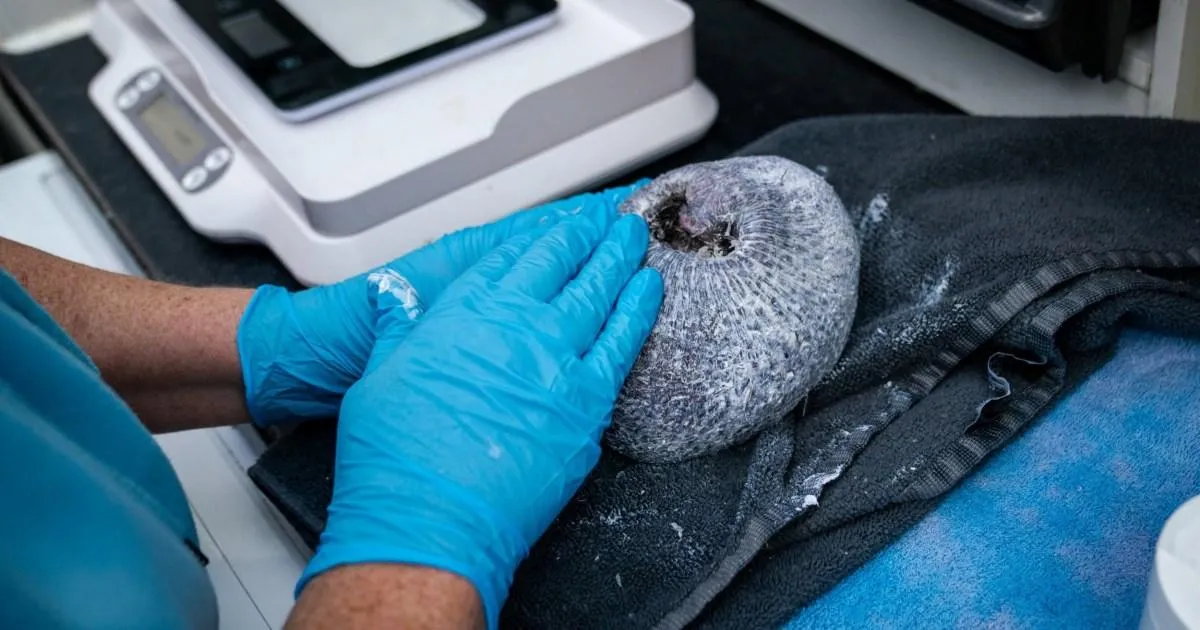
1. The Unlikely Arrival of a Prickle‑Less Hedgehog
In the quiet coastal village of Stoke Fleming, Devon, where the rolling hills meet the English Channel, a most unexpected patient has captured the hearts of animal lovers around the world. Ollie, a small hedgehog, arrived at the doorstep of the rescue charity Prickles in a Pickle in a state that would leave any seasoned wildlife rehabilitator stunned: he had no prickles at all. Instead of the familiar coat of stiff, protective spines that hedgehogs are universally known for, Ollie’s back was almost bare, with only a sparse scattering of short, broken quills clinging to pale, irritated skin. His tiny face was so crusted and swollen that he could barely open his mouth, and his eyes, though bright with a will to live, were framed by raw, wounded tissue. He was a strange, almost alien sight — a hedgehog stripped of his very identity. Found struggling to eat and clearly in tremendous pain, Ollie was brought into the care of the charity’s co‑founder, 66‑year‑old Judy Thomson, who immediately understood that this was no ordinary case. The little creature was not just suffering from a simple skin condition; he was bearing the heavy burden of a severe, systemic assault on his health. His condition was so dire that he could not even perform the most basic act of survival — feeding himself without bleeding. For Judy and her partner Alan Pook, the rescue was the beginning of a long, arduous, and deeply touching journey to restore not just Ollie’s health, but his very essence as a hedgehog. There was something almost poetic about the sight of a creature so vulnerable, stripped of his natural armor, yet still fighting with a quiet stubbornness that would inspire thousands of strangers to root for him. Ollie had arrived with nothing but his own fragile life, and it was up to the dedicated team at Prickles in a Pickle to give him a second chance.
2. A Hidden Epidemic Under a Warmer Sky
As Judy and Alan gently examined Ollie, the cause of his extraordinary disfigurement began to emerge. Veterinary tests confirmed that he was suffering from a dual infection: a severe case of ringworm, a fungal infection that attacks the skin and hair, compounded by a bacterial infection that had taken advantage of his weakened state. Together, these infections had caused most of his prickles to fall out, leaving behind painful crusts and lesions that covered his body. The most heartbreaking symptom was around his mouth, where thick, hard crusts had formed to such a degree that he could not open his jaws to eat. Every attempt to take food resulted in bleeding, a slow and agonizing process that had left him malnourished and barely alive when he was found. The reasons for this outbreak were deeply tied to the changing climate in the United Kingdom. In past winters, the freezing frost would naturally kill off many fungi, parasites, and bacteria that attack hedgehogs. But this year’s warmer weather meant that those pathogens survived the winter months, leading to a spike in illness among the already vulnerable hedgehog population. Judy explained, “The crust around his face was so severe that he couldn’t open his mouth to eat properly. Every time he opened his mouth, he bled. So it was very painful for him.” The implication was sobering: Ollie was not an isolated case, but a symbol of the environmental pressures that increasingly affect Britain’s garden wildlife. The warmer winters, while pleasant for humans, create a perfect breeding ground for diseases that decimate hedgehog numbers. Ollie’s suffering was a direct consequence of this broader ecological shift, a silent crisis unfolding in backyards and hedgerows across the country. For Judy, seeing him was both heartbreaking and infuriating — a tiny creature paying the price for a changed world, and yet, against all odds, still clinging to life.
3. A Slow and Steady Road to Recovery
The treatment for Ollie was neither quick nor straightforward. Initially, the vets tried conventional antifungal and antibiotic medications, but, much like in human medicine, the infections showed signs of resistance. “We’ve had to think outside the box,” Judy admitted, noting that they had to rotate treatments, use topical creams, and adjust his environment meticulously to ensure he could heal. The first weeks were touch‑and‑go. Ollie was too weak to eat solid food, so the team fed him by hand with a syringe, carefully managing his pain and ensuring he received enough nutrition to build his strength. His face, once obscured by thick crusts, slowly began to reveal the delicate features beneath as the infections receded. Judy described his progress with cautious optimism: “He’s looking a lot better now. His skin is better and not as crusty. He’s eating independently, maintaining his weight.” Though he was no longer in constant pain, his prickles had not yet regrown, leaving him vulnerable and strange to look at. But the staff at Prickles in a Pickle treated him with extraordinary tenderness, understanding that beneath his odd appearance beat the heart of a wild creature yearning to be free. However, the road to full recovery was far from over. A wild animal in captivity for a long period is never ideal, but Judy was committed to giving Ollie the time he needed. “Obviously, it’s not ideal to have a wild animal in captivity for a long period of time. But as long as they’re improving, that’s okay,” she said, acknowledging that patience was the only true medicine. Every day brought small victories — the first time Ollie groomed himself, the first time he curled up without bleeding, the first time he seemed to recognize his caregivers as sources of comfort rather than fear. It was a slow, painstaking process, but one filled with quiet hope.
4. The Unexpected Internet Sensation
As Ollie’s health improved, Judy decided to share his story with the world. She posted a video on social media, not expecting the overwhelming reaction that followed. In the video, Ollie walked cautiously across a soft blanket, his naked pinkish body waddling with that unmistakable hedgehog gait, but without the spiky coat that makes them so iconic. It was comical, sad, and fascinating all at once. Within days, the clip had been viewed more than 13 million times, drawing comments from people across the globe who were mesmerized by this odd little creature. Some called him an avocado, its rough exterior peeled away; others likened him to a rolled‑up sock or a very large potato. Judy laughed at the comparisons, saying, “He’s been likened to all sorts of objects, looking like he does. Like a rolled‑up sock or a very large potato.” But behind the humor was a genuine sense of connection. Ollie’s bareness made him relatable — a vulnerable soul facing the world without armor, which resonated deeply with millions of people who felt exposed or fragile themselves. His story was not just about a hedgehog; it was about resilience, gentleness, and the kindness of strangers. Judy had initially posted the video for her volunteers and followers, “to see what a prickle‑less hedgehog looked like,” because they look so different that someone might not even know it was a hedgehog. But the viral attention brought something more valuable than just curiosity: it brought support. Donations began pouring into the charity, and Ollie quickly became the “poster hog” for a fundraising campaign that raised nearly £5,000 to date. This flood of generosity was a lifeline for the much‑needed work of Prickles in a Pickle, and it all started with one small, bald hedgehog who, by simply being his authentic, odd self, taught people about compassion.
5. The Mission Behind the Cuteness
For Judy Thomson and Alan Pook, the care of hedgehogs is more than a hobby — it’s a full‑time, all‑consuming mission. Running Prickles in a Pickle from their home in Stoke Fleming, the couple spends between £65,000 and £70,000 a year on food, medication, heating, and veterinary bills. That’s an astonishing amount for a charity run out of a private residence, and it’s growing every year. When they started seven years ago, they looked after about 40 hedgehogs annually. Today, they take in over 1,000 hedgehogs each year, with up to 200 in residence at any one time. The increase is staggering — a reflection of the mounting threats facing hedgehogs in Britain, from habitat loss to road traffic, and now, as Ollie’s case illustrated, disease exacerbated by warmer winters. The financial pressure is relentless. Every volunteer, every bowl of food, every dose of medication costs money, and outside of their own funds and occasional donations, they rely heavily on the public’s goodwill. That’s why Ollie’s viral moment was such a gift. The £5,000 raised in his name will go directly toward helping other hedgehogs just like him — those with ringworm, those with injuries, those who have been orphaned or found wandering in the daylight, a sure sign of trouble. Judy’s voice carries the weariness of someone who works countless hours, yet the passion is still there. She speaks of the hedgehogs as individuals, each with their own quirks and challenges, and it’s clear that she and Alan have poured their souls into this cause. Ollie, once a nearly helpless, spikeless creature, has become a symbol of their tireless efforts — a small beacon that brought the world a little closer to understanding the quiet crisis that hedgehogs face.
6. Hope for the Future and a Gentle Goodbye
As Ollie continues his slow recovery, the team at Prickles in a Pickle begins to hope that, eventually, they can return him to the wild. It will not be easy. His skin is still delicate, and without proper prickles, he remains vulnerable to predators and the elements. But hedgehogs are remarkably resilient creatures, and with time, warmth, and good nutrition, his spines may begin to regrow — a second chance at a normal life. Judy remains cautiously optimistic, knowing that the ultimate goal is release back into a hedgehog‑friendly habitat. “As long as he’s improving,” she repeats, “that’s okay.” But she also knows that his story has touched people in a way that transcends the individual animal. For those who followed his journey, Ollie has become a lesson in the power of empathy — a reminder that even the strangest, most vulnerable creature deserves care and a second chance. His face, once obscured by crust and pain, now shows a curious, gentle spirit. He has already given back more than he ever took: raising awareness, raising funds, and raising our collective hearts. For Judy and Alan, each day spent nursing Ollie is a day spent doing what they love most, but also a day in which they wonder how many more hedgehogs they can save before the costs overwhelm them. They hope that Ollie’s fame will inspire more people to support local wildlife rescues, to hedgehog‑proof their gardens, to drive carefully at night. Because as Ollie’s story shows, sometimes the smallest and strangest-looking creatures can bring out the best in humanity. The day he is finally released, bald but brave, will be a bittersweet moment — a goodbye to a beloved patient, but a triumph for the spirit of wildness. And somewhere in the hedgerows of Devon, a once‑naked hedgehog will trundle off, carrying with him the love of millions.