

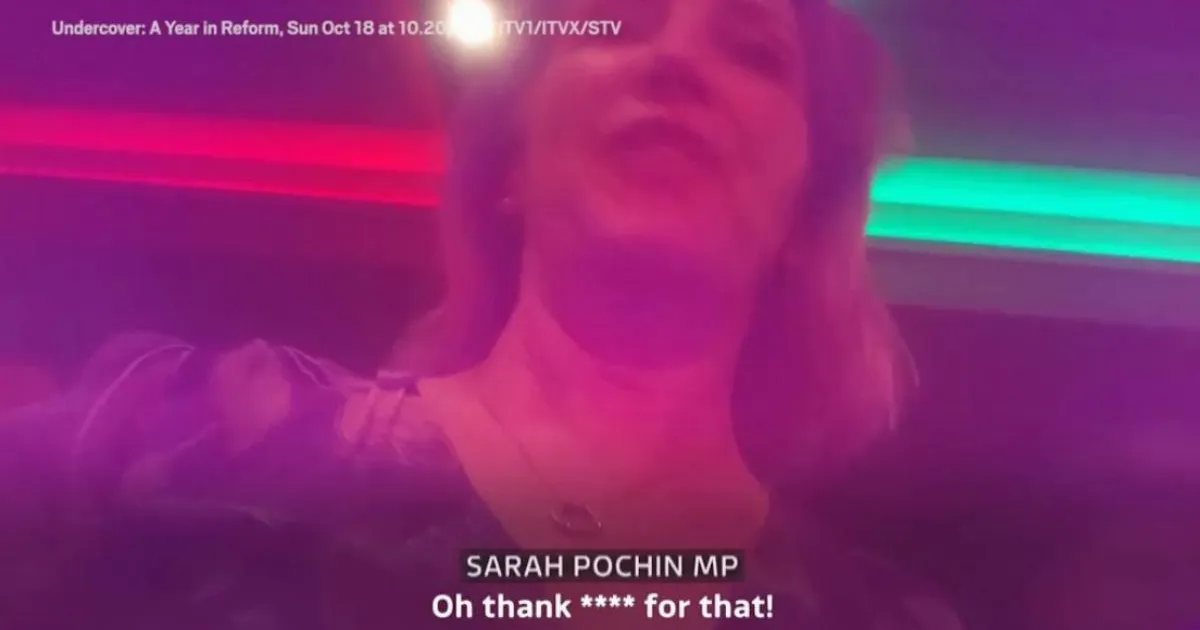
It began like any other Christmas party—small talk, tinsel, the low hum of festive cheer—but this one was secretly being filmed. Undercover reporters from ITV had slipped into Reform UK’s world, and what they captured was a raw and uncomfortable confession from inside a party that has quickly become one of the most talked-about forces in British politics. The footage caught Sarah Pochin, the Reform MP for Runcorn and Helsby, letting her guard down with a woman she believed was a new press officer. When the supposed staffer mentioned she would be starting in January, Pochin’s relief was immediate and unguarded: “Thank f* for that.” Then came the truth she seemed almost desperate to share: “We so need women press officers. They are so f**** chauvinistic.” The words did not sound rehearsed or calculated. They sounded like the exhaustion of a woman who had spent months smiling through a culture she believed pushed women to the edges. She spoke of a “bit of a male issue going on,” and admitted she sometimes felt forced to pretend the party was welcoming to women, even when it was not. That small, human detail is what makes the footage sting. This was not a political attack from an enemy; it was a warning from an insider, whispered at a party, to a stranger she hoped would become an ally.
Pochin’s comments become even more human when placed in context. She is not a career politician coasting on safe margins; she won her seat in a by-election by just six votes. She knows what it is like to fight for every single voter, and she has stepped into the Commons as one of the few women in a movement dominated by loud, powerful male voices. Yet instead of feeling victorious, she seemed isolated. The undercover reporter, posing as an incoming female press officer, was told she would have to be prepared to “defend the indefensible.” That phrase is chilling because it reveals so much about the job she was supposedly about to take on. It was not, according to Pochin, a job about promoting good news or sharing a positive vision. It was a job about damage control, about standing in front of journalists and voters and explaining away the worst things that male colleagues had said and done. Imagine being told, before your first day at work, that your main task would be protecting people who made your stomach turn. For Pochin, this seems to be a lived reality. She has had to perform a version of loyalty she does not fully believe in, and her private relief at the arrival of another woman suggests she has been carrying that weight alone. It is a deeply lonely place to be: surrounded by colleagues, yet unable to say what you really think until you are in a corner with someone you trust.
The investigation that captured these moments was not a quick sting operation. It was a year-long undercover project that gave ITV access to Reform UK’s headquarters at Millbank Tower in Westminster. Across months of filming, the hidden cameras caught far more than one MP’s complaint about sexism. They caught a party machinery designed to manage scandal rather than confront it. One example involved Chris Parry, a Reform mayoral candidate for Hampshire and the Solent, who had written that then deputy prime minister David Lammy should “go home to the Caribbean where loyalty lies.” The racial undercurrent of that remark should have been indefensible, and Reform’s own director of communications, Ed Sumner, recommended that Parry be sacked. But Nigel Farage, the leader of the party, decided otherwise. Parry could stay, Farage ruled, as long as he apologised. It was only after Parry made further controversial comments about Shomrim, the Jewish voluntary neighbourhood patrol service, that he was finally suspended. For anyone watching the footage, the pattern is grimly familiar: a racist remark is made, a serious recommendation is ignored, an apology is accepted, and the person stays in place until the pressure becomes too loud to ignore. That is not a culture rooted in accountability; it is a culture rooted in calculation.
The hidden camera also captured officials deliberating over yet another councillor, Gavin Beales from north Northamptonshire, who had been found to have links to a white supremacy dating site that promoted Nazi publications. Their private reaction was staggeringly casual. They described his connection to the site as “not great, but not a resignation issue.” Let that settle for a moment. A man connected to a platform promoting Nazi literature was considered, by a professional political press department, to be only a minor embarrassment. The party later insisted that Beales had “no case to answer,” even though the evidence was sitting there in public view. Then there was Alan Feeney, a councillor and deputy mayor of Solihull, caught on tape describing Asian homeowners as “parasites” and declaring that no more than one percent of Britain “can be non-white.” Those are not careless words; they are open expressions of racist ideology. Feeney has since said he left Reform for “personal reasons,” a vague phrase that conveniently lets the party avoid saying the word “racism.” Watching these clips together, the message becomes clear: Reform UK is not a party where one or two bad individuals happened to slip through the cracks. It is a party where the officials who are supposed to root out extremism instead shrug, rationalise and hope the story will go away. The dehumanising effect is enormous. People become problems to be managed, not citizens to be respected.
Robert Jenrick, Reform’s treasury spokesperson and a former Conservative cabinet minister, was forced to respond to the investigation like a man trying to put out a fire with a bucket of soothing words. He said he “didn’t like” some of what he saw, but insisted that all political parties have “bad apples” and that the relevant councillors had been suspended or asked to resign. He also dismissed Pochin’s comments, saying her recollection was not his experience of the party, and added that she could “rely” on him. On the surface, that sounds reasonable. Every party has its problem members. But the “bad apple” metaphor is itself a way of avoiding responsibility. If you keep finding bad apples in the same orchard, and if you keep deciding that each one is not quite bad enough to remove until the public finds out, then the orchard itself is the problem. Jenrick also said that people should not be thrown under the bus unfairly, which sounds noble, but in this context it becomes a justification for leniency. Even when Reform’s own communications chief recommended dismissal, the instinct was to protect the offender, not to uphold a standard. And perhaps the most painful moment in Jenrick’s response was his calm dismissal of Pochin’s lived experience. When a woman says she works in a chauvinistic environment, the male response is often gentle denial: “That hasn’t been my experience.” That is exactly how sexism endures. It is not always shouted from rooftops; it is quietly waved away by people who have never had to live it. Pochin’s honesty was treated as a minor discrepancy rather than a serious warning, which tells women everywhere that speaking up may not change anything after all.
So what does all this mean for Reform UK, and for the people it hopes to represent? The party is obviously aware that it has a problem, because it claims to have improved its vetting and insists there is no room for racism within its movement. But awareness is not the same as change. The footage reveals a party where women feel excluded, racist statements are dismissed as minor issues, and leaders overrule their own experts to keep compromised people in place. It shows the human cost of a political culture built on grievance: the loneliness of a woman MP who can only tell the truth to a stranger, the officials who choose silence over justice, the minority communities left wondering whether their representatives even think of them as fully human. There is also a deeper lesson here about trust. Democracy depends on the belief that elected officials are accountable to the people they serve. When hidden cameras reveal that the party’s own headquarters treats Nazi material as a “not great, but not resignation issue,” that trust begins to crumble. Sarah Pochin’s words, captured without her knowledge, have become a powerful testimony to what it feels like to be a woman on the inside of a movement that claims to speak for ordinary people. Her relief at seeing another woman, her warning about defending the indefensible, and her exhaustion at pretending everything was fine are all recognisably human reactions to an impossible situation. The question now is whether anyone in leadership will really listen. Or will Reform continue to do what it has always done: wait for the cameras to go away, trust the public’s memory to fade, and hope that another scandal will not arrive until the next election cycle? The saddest part of this story is that it will probably take another undercover investigation, another hidden camera, and another woman whispering the truth before anything truly changes.