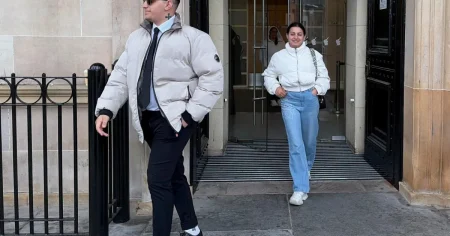



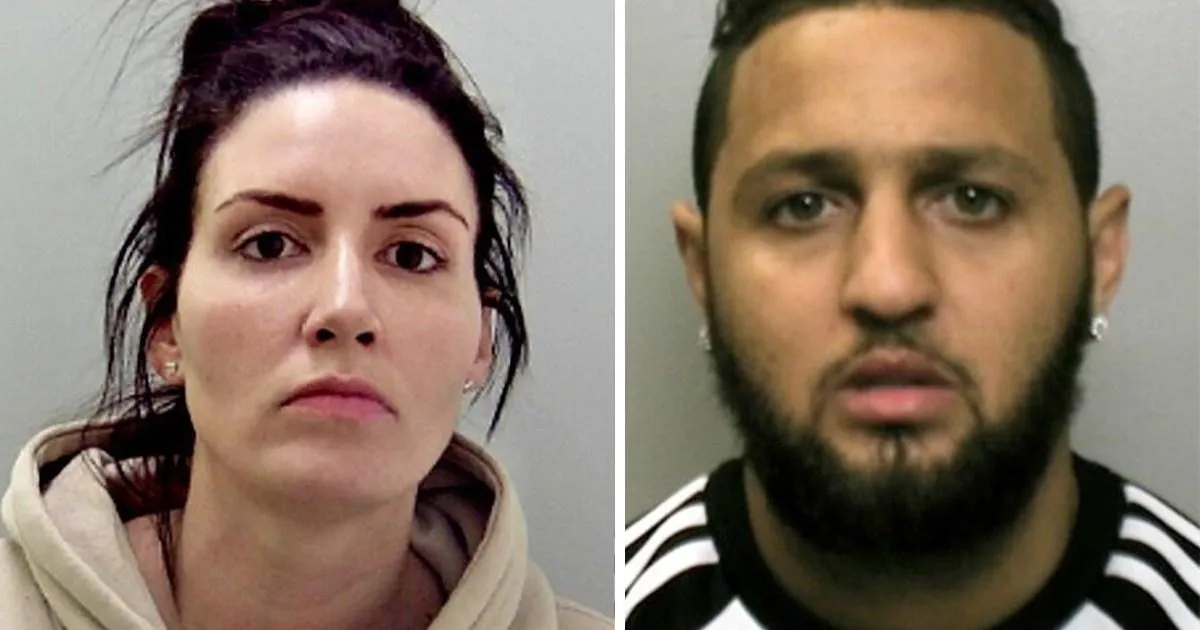
Jade Morris spent her days inside HMP Long Lartin, a category A prison in Worcestershire that holds some of Britain’s most dangerous men, including terrorists and murderers whose names are known across the country. It is not an ordinary prison; it is a high-security facility designed to hold offenders who cannot be trusted anywhere else, and the officers who work there are expected to be constantly alert. As a prison officer, Morris was part of a carefully calibrated system of authority, surveillance and restraint. She had keys, she had training, she had a duty to maintain security and professional distance at all times. She was also a 37-year-old mother of two, living in Holmer, Herefordshire, and going through a divorce from a husband who served in the Armed Forces. At some point in the summer of 2022, just six months after she began working at the prison, that distance collapsed. Morris entered into a secret relationship with Jerome Nunes, a 35-year-old inmate who was serving a 12-year sentence for his role in a gang that had flooded Newport with cocaine. For six months, from July 2022 to January 2023, the two carried on an intense, hidden romance conducted largely through WhatsApp and Snapchat. They exchanged more than 10,000 messages. Some were ordinary. Many were intimate. Some, the court would later hear, were sexually explicit selfies sent by Morris. This was not a momentary lapse or a single foolish mistake; it was a sustained, deliberate and reckless relationship. It was the kind of relationship that could only end one way, and it did. Last week, at Birmingham Crown Court, Morris was jailed for 12 months after pleading guilty to misconduct in a public office and encouraging Nunes to use an illegal phone. The woman who once held authority over the prison population had become a prisoner herself.
How did a prison officer end up in such a position? The answer lies partly in the strange, lonely world of prison work and partly in Morris’s own personal circumstances. She had started at Long Lartin in January 2022, and by July she was already in contact with Nunes. At that point, her marriage was collapsing. Her husband was away on military service, and she was at home with two children, trying to hold her life together. It is not hard to imagine the appeal of a man like Nunes. He was attentive in a way that perhaps no one else in her life was at that moment. He had time, endless time, to ask questions, to listen, to make her feel important. From his cell, he could offer the kind of constant emotional presence that a busy, stressed woman might crave. Their relationship quickly became sexualised. On WhatsApp and Snapchat, they created a private world where labels like “prison officer” and “prisoner” did not seem to exist. She sent him photographs of herself that she would never have wanted her colleagues or family to see. He wrote letters, including one later found by police, that confirmed the relationship was intimate. The volume of communication was staggering: over 6,000 messages in just over a month, and more than 10,000 over the entire relationship. These were not occasional texts. This was a full-time emotional affair, maintained in secret, at enormous risk to both of them. Morris must have known that prison officers are not allowed to have personal relationships with inmates. She must have known that a category A prison, full of sophisticated criminals, was exactly the wrong place to lower her guard. But knowledge is not always enough to stop the heart from wanting what it wants. The affair gave her something her real life was missing: excitement, validation, a sense of being desired. It was, in every sense, a dangerous escape from the disappointments and pressures of her everyday existence.
The end came not because Morris confessed, but because Nunes made a mistake. In October 2022, with the relationship still in full swing, prison officers carried out a search of Nunes’s cell. Nunes tried to get rid of an encrypted mobile phone by throwing it out of his window. It was a desperate, clumsy move, and it failed. The phone was recovered, and although its contents were encrypted, investigators were able to identify the phone number. That single number became the thread that unravelled the entire secret. Police traced the number to the torrent of communication between Nunes and Morris. They found thousands of messages on WhatsApp and Snapchat. They found sexually explicit photographs. They found the letter Nunes had written, which confirmed the true nature of the relationship. Even after the phone was recovered, the two continued to communicate until January 2023, as if the danger had not registered. For Morris, the moment of discovery must have been terrifying. Imagine watching a police officer lay out the evidence of every late-night conversation, every flirtatious exchange, every photograph you had sent in the belief that it would never be seen by anyone else. The private world she had built with Nunes was suddenly public, and the consequences were not merely professional. She was not going to get a warning or a quiet dismissal. She was going to be prosecuted. The relationship that had begun as an escape from her problems had become a crime, and the evidence was overwhelming. There was no point in denial, no plausible explanation for 10,000 messages, no way to explain away explicit images. By March, Morris had pleaded guilty to misconduct in a public office and to encouraging Nunes to use an illegal phone. She stood in court with her life in pieces, waiting to hear what that would cost her. The secret that she had kept from her husband, her children, her colleagues and her community was about to become public in the most humiliating way possible.
The sentencing hearing at Birmingham Crown Court was a sobering occasion. Judge Peter Carr did not sugar-coat the situation. He reminded Morris that she had been working at the prison since January 2022 and that she had been fully aware of her responsibilities. He described Nunes as a prisoner serving a long sentence, and said that it had soon become clear that a wrongful relationship existed between them. The judge recounted the details of the cell search in October 2022, when Nunes had tried to hide the phone, and explained how the authorities had managed to recover it and identify the number. Then he turned to the messages. The judge told Morris that the messages included images of her and went back to July 2022. There had been many calls, over 6,000 messages in just over a month, and more than 10,000 in total. “You were clearly in an intimate relationship with Mr Nunes,” he said. But he also acknowledged that there was no evidence the relationship had been physical. It had been conducted through screens, through photographs, through words. That made it no less serious in his eyes. The judge pointed out that Morris could have reported the situation at any point. She could have gone to her supervisors, explained that Nunes had made contact, asked for help. Instead, she chose to continue the relationship, to feed it, to encourage it. Judge Carr concluded that imprisonment was “the only appropriate sentence” for both defendants. The message was clear: people who hold positions of trust in the prison system cannot be allowed to break the rules for personal gratification, no matter how vulnerable or unhappy they may be. The integrity of the entire system depends on boundaries, and Morris had crossed them deliberately, repeatedly, and for months. Her status as a married mother going through a divorce did not give her a licence to betray her oath.
Morris was sentenced to 12 months in prison. Nunes, who was already serving 12 years for his role in an eight-man gang responsible for bringing and distributing £2 million of cocaine throughout Newport and the surrounding areas, was handed an additional nine months. For Nunes, the extra sentence was a setback, but he was already going to spend years behind bars. For Morris, the sentence was a complete rupture. The 37-year-old mother of two from Holmer, Herefordshire, would lose her job, her reputation, and her freedom. Her children would have to grow up with the knowledge that their mother had been sent to prison for having an affair with a drug dealer. Her family would have to endure the public shame of seeing her story in the newspapers, complete with the detail that she had sent sexually explicit selfies to an inmate. The case also raised uncomfortable questions about prison security. If a prison officer could be drawn into a relationship with a prisoner after only a few months on the job, what other lines might she be persuaded to cross? The prosecution and the court clearly believed that a deterrent was needed. Other prison officers had to understand that this kind of behaviour would not be tolerated, no matter how sympathetic the circumstances might seem. The relationship between Morris and Nunes had been exposed, dissected, and punished. The messages that once felt so private and exciting were now part of the official record of her downfall. In the end, both defendants left the court in handcuffs, their relationship destroyed, their futures irrevocably altered. What had begun as a forbidden flirtation in a high-security prison ended in the very place where they had first met: behind bars.
And yet, behind the scandal, there is a human story that is more tragic than sensational. Jade Morris was not a corrupt official who set out to undermine the prison service. She was a woman in the middle of a divorce, raising two children, working in a stressful and often thankless job. She was lonely, perhaps, and exhausted, and vulnerable. When Jerome Nunes began to pay attention to her, she responded not with the professional detachment her training required, but with the hunger of someone who had been starved of affection. It was a catastrophic lapse of judgment, but it was also a very human one. No one can know exactly what she felt, but the evidence suggests a woman who was not thinking clearly, who was living inside a fantasy that could never survive contact with reality. The rules exist for a reason. Prison officers hold immense power over people who have been stripped of their liberty, and that power must never be used for personal gratification. Relationships between officers and inmates are dangerous because they blur the boundaries on which the entire justice system depends. A prisoner who can persuade an officer to send explicit photographs and encourage illegal phone use has already compromised the security of the institution. Morris’s fall from grace is a warning, not just to prison officers, but to anyone who believes that a secret relationship conducted on a phone can stay hidden forever. It cannot. The phone was thrown from a window. The messages were recovered. The truth came out. For Morris, the cost is a year in prison, a lost career, and a life in ruins. For Nunes, it is more time behind bars. And for the rest of us, it is a reminder that boundaries are not arbitrary obstacles placed in our way. Sometimes they are the only things standing between us and the edge of the cliff. Morris found that out too late, and the price she paid was not just her freedom, but the life she had built.