

The sun finally broke through London’s clouds just in time for Trooping the Colour, turning the capital into a vibrant stage for King Charles’ official birthday celebration. After a long, damp week, the weather provided a perfect backdrop for the historic military parade at Whitehall, where thousands gathered to witness the pageantry of the Household Division. The air felt charged with a mix of celebration and traditional order, as the sight of crimson uniforms and towering bearskin hats stood out sharply against the bright summer sky. It was a day that felt deeply rooted in the past, yet it resonated with the modern curiosity that always follows the British Royal Family whenever they appear in public.
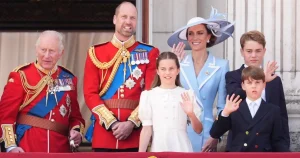
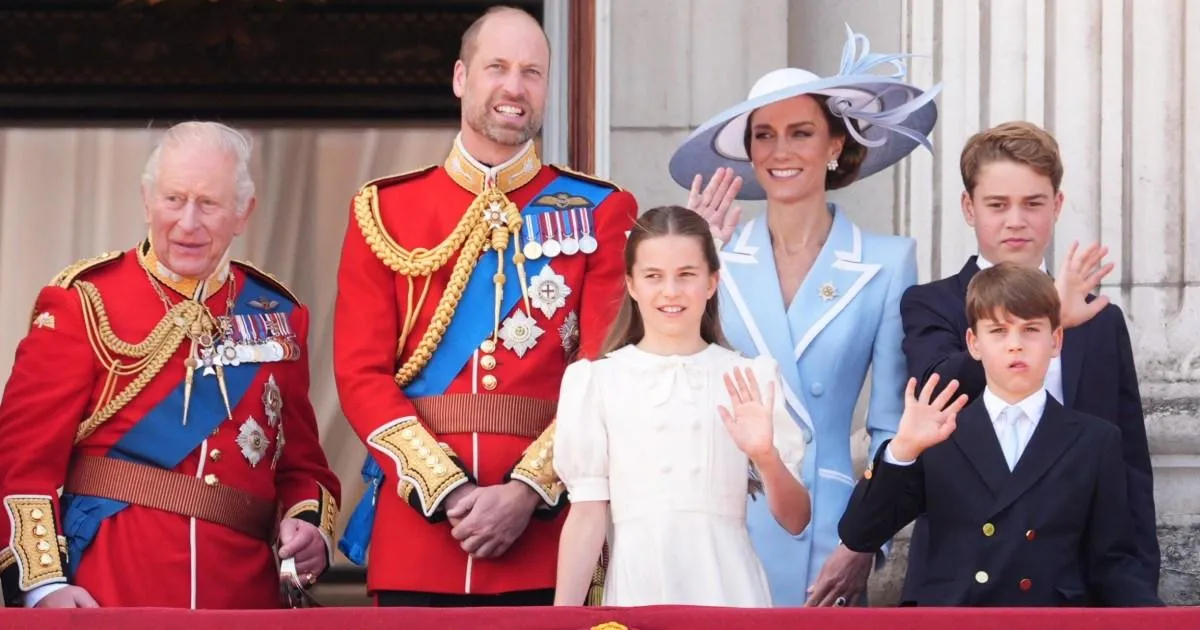
All eyes, however, were firmly fixed on the Princess of Wales and her three children, who provided the day’s most charming imagery. Dressed in a sophisticated baby-blue ensemble, Kate Middleton navigated the high-profile event with her usual poise, while her children—Prince George, Princess Charlotte, and Prince Louis—looked like the quintessential future of the monarchy. It was impossible not to notice the striking resemblance between Charlotte and her mother, while George and Louis mirrored their father, Prince William, in sharp suits and blue ties. Their coordinated appearance served as a touching focal point amidst the rigorous military precision, offering a softer, human touch to a day otherwise defined by rigid protocol and stiff, ceremonial salutes.
The ceremony itself was a masterclass in tradition, centered on the King’s close inspection of his troops. Standing alongside Queen Camilla, who honored her connection to the Grenadier Guards through her elegant attire and meaningful regalia, King Charles carried out his duties with a sense of solemnity. He was accompanied by senior royals, including Princess Anne and Prince Edward, each representing their own military regiments. For the soldiers involved, the day was not just a parade but an emotional tribute; they marched with the weight of the past weeks in their hearts, particularly remembering Lance Bombardier Ciara Sullivan, whose tragic passing recently left a profound void in their ranks.
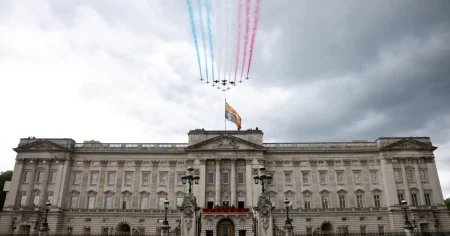
Many may wonder why a monarch born in the chilly, grey month of November celebrates his birthday in the middle of June. The answer is a charmingly British concession to the weather, dating back to the reign of King George II in the 18th century. Realizing that a mid-winter parade was a recipe for shivering crowds and ruined festivities, the tradition of an “official” summer birthday was established. This choice allows the pomp and circumstance of the Trooping the Colour to unfold under clearer skies, ensuring that the spectacle—from the meticulous marching of the guards to the thunderous roar of the RAF Red Arrows flypast—can be enjoyed by the public without the threat of a wash-out.
While the atmosphere inside the Buckingham Palace gates was one of unity, the reality of modern Britain was visible just outside the perimeter. The anti-monarchy group ‘Republic’ took to the streets with placards and chanting, reminding onlookers that the Royal Family remains a subject of intense national debate. Among the banners criticizing the monarchy, the absence of Prince Andrew stood out as a stark indicator of the “Firm’s” current internal boundaries. His continued exclusion from high-profile proceedings serves as a permanent shadow over the family’s public image, providing a gritty, realistic contrast to the otherwise polished and carefully curated narrative of the day’s success.
As the day concluded with the iconic balcony appearance, the sight of the family watching the flypast captured the enduring pull of the monarchy. Prince Louis, ever the scene-stealer, offered a candid moment of youthful spontaneity, leaning over the balcony to get a better view, an endearing contrast to the formality of the soldiers marching below. Despite the protesters at the gates, the complex history of the institution, and the solemn remembrance of fallen comrades, the day ultimately succeeded as a piece of theater. It was a snapshot of a family—and a country—navigating the delicate balance between centuries-old tradition and the scrutiny of the present day, all while chasing the elusive English sun.