


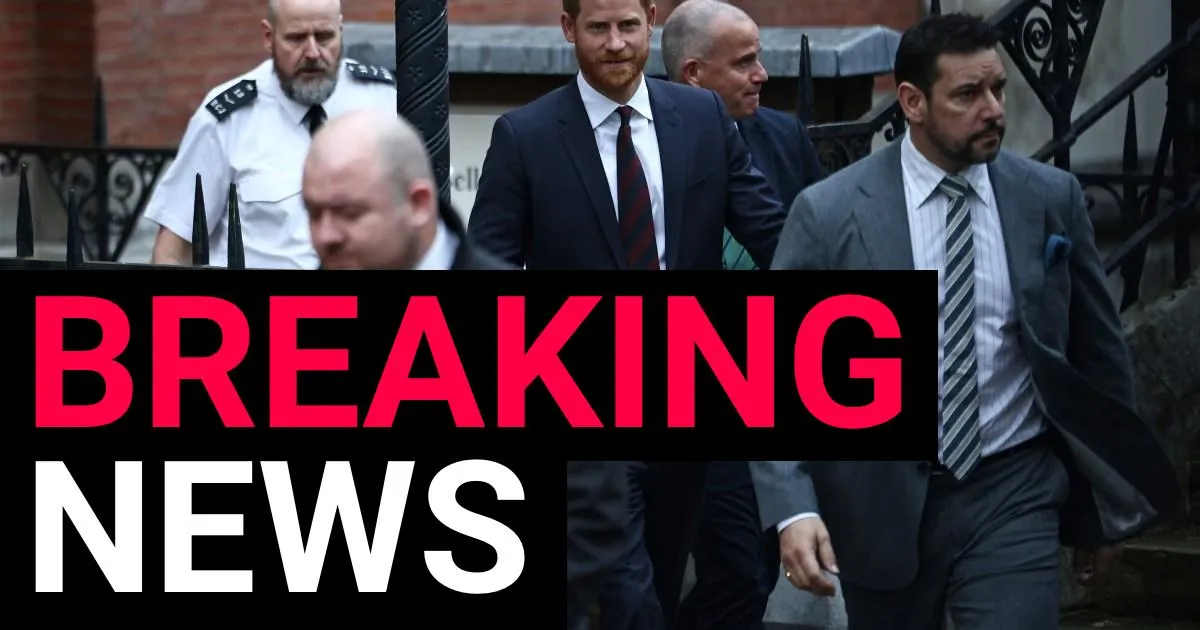
On a grey London morning, the Duke of Sussex stepped out of the Royal Courts of Justice into a wall of cameras. The irony was not lost on anyone. Prince Harry, who has spent much of the last decade challenging the often invasive machinery of the British tabloid press, was walking through a corridor of lenses to hear the latest chapter in his long legal war. He had just lost—at least for now. The judge had dismissed the unlawful information-gathering claims that Harry, Baroness Doreen Lawrence, Sir Elton John, David Furnish, Liz Hurley and Sadie Frost had brought against Associated Newspapers Limited, the publisher of the Daily Mail and the Mail on Sunday. And not only were the claims dismissed, but the group had been ordered to make an interim payment of more than £9.5 million toward the newspaper’s legal costs. For Harry, this was not a setback. It was a “whitewash.” In his own mind, and in the minds of his fellow claimants, the decision had simply papered over a system that allows powerful publishers to escape accountability. The courthouse moment, captured by photographers as Harry left the building, seemed to sum up the tension between a much older tradition of royals avoiding public confrontation and a new generation willing to stand up. It was also, for anyone watching, a reminder of how messy and expensive the pursuit of justice can be. This was not a single dramatic hearing. It was the latest move in a chess game that has been played out over years, in multiple courts, with many different newspapers. And it involved not just celebrities, but people with complicated histories, real grief and deep convictions. There is something almost Shakespearean about a man who is followed by the press while fighting the press. The cameras did not need to be told where to point; they had been waiting for him before he appeared, and they knew exactly what this moment meant.
The legal battle that led to this dramatic moment was never simply about one article or one photograph. At its widest, it was about the entire culture of tabloid journalism in Britain and the methods some publications have used to obtain stories about famous people. The claimants’ lawyers told the court that private investigators, freelance journalists and staff at Associated Newspapers had engaged in voicemail interception, landline tapping and “blagging”—the practice of obtaining private information by deception. These are not polite journalistic techniques. They are the kind of intrusions that leave people feeling violated in the most personal corners of their lives. The central claim was simple: stories that appeared in the Mail and the Mail on Sunday could not have been written without someone secretly breaking the law to gather information. The claimants were not, by any means, a random collection of celebrities. Each had lived with press intrusion for years. Prince Harry had already made history by becoming the first senior royal in more than a century to testify in court in a phone-hacking case. Baroness Lawrence is the mother of Stephen Lawrence, a teenager murdered in 1993, and a tireless campaigner for justice; she knows more than most about how powerful institutions fail to tell the truth. Sir Elton John and David Furnish have been vocal about privacy rights for decades, and have watched friends like Princess Diana suffer because of the same kinds of pursuit. Liz Hurley and Sadie Frost have seen their relationships, friendships and private moments dragged into tabloid headlines. For them, this case was not an abstract legal exercise. It was an attempt to hold an institution to account and to force a reckoning with the tactics that have made British tabloids feared and famous in equal measure. It was also deeply personal. When the law becomes the only shield you have, and that shield fails, it feels less like a legal setback and more like a betrayal of the very idea of fairness.
Mr Justice Nicklin heard the evidence and was not persuaded. In a ruling that sent shockwaves through the celebrity world and the media industry, he dismissed all claims against Associated Newspapers. It was a decisive victory for the publisher, whose lawyers had argued that the articles in question were obtained through legitimate reporting. The judge accepted that account, at least to the extent that he found no grounds to proceed. He found that the Mail’s journalists had not tapped phones, and that the allegations of blagging could not be sustained. The cost order was the final blow. The claimants were ordered to pay £9,544,355 as an interim payment, meaning that while the full costs are assessed, a huge sum of money must change hands now. To make matters worse, the judge also made an indemnity costs order—a rare and unusually harsh legal measure intended to compensate the winning party more fully than standard costs would allow. For most people, the figure is almost unimaginable. It is the kind of sum that could bankrupt a lesser litigant. But it was also a strategic tool: an order like this can deter other claimants from bringing similar cases, which is precisely why the group decided to appeal. Legal experts were quick to point out that the ruling does not necessarily prove the claimants were wrong. It proves that they did not persuade the judge. There is a difference, but it is a cold and technical one. What remained after the judgment was a sense that the celebrity claimants had not only lost their case, but had been punished for daring to bring it to court in the first place. That feeling of being punished for speaking out is central to the appeal, and it helps explain why they are willing to keep going despite the enormous financial risk.
Now, the claimants have lodged an appeal. On Friday, court staff confirmed that applications had been filed with the Court of Appeal for permission to challenge both the dismissal of the claims and the indemnity costs order. A spokesperson for the group said the claimants “respectfully disagree” with the judge’s decisions, which they consider to be both legally and factually flawed. The word “respectfully” does a lot of work here. It is the language of a system that expects deference, but the tone underneath is one of determination rather than defeat. The publisher, for its part, has always denied the allegations. Its lawyers presented what they called a compelling account of a pattern of legitimate sourcing. They said journalists relied on friends and “leaky” social circles, press officers, spokespeople, previous reporting, freelance journalists and stories from other newspapers and news agencies. In other words, they insisted that the stories were obtained not through secret intercepts or blagging but through ordinary reporting practices, the kind that every newsroom would say they use every day. The appeal will now test that account—and the first judgment—again. But an appeal is not a fresh chance to win. It is a narrower, technical process that looks at whether the law was interpreted correctly and whether the judge made errors that affected the outcome. The claimants know this. Their legal team will have to convince the Court of Appeal not just that they feel aggrieved, but that the judge went wrong in a way that matters. The appeal process may take months. In the meantime, the interim payment still hangs over them. They are fighting with one hand tied, but they are still fighting. The appeal could also be seen as a warning: do not assume the fight is over because one judge has spoken.
This legal fight does not exist in a vacuum. It is part of a much longer and darker history between the British press and the people it covers. For decades, tabloid newspapers were accused of using private investigators to hack voicemails, pay off insiders and invent stories. The phone-hacking scandal that exploded around the News of the World in 2011 eventually closed that newspaper and led to the Leveson Inquiry, which exposed the scale of misbehaviour and the cosy relationship between the press, politicians and the police. Prince Harry has become the most visible symbol of resistance, but he is not alone. When he settled his case against Mirror Group Newspapers, he spoke of the emotional toll of spending years seeing his private life dissected, distorted and commodified. He has repeatedly said that his mother, Princess Diana, was destroyed by the same ravenous press culture, and that he is determined not to let history repeat itself. His fellow claimants have their own scars. Doreen Lawrence has fought for more than three decades for justice for her son and has watched her family be treated as public property. Sir Elton John has spent a lifetime navigating fame and has seen friends like Princess Diana suffer because of media pressure. For all of them, the question of whether ANL’s journalists crossed the line is not a technicality. It is about whether powerful people can be held to rules, whether privacy means anything, and whether the press can be trusted to police itself. For ordinary readers, who are not famous and will never be pursued by paparazzi, the case can seem like a dispute among the wealthy. But the principle underneath is universal. The same legal protections that keep a duke’s letters private also keep a schoolteacher’s medical records private. The same safeguards that protect a singer’s phone messages protect the rest of us from the most intrusive kinds of surveillance. That is why this appeal deserves watching, not as a celebrity soap opera, but as a test of whether justice is equal for everyone.
Ultimately, this is a story about power, money and the lengths to which people will go to protect their reputations and their privacy. The appeal filed by Prince Harry and the other claimants is a long shot in many ways. Appeals are not retrials; they are about whether the law was applied correctly. The Court of Appeal will not simply hear the evidence again and decide who is more sympathetic. It will scrutinise the judgment for legal errors, and it may decide that Mr Justice Nicklin was entitled to reach the conclusions he did. But the claimants are willing to take that risk. For them, walking away would be worse than losing again. The interim payment is already ordered, and the financial burden is immense. Yet the statement from their spokesperson radiates a kind of quiet defiance. The fight, they insist, is not over. What happens next is impossible to predict. The Court of Appeal might refuse permission, and the case would end with the original judgment intact. Or it might allow the appeal and send the matter back to be heard again, reopening wounds and leaving the press and the claimants facing yet another round of litigation. Either way, one thing is clear: these are not people who are ready to accept a version of events they believe to be incomplete. They see their legal defeat as an injustice, not as an end. And in a country where the tabloids have long shaped public life, their decision to keep fighting matters far beyond the courtroom. It speaks to something fundamental about who gets to tell the story, whose version of the truth survives, and whether ordinary people—even extraordinary ones—can ever really stand up to a machine that seems designed to win. They may lose. But losing in public is different from surrendering in silence. The appeal is not just a legal move. It is a human refusal to be silenced.