

The Curious Case of the Grounded Glutton
In the quiet, leafy suburbs of Roanoke, Virginia, a most unusual mystery was unfolding. It began not with a bang, but with a soft thud—the sound of a majestic red-shouldered hawk awkwardly landing in a suburban driveway, where she promptly grounded herself, seemingly incapable of taking off again. The residents, concerned for the beautiful bird of prey, carefully scooped her up and transported her the short distance to the Southwest Virginia Wildlife Center of Roanoke, hoping that the experts there could solve the riddle of her sudden inability to fly. The staff at the center, seasoned professionals accustomed to diagnosing a wide array of avian ailments, prepared for the worst. They suspected broken wings from a collision with a car or a window, neurological damage from a concussion, or perhaps the insidious effects of lead poisoning from scavenging. As they meticulously began their examination, they were ready for the “usual suspects”—the common, tragic injuries that befall birds living so close to human habitation. But as they ran their checks, a growing sense of bewilderment began to take hold. There were no broken bones, no signs of head trauma, no lesions, and no apparent toxicity. The hawk was, to all outward appearances, in perfect physical condition. The mystery was deepening, and the answer, when it came, was far more amusing and ironic than any of them could have predicted.
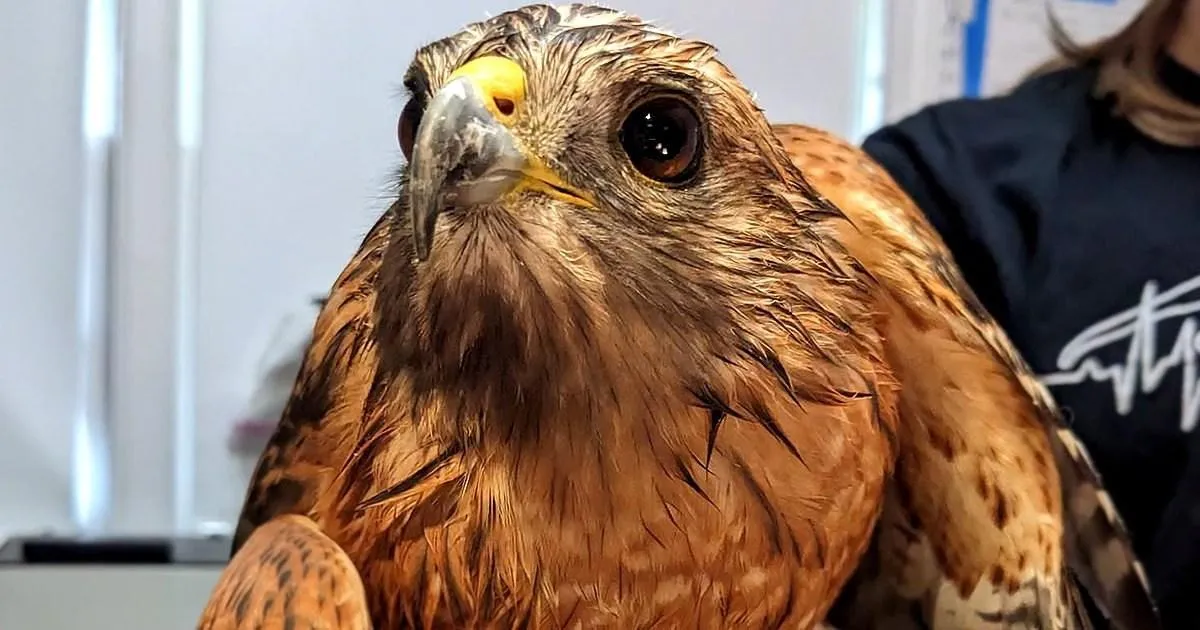
Puzzled by their inability to find a standard cause for the hawk’s predicament, the veterinary staff turned to the most basic and telling of diagnostic tools: the scale. As the bird was gently placed upon it, the number that flickered up prompted a collective raising of eyebrows. At over 910 grams, the hawk was significantly heavier than a healthy adult of her species should be. This was not a bird suffering from emaciation or starvation; in fact, it was the polar opposite. The staff could not even feel the bird’s keel bone, the prominent breastbone that is a key indicator of a bird’s body condition, because it was completely obscured beneath a thick, generous layer of fat. The absurdity of the situation was not lost on them. They had been searching for complex medical trauma when the simplest explanation was staring them in the face: this hawk was, in layman’s terms, just too fat to fly. Overweight to the point where her own body weight was physically hindering her ability to achieve lift-off. The team at the wildlife center, tickled by the irony, took to social media to share their discovery, posting a photo of the beautifully plump raptor with the caption: “At over 910g in weight, she was too darn fat to fly! We couldn’t even palpate her keel due to the heavy layer of fat covering it.” The post was a masterpiece of understated professional humor, and it was about to unleash a wave of online delight.
With the immediate diagnosis clear, the more profound question remained: how on earth did a wild hawk get so fat? In nature, predators are lean, efficient hunters who burn calories to catch their meals. It is, as the wildlife center noted, “rare for wild animals to become obese without human intervention.” The staff began to theorize. Was she a lost falconry bird, accustomed to a life of pampered ease? Perhaps she was an escaped pet, illegally kept and overfed? Or maybe, just maybe, she was being intentionally fed by some well-meaning but misguided human. All of these possibilities were investigated and ultimately ruled out. The trail seemed to go cold until the staff asked the finder of the bird a simple, yet crucial, question: did any of her neighbors keep free-ranging chickens? This query sparked a lightbulb moment for the finder, who began to investigate the local neighborhood gossip. It didn’t take long for the truth to emerge with startling clarity. The neighbors’ flock of free-roaming chickens had been diminishing at what was described as an “alarming rate.” The connection was immediate and undeniable. Their mystery hawk was not a lost pet or a victim of human kindness; she was a cunning, opportunistic predator who had stumbled upon the avian equivalent of an all-you-can-eat buffet.
The entire picture came into sharp focus, painting a hilarious portrait of pure, unadulterated gluttony. Every morning, the neighbors would let their chickens out to roam and peck in the yard, unknowingly setting the table for their feathered nemesis. The hawk, perched in a nearby tree, would watch and wait. Then, with the element of surprise and a distinct advantage in size, she would swoop down, pick off a plump chicken, and feast to her heart’s content. Once her crop was full and her belly distended, she would waddle or fly heavily back up into the trees to digest her massive meal in a blissful, food-coma-induced sleep. When she woke up hungry again, she would simply repeat the process. This cycle of “feasting and sleeping,” as the wildlife center affectionately described it, had gone on for weeks. It was a life of sheer, unapologetic indulgence. The hawk had effectively turned a suburban backyard into her own private, sustainable food source. The chickens were easy prey, requiring little effort to catch, which meant the hawk could consume far more calories than she was expending. The result was an adorable, yet slightly ridiculous, feathered ball of pure excess and the most likely cause of her embarrassing predicament. She was grounded not by injury, but by her own success as a hunter.
The internet, as it is wont to do, reacted with a delightful mix of hilarity and relatability. The story of the “fat hawk” became an instant viral sensation, with the comments section filling up with jokes and memes. People were tickled by the stark contrast between the hawk’s fierce, predatory reputation and her current, comically bloated state. “The diagnosis Fat has sent me,” wrote one user, capturing the collective amusement. Another person couldn’t help but comment on the hawk’s unrepentant expression in the photographs, writing, “Her face is the face of a raptor who will do this again,” perfectly summing up the bird’s apparent lack of shame. Others found a deep, personal resonance with the story, joking about the hawk’s relatable struggle with overindulgence. For many, this wasn’t just a story about a bird; it was a reflection of the universal human experience of getting a little too comfortable with a good thing. The hawk, an apex predator, had been reduced to a symbol of overeating and laziness, and the internet was eating it up. The story even sparked humorous comments about body shaming, with one person jokingly calling out the year for still judging birds for their weight. The sheer absurdity of a wild creature becoming obese was a welcome source of lighthearted entertainment, uniting people from all walks of life in a shared sense of amusement.
Yet, beneath the laughter and memes, the wildlife center was keen to impart a more serious, cautionary message. This amusing anecdote, they explained, was a stark illustration of a “man-made issue” with potentially deadly consequences. The obesity was only possible because of the artificial environment created by humans—the free-ranging chickens were an easy food source, an unnatural bounty that disrupted the natural order. The story concluded with a “sobering reality”: “This is a man-made issue, and this could have had a sadder ending if she had been found by a larger predator instead of the finder. Without flight, she is extremely vulnerable.” The hawk, for all her successful hunting, had rendered herself defenseless. She couldn’t escape danger, couldn’t hunt properly, and was completely vulnerable to any other predator that might stumble upon her. Her gluttony, a direct result of human influence on her environment, had nearly been her undoing. The message was clear: don’t feed wildlife, directly or indirectly. The advice to chicken owners was equally important: “covered runs are the way to go for chicken keeping!” The tale of this one distinctly round hawk serves as a perfect, albeit hilarious, lesson in the unintended consequences of our actions on the natural world. While she was able to enjoy a life of luxury for a while, the story underscores the delicate balance of nature and the importance of keeping wildlife truly wild, even if it means protecting our chickens from the neighborhood’s newest, and most rotund, resident.