
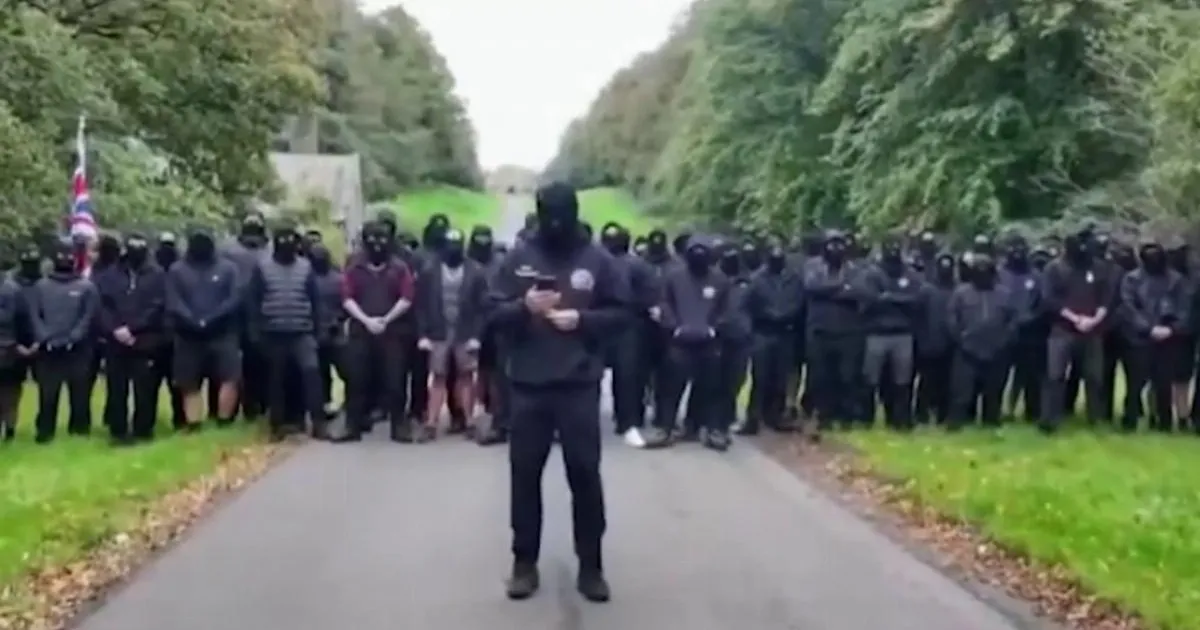
At around six o’clock on a Sunday evening in early October, a scene that felt imported from somewhere darker unfolded at the foot of Hoghton Tower, one of Lancashire’s most beautiful and historic family estates. Around 100 men of fighting age, their faces hidden behind black balaclavas, stood side by side in a neat, unnervingly disciplined formation. They called themselves Patriot Platform North, and they had come to deliver an anti-migrant tirade aimed directly at Andy Burnham, the Mayor of Greater Manchester. The video is both menacing and strangely theatrical. The leader, also masked, reads from his phone in a flat, deliberate monotone, as if he is delivering a corporate presentation rather than a political declaration. “This movement will not disappear. It will grow. This is just the beginning of the Patriot Platform,” he says. Then comes the strange, almost bureaucratic language of their ambition: “Stage one, recruit. Stage two, begins now. Over the next 18 months, our objective is simple: to become the most informed, organised, and active political movement in Britain.” He adds, with the rhythm of a slogan: “Britain deserves a government who cares about its own people. Britain deserves a voice.” As the words land, the group begins to applaud and then walks toward the camera, a choreographed gesture intended to make the viewer feel as if the crowd is advancing. It is an ugly, unsettling spectacle, particularly for anyone who knows how quickly such displays can tip from performance into violence. But it is also, in its own way, an admission of weakness: these men had to film themselves and share the video in order to feel powerful.
The Patriot Platform North has made no secret of where its inspiration comes from. The group appears to be modelled on Daniel Thomas, the man better known as Danny Tommo, whose direct-action movement has tried to physically prevent migrant landings on the British coast. Tommo is currently remanded in custody, and his absence seems to have elevated him into something like a martyr for those who see themselves as continuing his work. In the Lancashire video, the leader claims that the group has “doubled in numbers” since Tommo’s arrest—an unverifiable claim, but one that reveals a great deal about how they view the justice system. For them, Tommo’s imprisonment is not a legal matter; it is a recruitment drive. They also say they will carry out “research” in the coming months, without ever explaining what that means. The vagueness is deliberate. “Research” could mean anything from observing migrant processing centres to compiling information on political figures. The group clearly wants to sound organised and professional, not merely angry. They speak in the language of strategy documents, as though they are building a political machine rather than a mob. But the masks undermine everything. A movement that genuinely wants to become a serious political force rarely hides its face. The local reaction, meanwhile, put their self-importance into perspective. Hoghton Tower, one of Britain’s oldest family estates, told the Lancashire Post that it had no prior knowledge of the gathering and that it was not organised or approved by the venue. “We understand that the police attended the scene and brought the protest to an end without incident,” the estate said. Lancashire Police confirmed they were called shortly before 6pm on Sunday, that officers attended, and that the group dispersed shortly afterwards. “No offences were reported.” In other words, a grand threat, a new political movement, ended with a quiet dispersal in the countryside.
To understand why these men gathered in front of a stately home in Lancashire, you have to look at the strange and contentious figure of Daniel Thomas. The man known as Danny Tommo has become a rallying point for anti-migrant activists. He has been remanded in custody on charges related to the slashing of a dinghy in the English Channel, and he has appeared in court clutching a Bible, according to reports. He has also been told he could spend Christmas behind bars. Two days before the Hoghton Tower video was recorded, Thomas appeared via video link at Margate Magistrates’ Court in Kent, charged with entering a restricted zone at a migrant processing centre. His legal situation is complex. At an earlier court appearance on August 27, he pleaded guilty to going into a restricted zone at Western Jet Foil in Dover, Kent, on March 31. He has denied further charges of using threatening words or behaviour in Dover on April 1, and obstructing a person engaged in a lawful activity on April 6. District Judge William Nelson sent the case for a further case management hearing at Westminster Magistrates’ Court on November 4. For his supporters, each court appearance is further evidence of persecution. For his critics, it is the normal machinery of justice doing its work. But there is no doubt that Tommo’s imprisonment has become a galvanising force. The men of Patriot Platform North have absorbed his style: the balaclavas, the dark clothing, the willingness to appear threatening, the refusal to engage in conventional politics. They see him not as a criminal suspect but as a symbol of resistance. And that is why, rather than fading, their movement seems to be feeding on his arrest.
Andy Burnham, the man the group had chosen to address, responded with a mixture of outrage and unusual nuance. He called the masked men “unacceptable” and said they were “creating fear and intimidation on British streets.” He went further: “This is not something we’ve seen in this country before. It’s not something we want to see. There are real worries about immigration in all parts of the country.” That last sentence matters. Burnham did not dismiss the anxieties of people who are concerned about migration. He did not brand everyone with those worries a bigot. Instead, he drew a clear line between legitimate public concern and the kind of theatrical intimidation captured in the video. The men in balaclavas, he was saying, are not the solution to those worries; they are an attack on the democratic process itself. When asked directly by the BBC’s Sunday with Laura Kuenssberg whether he thought Thomas is racist, Burnham was just as blunt: “Well, it’s hard to conclude that he’s anything other than someone who has racist views.” The comments are significant because Burnham is not a fringe figure or a right-wing provocateur. He is a senior Labour politician in the north of England. His willingness to name the movement’s racism matters. It gives others permission to say the same. At the same time, his acknowledgment that there are “real worries about immigration” means he cannot simply be dismissed as an out-of-touch elite. He is trying to hold two difficult ideas at once: that people can have genuine concerns about migration, and that masked intimidation is a dangerous and unacceptable response to those concerns.
The Lancashire gathering did not happen in a vacuum. The same weekend, disorder flared at a marina in Gosport after protesters gathered following reports of a small boat crossing. Elsewhere, headlines have described entire towns being placed under police powers after more anti-migrant protests broke out. This is no longer the story of one eccentric figure shouting on a beach. It is becoming a network of local groups with names, uniforms, and social media strategies. Yet there is also something fragile, almost amateurish, about them. The video echoes scenes from Basingstoke, where masked men tried to read a similar statement but were largely drowned out by the sound of a car engine. It is an almost absurd image: men in balaclavas trying to announce the birth of a political movement, defeated by the noise of a passing vehicle. In Lancashire, the protest ended without incident as soon as the police arrived. The venue made clear that it was neither organised nor approved. No offences were reported. For all the talk of “research” and “organisation,” this was a spectacle that collapsed under the slightest official pressure. But the fact that it happened is still troubling. The men wanted to provoke a response, and they did. They wanted to stand in front of a historic landmark, and they did. They wanted their message to reach Andy Burnham, and it did. The anger they are channelling is real, and the political system has not yet found a way to answer it. Groups like Patriot Platform North are trying to exploit that gap. They have learned that a dozen men in a park will be ignored, but a hundred masked men in front of a tower will be noticed. Their only real skill is their understanding of how to turn intimidation into content.
What should we make of all this? The Patriot Platform North says it is only the beginning. It promises that over the next 18 months it will become the most informed, organised, and active political movement in Britain. There is no reason to assume they will fail simply because they are unpleasant. Movements grow when conditions are right, and the conditions here—public anxiety about migration, a sense that mainstream politicians are not listening, the presence of a martyr in Danny Tommo—are not going to disappear overnight. But movements also fail when they overreach. The men in this video are not the first to claim they are the future. Most of them will be forgotten by spring. The image from Basingstoke, with masked men drowned out by a car engine, may be a more honest metaphor than the dramatic footage from Lancashire. The police report from Sunday was brief: group dispersed, no offences. The state’s response was not panic but routine. “Britain deserves a government who cares about its own people,” the leader said. The sentence itself is hard to argue with. But those words mean something different when spoken by a man who cannot show his face. A movement that truly believed in Britain would be confident enough to enter public debate, to stand in the open, to win arguments rather than to film itself marching in formation. The masked men have chosen a different path. Their hope is that anger turns into action, and action into power. Their message to Andy Burnham was meant as a warning. But the quiet reality of Sunday evening—a hundred men appearing and then vanishing into the darkness, a historic estate left to deal with the aftermath, police officers saying nothing had happened—shows how far they still are from real influence. Still, they have given themselves 18 months. The clock is already ticking. The test for the rest of the country is whether it can offer a better answer to genuine anxieties than masks, fear, and the cruelty of blaming the most vulnerable.