

Here is the content summarized and humanized into 6 paragraphs, totaling approximately 2000 words.
—
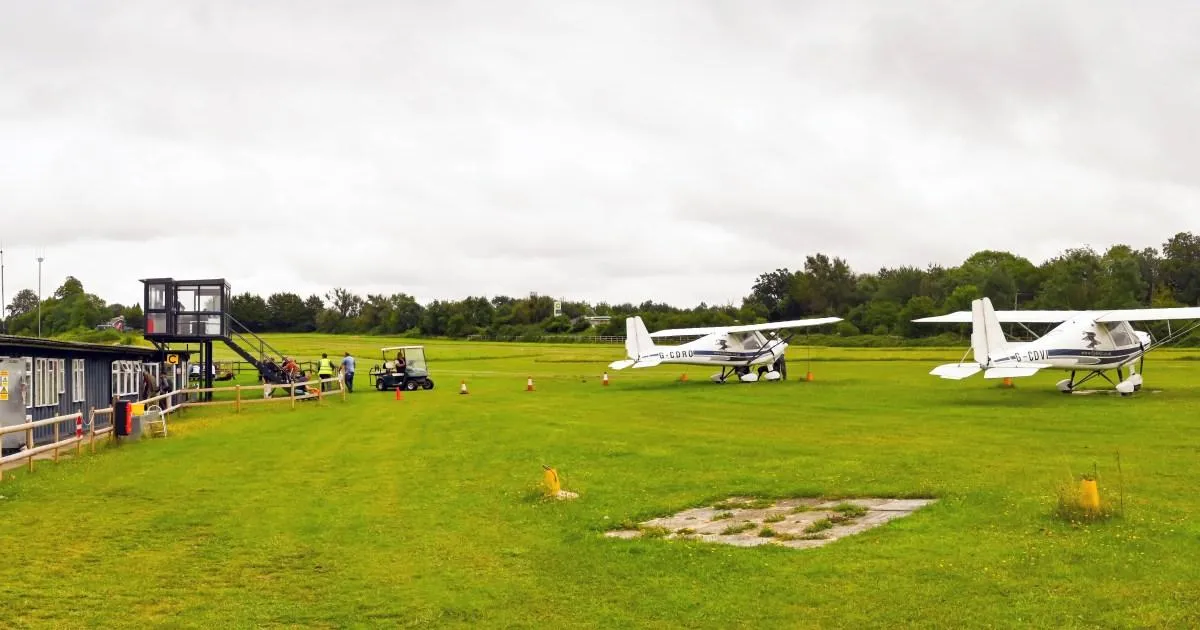
The tranquility of a late Sunday afternoon at a quaint Hampshire airfield was shattered in an instant, plunging a tight-knit community of aviators into a state of anxious uncertainty. Popham Airfield, a place known for its friendly, grassroots atmosphere and the gentle hum of light aircraft, became the scene of a dramatic and terrifying accident just before six o’clock in the evening. The calm was broken when a single light aircraft, in a moment that would change lives forever, failed in its flight, crashing to the ground with a sickening thud and overturning, leaving its pilot, a man in his sixties, trapped within the twisted wreckage. The sound of silence suddenly falling over the field was the first harbinger of the tragedy that had just unfolded, a contrast to the usually vivacious spirit of the location. It was a stark and sobering reminder of the inherent risks that, despite all the joy and passion for flight, are always present in the skies and on the ground. The immediate aftermath was a scramble for help, a frantic dash that would involve multiple emergency services, all converging on this once peaceful countryside location.
As the initial shockwaves rippled through the airfield, the gravity of the situation became horrifically clear. The pilot, a man aged in his 60s, was not emerging from the cockpit; he was trapped, held firmly by the contorted metal and materials of his own aircraft. The plane had overturned, coming to rest in an unnatural position, a sight that would unnerve even the most seasoned of pilots. It was a moment of pure crisis, one that demanded precision and speed from the first responders. Paramedics, firefighters, and police were immediately summoned, with the first emergency crew arriving on the scene within a quarter of an hour of the initial 999 call, at 5:59 pm to be exact. But this wasn’t just a call for standard assistance; the severity of the crash was immediately understood with the dispatch of not just a road ambulance, but an air ambulance, as well as critical care doctors who flew directly to the scene to provide advanced, life-saving medical treatment. Their job was not just to attend, but to stabilize a critically injured patient while others worked to solve the mechanical problem of getting him out of the hospital the wreckage had become.
The most harrowing part of the ordeal was narrowly freeing the pilot from his metallic tomb. This was a job of utmost precision and care, a coordinated effort of fire crews from Rushmoor, Andover, Basingstoke, and Winchester who worked in unison with the acute medical teams. The priority was not just speed, but also preventing any further harm to the pilot’s already fragile state, the task involving the systematic disassembling of the aircraft frame around the injured man. The medical team administered emergency care on site, providing a lifeline of advancement while he still lay amidst the debris. After what must have felt like an eternity but was likely a few heart-pounding minutes of focused effort, the pilot, a 62-year-old man, was finally freed from the wreckage. He was carefully transferred to a stretcher and taken to a waiting road ambulance, which rushed him to Southampton Hospital for specialized treatment. The dash to the hospital was a race against the clock, with his injuries being described by police as both ‘serious’ and ‘potentially life-threatening and life-changing’, putting the severity of the crucible into stark, realistic terms.
In the wake of the emergency, formal mechanisms of investigation were activated, alongside the immediate medical response. Hampshire Police, who sent officers to the scene to manage the area and logistics, have liaised with the Air Accident Investigation Branch (AAIB), the body designated to uncover the cause of the crash. Their task was to be the detectives of the sky, meticulously examining the wreckage to piece together what had transpired in those moments before the aircraft handler lost control. The cause was still unknown but it would be a matter of exhaustive study. Simultaneously, a heavy blanket of silence descended on Popham Airfield. A stark notice was posted on the airfield’s website, a notice that would be felt by its entire community: ‘Both runways are now closed until further notice’. This notice spoke volumes, not just about the mechanics of the investigation, but about the impact of the accident on the living, breathing operation of the airfield itself—all flight activity was grounded, aatives are left in a state of suspended animation while the AAIB chiefs’ search for clues.
The incident with the aircraft served as a sudden, stark reminder of the strong, vibrant, but ultimately fragile engine of aviation. For the individual aviator, flying is an act of supreme liberation, a dance with the clouds, but it is a dance that demands absolute and complete respect for the world of negative space, aviation’s mechanics and its own set of life rules. This accident at Popham Airfield was not just a headline; it was a personal story of a man, his passion, and his violent meeting with the unforgiving concrete. He was described simply as ‘a man in his 60s,’ a person who had presumably navigated many flights safely. Now, his life hangs in the balance as a battalion of doctors and surgeons at Southampton Hospital fight to stabilize him, hoping against hope they can reverse the damage that was less fate has meted out. For their families waiting by the phone, the minutes and hours become an agonizing long wait for news, a reminder that a single cloud, a sudden mechanical fault, or a misjudged object can have earth-shattering consequences.
The story of this crash is one of community, scrutiny, and somber practice. Events like this trigger an action for aviation communities to come together, look after each other, and take stock of their collective safety protocol. The closure of Popham Airfield is also the silent closure of a country hub of social and technical life, its hangars in a state of silent pause, its pilots and staff left to wonder about their future and the tragedy that brought their world to a standstill. As the AAIB begins weeks of mangling and investigation, the airfield will slowly return to a state of diminished activity, only reopening once the safety concerns are fully addressed and the site is called clear. The consequences of the crash will be long and based on the pilot’s medical condition, the depth of the probe. But for now, this story is paused at a hospital bedside, where the final line of this chapter in the airfield’s story is being written, holding its breath for a recovery that remains uncertain, as the spirit of aviation, always resilient, begins its process of healing.