

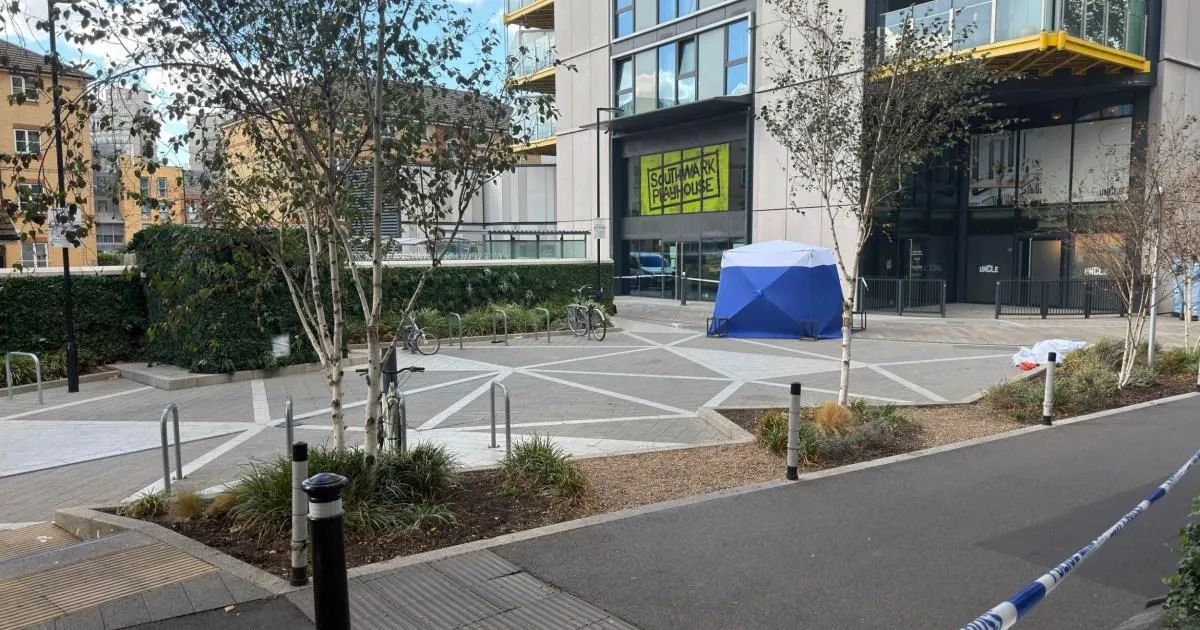
The quiet Thursday morning air around Elephant and Castle was brutally interrupted just before half past nine, when a young woman’s life came to a sudden and devastating end. She was found on the ground near the Southwark Playhouse theatre, at the base of the towering UNCLE residential block on Churchyard Row, and despite the rapid response of paramedics and police, she was pronounced dead at the scene. She was only in her twenties. At this stage, the Metropolitan Police have stated that they are not treating her death as suspicious, but that has done little to soften the shock that has rippled through the building and the surrounding community. For the people who live and work in the sleek, glassy tower, this was not an isolated tragedy but an agonizing echo of a far worse one that had unfolded just a few months earlier. In May, a mother, a father, and their nine-year-old son had plunged to their deaths from the 36th floor of the same 45-storey building. Now, the residents were waking up to the horrifying realisation that it had happened again, literally on their doorstep, and the weight of that repetition was almost too much to bear.
The emotional atmosphere inside the building in the hours and days following the woman’s fall was described as one of deep shock and sorrow. Staff members, many of whom had been on shift when the tragedy unfolded, found themselves struggling to process what they had seen. One staff member, speaking to reporters, said, “We are all really shaken up. She was a nice woman.” That simple, heartbreaking statement captured the mood of a place that had suddenly become a site of repeated grief. The building management quickly sent out an email to residents acknowledging the incident, but the details were sparse, leaving many people with more questions than answers. Residents and employees were offered support, but the trauma of witnessing such an event is not easily eased by a generic message. Another worker, visibly haunted by the experience, recounted how they had seen the woman on the ground, describing it as “very hard to describe” and “terrible.” They noted that she had been wearing gym clothes and that she lived with her husband, with no children. The worker added that they could not sleep, so upset were they by the scene. The humanity behind the headlines was undeniable—this was not just a statistic or a police report, but a woman with a life, a home, and a partner who had suddenly lost her in the most violent and public way imaginable.
As news of the incident spread through the building, the residents’ private message group became a space for collective mourning, disbelief, and fear. One IT worker who lives in the block described the mood: “The company who run the building messaged us. I had seen the police outside and I thought the worst may have happened after what happened last time with the family all dying. We are all obviously very upset that this has happened literally on our doorstep again. It’s devastating.” The sense of “again” was impossible to escape. To live in a place where such a tragedy has occurred once is traumatic enough; to have it happen twice in the same year created a surreal, almost unbearable sense of dread. The resident continued, “There is a message group for everyone living here, and it’s all people are talking about. We can’t believe it’s happened again. I didn’t know the woman but my thoughts go out to her family.” This outpouring of empathy from strangers who shared only a building address speaks to the human capacity for compassion in the face of shock. But it also reveals the deep unease that now hangs over the luxury tower, a structure that was supposed to represent modern, secure, aspirational living but which now carries a shadow it cannot shake.
The building itself, located near Elephant and Castle station, is one of those glittering high-rises that have become synonymous with a certain kind of London life. It has a gym, a 24-hour concierge, and upper floors that command sweeping views over the capital. Rents are eye-watering: around £3,000 a month for a one-bedroom apartment and up to £3,600 for a two-bedroom. It is a place of glass, steel, and curated amenities, designed to make residents feel they have arrived at a pinnacle of urban sophistication. But on Thursday, all of that luxury meant nothing in the face of a human tragedy. Another resident recalled the scene: “There were police, paramedics here. It was a big scene. It was a nice day and lots of people around.” The irony of a beautiful day being the backdrop for such horror was not lost on anyone. The forensic officers arrived, cordoning off the area near the theatre, and the London Ambulance Service confirmed that they had been called at 9:32am to reports of a person falling from height. They sent ambulance crews, paramedics in fast response cars, and an incident response officer. But despite their best efforts, a woman died at the scene. The investigation that followed, including a post-mortem, would seek to answer the question of why, but for the community, the immediate pain was less about cause and more about loss.
The psychological weight of living in a building marked by such repeated tragedy cannot be overstated. For those who witnessed the aftermath, the images are likely to linger for a long time. The worker who saw the woman on the ground was not the only one struggling to sleep. The sense of vulnerability that such an event creates is profound—it reminds everyone that no amount of luxury, no 24-hour concierge, no fancy gym, can shield you from the fragility of life or the depths of human despair. There is also a particular burden on the staff who work in the building, those who had to respond, who had to wait for emergency services, who had to carry on with their duties while their minds were reeling. They are the ones who must clean up, who must stand at the concierge desk as residents come and go in states of anxiety, who must maintain a professional facade while privately grieving for a woman they knew, even if only by sight. And there is a broader question that this tragedy forces into the open, one that is uncomfortable but necessary: what happens to the people who reach such a point of desperation that they see no other way out? Why are these moments happening so often, in so many places, to so many different kinds of people—from a family of three to a young woman in gym clothes?
In the midst of all the shock and sorrow, there is a glimmer of hope in the form of support and solidarity. The staff and residents are being offered counselling, and the collective grief is being shared rather than bottled up. The message group, while filled with anxious chatter, is also a place where people can express their condolences and check on one another. The article itself ends with a reminder that the Samaritans are available to listen, day or night, 365 days a year, and that anyone can call for free on 116 123 or email [email protected]. This is a crucial lifeline, and it is no accident that such information accompanies