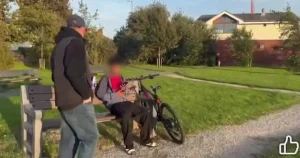


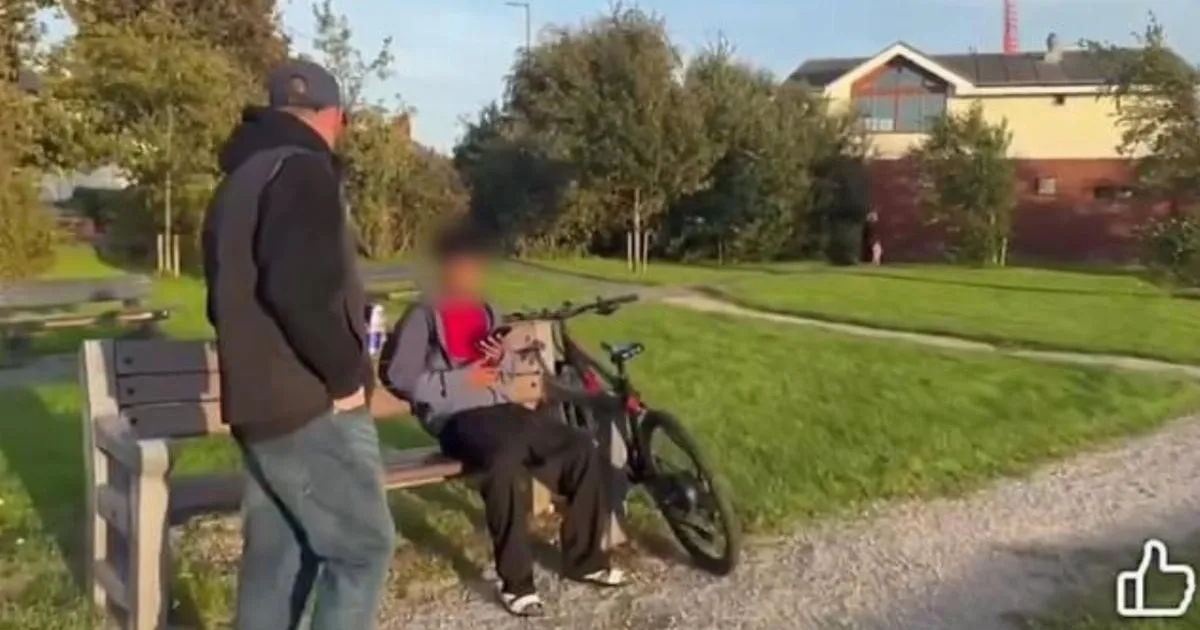
It was an unremarkable Friday afternoon on Thornton village green, the kind of day when the light lingers and the world seems to slow down. A young Black man had taken a bench, his bike resting beside him, his phone in his hand. He was not facing the children’s play area. He was not staring at anyone. He was simply existing in a public place, as anyone should be allowed to do. Then two men approached, one holding a Red Bull can, the other filming. They called themselves part of Danny Tommo’s “Patriot Patrol,” and they had decided, with no authority and no evidence, that he did not belong there. The footage was captioned “God wills it,” a phrase that rings through history with the terrible echo of crusades and colonial violence. “There’s one sat here,” the cameraman announced to his followers, as if the man on the bench were a suspicious object rather than a person. The dehumanization was immediate and casual. The young man had done nothing wrong, but in the eyes of these self-appointed patriots, his presence was itself a problem—because he was Black, because he was alone, because they assumed he was foreign, because they had invented a threat where none existed. This is the quiet, everyday face of racism: a sunny afternoon, a public bench, a phone call with no emergency, and a young man being singled out for no reason other than the color of his skin.
The confrontation that followed was wrapped in the language of politeness, which made it even more sinister. “You can’t sit here where the women and children are, mate,” the man said, as though the bench were a private garden and not a shared public space. “Can you just go round there, please? There are women and children on the park. They don’t feel safe at the minute, that’s all. They don’t feel safe with foreign men sitting staring at them unimpeded.” Every word was carefully chosen to sound reasonable, even concerned. But beneath the “please” and the “mate” lay an ugly accusation: that this particular man, simply by sitting on a bench, was a sexual or violent threat. When the young man asked, almost gently, “Because of me?” the answer was a masterpiece of cowardice. “We’re not saying you but other people have been sitting there making them feel uncomfortable. We’re not blaming you, just other people.” But they were blaming him. They had walked up to him, filmed him, and ordered him to move. The mention of “other people” was not an excuse; it was a justification for prejudice—a way to say that his face reminded them of someone they had decided to hate. The young man said “alright,” picked up his bike, and moved off. He did not argue. He did not ask to see their identification, their legal power, or their right to make such a demand. He simply left, perhaps because he knew that arguing with men who are already filming you, already treating you as an enemy, could only make things worse. That quiet compliance, that weary acceptance, is not an admission of guilt. It is the survival instinct of anyone who has learned that the price of confrontation can be far higher than the cost of walking away.
This incident did not happen in isolation. The Blackpool Patriot Platform, which shared the now-deleted footage, described the men as “Blackpool patriots” on “peaceful patrol” around areas “highlighted as problem areas by the public.” They wrote that “one male was found sat on the park watching over at the children’s play area and was ask politely to move on,” and they openly encouraged people to message the page if they saw “migrants hanging round your local areas.” Let that language soak in. People are not stray animals to be reported. Migrants are not a vermin infestation to be cleared from public benches. The group claims to be part of a broader operation linked to Daniel Thomas, also known as Danny Tommo, a far-right activist whose self-styled Patriot Patrols have been blocking ports and attempting to prevent migrants from entering the United Kingdom. Their propaganda is both absurd and chilling. They have created artificial intelligence images of themselves as medieval Crusader knights marching toward Blackpool Tower, a fantasy of righteous violence that has nothing to do with the reality of harassing a man on a park bench. In another video apparently shared by their account, a person lies dazed on the pavement after being accused of urinating on a church—vigilantes administering their own crude justice without police involvement, without due process, without mercy. This is the pattern of far-right vigilantism: it starts with inflated rhetoric about protecting women and children, then moves to intimidation, and then to physical aggression. The man in the video was not being protected by these self-appointed guardians. He was being hunted.
The man at the center of this movement, Daniel Thomas, is no knight in shining armor. He is a 37-year-old of no fixed address who was due in court facing charges related to an incident in the English Channel. He has allegedly slashed a rubber dinghy while an emergency responder was on board—a boat that was almost certainly being used to rescue or transport people in desperate circumstances. He pleaded not guilty to criminal damage and to failing to disclose the PIN to his phone to police under the Regulation of Investigatory Powers Act 2000. This is a man who claims he can mobilize hundreds of followers at a few hours’ notice, and he has built his following by turning human suffering into a stadium sport. The “Patriot Patrol” is not a neighborhood watch; it is not a legitimate civil society organization; it is a motley collection of conspiracy-minded activists who have decided that they, and only they, know who belongs in this country. Their actions in Blackpool are not the actions of patriots protecting their communities. They are the actions of bullies exploiting fear. The fact that Thomas now faces the courts does not erase the damage done by the wider movement. The young Black man in Thornton did not know the legal details of Danny Tommo’s court case. He only knew that two men had confiscated his peace on a Friday afternoon, and that their camera had turned his body into evidence for a crime he never committed. Even if Thomas is convicted, even if the Patriot Patrol is dismantled, the memory of that moment will remain—a reminder that hatred does not always arrive with a shout and a weapon. Sometimes it arrives with a smile, a Red Bull can, and the word “please.”
We need to sit with the human cost of this incident, because it is so easy to scroll past it. The young man in the video will probably never see this article; his name has not been widely reported, and the footage that made him a target was intended to humiliate him. He may not even know that strangers are discussing him now, that people are arguing about whether he should have moved or stood his ground. But he felt the sting of that moment. He will remember the way the sunlight looked, the way his phone felt suddenly irrelevant, the way his body tensed when two strangers approached him with a camera and a story already written about him. He will wonder, perhaps for the rest of his life, whether he should have been angrier, or quieter, or faster to leave. That is the insidious cruelty of this kind of vigilance. It does not just tell a person that they are unwanted in a single place; it tells them that they are unwanted everywhere, that their face is a problem, that their existence makes other people uncomfortable. The men who approached him did not care that he was sitting next to his bike, minding his own business. They did not care that he was not looking at the children’s park. They did not care about evidence or logic or proportionality. They cared only about the category into which they had placed him: the foreign man, the threat, the outsider. And by making him move, they sent a message to every Black person and every migrant in that community: you are only tolerated as long as you remain invisible. You may use the public spaces, but you do not belong to them. You are a guest in your own life, and we can revoke your welcome at any time.
This is not patriotism. Patriotism, at its best, is a love of one’s country and one’s neighbors—a commitment to the common good that crosses every line of race, religion, and origin. What happened on Thornton village green was the opposite. It was the use of fear to enforce racial hierarchy, the weaponization of “women and children” to exclude a man who had done no harm. The phrase “God wills it” deserves special scrutiny. If the men who said it believe in a God of justice, they have forgotten that justice is not served by harassing strangers. If they believe in a God of love, they have forgotten that love does not tell people to leave. The real safety of women and children in public spaces is a serious issue, but it is not protected by treating every unfamiliar face as a potential predator. In fact, the obsession with “foreign men” as dangers to white women has a long and violent history—a history that has led to lynching, to internment, to deportations, to wars. We should know better. We do know better. The answer to the fear of strangers is not more patrols and more cameras; it is more community, more conversation, more willingness to see the person behind the stereotype. The man on that bench could have been a neighbor, a student, a friend, a father. Instead, he was reduced to “one,” a faceless object in a patrol report. If we accept that, we all lose a little of our humanity. If we reject it, we might begin to build a country where a sunny day is just a sunny day, where a bench belongs to everyone, and where no one has to explain why they are sitting quietly in a place they have every right to be. Let us not forget the image of that young man picking up his bike and walking away. He did not raise his voice. He did not provoke violence. He simply left, carrying the weight of a society that had already judged him before he opened his mouth. That is the tragedy. And the very least we can do is refuse to look away.