

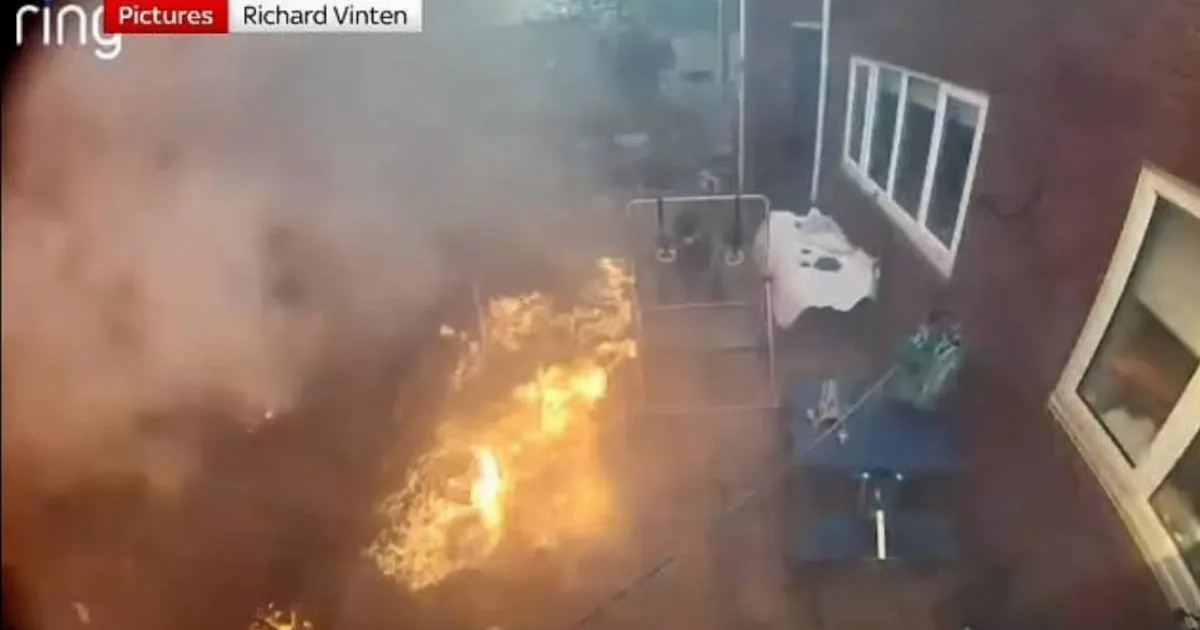
When the doorbell camera started recording, it captured the kind of scene that feels impossible in an ordinary neighborhood: a woman running for her life, her own home collapsing into flame just footsteps behind her. Rose-Anne Vinten had only seconds to escape the wildfire that tore through Stourbridge on Thursday, a blaze so ferocious it devoured nineteen homes in a single afternoon. The footage is raw, terrifying, and deeply human. There is no dramatic music, no Hollywood polish, just the frantic sound of footsteps on gravel, the crackle of fire, and a mother moving as fast as her body would allow. Rose-Anne and her husband Richard had moved into what they called their “forever home” just five months earlier. They had barely finished unpacking their lives into those walls. The house was supposed to be the start of the next chapter for their family, a place where their two children would grow up, where birthdays would be celebrated and quiet evenings would be spent. In a matter of minutes, all of that was reduced to ash. And yet, as the footage shows, Rose-Anne did not hesitate. She ran, not knowing if the house would be standing behind her, not knowing if everything they had built had already been lost, but knowing that her children needed her to get out alive.
What makes Rose-Anne’s story so haunting is not just the fire itself, but the way she held herself together for the sake of her kids. Speaking to ITV News, the mother-of-two described the experience as feeling like she was in a movie. It was the sort of surreal terror that seems too big to be real, the kind of thing that happens to other people in other places. But it was happening to her. She was scared, deeply scared, but she knew she had to be brave. Her daughter was already worried, watching the world outside turn into a furnace, and Rose-Anne understood that her own panic would only make things worse. So she swallowed the fear, kept her voice steady, and focused on getting everyone to safety. Then came the moment that broke through her composure. She went over to her neighbor’s house and saw them standing at the window, staring helplessly as their own home burned. They could see the flames consuming what they had worked their whole lives for. They could see their memories going up in smoke. And Rose-Anne, who had been so strong until then, had to hold it all in. She couldn’t fall apart, not yet. There were children nearby, frightened people, a whole community in shock. So she stood there and carried the weight of the moment, even as her own heart was breaking.
The destruction in Stourbridge was not an isolated incident. It was part of a terrifying day of fire across the West Midlands and beyond. West Midlands Fire Service chief fire officer Simon Tuhill said that firefighters were called to ten significant blazes across the region on Thursday, scenes that some described as apocalyptic. The fire control 999 centre received more than 1,100 calls in a single day. More than one thousand people ringing for help, desperate, confused, afraid. Fire crews were stretched to their absolute limits, mobilizing to hundreds and hundreds of incidents as the heat and wind turned the landscape into a tinderbox. In Stourbridge, the aftermath looked like a war zone. Aerial images showed row after row of homes gutted, roofs collapsed, walls blackened, gardens filled with debris. What had once been a quiet residential street was now a smoldering ruin. The sheer scale of the loss is difficult to process. Nineteen homes destroyed means nineteen families who have lost everything. It means children’s toys buried in rubble, photographs melted, sofas and beds and kitchen tables reduced to charcoal. It means people arriving home from work to find that their address no longer exists. For the Vintens, the dream of a forever home had turned into a nightmare that they will carry with them for the rest of their lives.
The human cost of the fires went far beyond property. West Midlands Ambulance Service reported that 54 people had been treated by paramedics across the region, including 19 who were admitted to hospital. Some were residents who had inhaled smoke while trying to escape. Others were firefighters pushing their bodies to the limit in extreme conditions. Staffordshire Fire and Rescue Service later confirmed that six firefighters had been taken to hospital, suffering from smoke inhalation and heat exhaustion. These are the people who run toward the flames while everyone else runs away. They work for hours in heavy gear, in blistering heat, breathing in toxic air, lifting hoses, breaking down doors, checking every room for trapped residents. They do this not because it is easy, but because they are committed to protecting their communities. And on a day like Thursday, when the fires seem to be everywhere at once, their bodies pay the price. The paramedics, too, were overwhelmed, rushing from one emergency to another, treating burns and breathing problems, trying to calm panicked children and elderly residents. The emergency services held the line, but it was close. There were moments when the sheer volume of calls threatened to outpace their ability to respond. The fire chief’s words were a rare admission of how dangerously stretched the system had become. The message to the public was clear: save 999 calls for genuine emergencies, don’t call to complain about a neighbor’s barbecue, don’t add to the chaos. The system was already at its breaking point.
The political response came quickly, as it always does in the aftermath of disaster. The Prime Minister visited Stourbridge on Friday and admitted he had never seen scenes like this in Britain, a whole house gutted, still smoldering, the smell of smoke hanging in the air. It was an astonishing admission from a national leader, evidence that even those in power were shocked by the ferocity of the fires. Meanwhile, Andy Burnham announced that he had called in the military to help deal with the unfolding crisis. Plans were being drawn up for emergency financial support for fire services battling the spread of wildfires across the country. And perhaps most symbolically, a ban on disposable barbecues was announced, a direct acknowledgment that human carelessness had played a role in igniting some of these blazes. It is a small measure in some ways, but it speaks to a larger anxiety. The weather has become more extreme. The ground is dry. The fire season is no longer something that only happens in distant countries. It is happening here, in residential streets, in back gardens, in the places where families are supposed to be safe. The visit from the Prime Minister was a moment of recognition, but also a moment of reckoning. Why did the emergency alert not reach millions of people? Why were the fire services so stretched that they had to ask for military support? Why had so little been done to prepare for what was clearly coming? These are uncomfortable questions, but they demand answers. The fires in Stourbridge were not an act of God. They were a warning.
In the end, the story of Rose-Anne Vinten and her family is a story about what truly matters. They lost their forever home, but they did not lose each other. They escaped with their lives, their children, and each other. That is not a small thing. In the days after the fire, the community has begun to come together. Neighbors are checking on neighbors. Donations are being collected. Offers of shelter and food and clothing are pouring in. There is grief, yes, but there is also resilience. The doorbell footage that captured Rose-Anne’s desperate run is now a symbol of survival, a reminder that even in the face of overwhelming fear, a mother will always find the strength to protect her children. The family’s home may be gone, but the memories they made in those five short months cannot be taken from them. The sound of laughter in the living room, the conversations in the kitchen, the feeling of walking through the front door for the first time and knowing that this was the place where they would build their lives. Those things live on, not in the walls, but in their hearts. Rebuilding will take time. The scars will remain. But the Vintens, and all the families affected by this terrible day, will carry something with them that the fire could not touch. They will carry each other. And in the long and difficult road ahead, that will make all the difference.